Topic

Financial Debt

Financial debt under Indian law refers to disbursed loans or credit facilities with a time value of money, governed primarily by the Insolvency and Bankruptcy Code, 2016.

9 articlesLatest July 2026
Fraudulent Transactions Do Not Constitute Financial Debt Under Section 5(8) IBC : NCLAT Rejects CIRP Admission for Unauthorized Disbursements
Case Law Analysis
|National Company Law Appellate Tribunal

Fraudulent Transactions Do Not Constitute Financial Debt Under Section 5(8) IBC : NCLAT Rejects CIRP Admission for Unauthorized Disbursements

NCLAT holds that disbursements made into unauthorized accounts through fraudulent means cannot be classified as financial debt under the Insolvency and Bankruptcy Code, 2016. The ruling bars initiation of Corporate Insolvency Resolution Process (CIRP) where loan agreements lack valid authorization, reinforcing the doctrine of indoor management in financial transactions.

Section 5(8) IBC | Round-Tripping Transactions Without Time Value of Money Do Not Constitute Financial Debt : NCLAT
|National Company Law Appellate Tribunal

Section 5(8) IBC | Round-Tripping Transactions Without Time Value of Money Do Not Constitute Financial Debt : NCLAT

NCLAT rules that inter-group fund transfers lacking genuine credit disbursal or repayment obligation fail the 'financial debt' test under Section 5(8) of the Insolvency and Bankruptcy Code. The ruling shields corporate debtors from IBC proceedings where transactions are sham or circular, reinforcing the need for commercial substance in financial creditor claims.

Section 5(8) IBC | Interest-Free Director Loans Constitute Financial Debt If Commercial Borrowing Effect Exists : NCLAT
Case Law Analysis
|National Company Law Appellate Tribunal

Section 5(8) IBC | Interest-Free Director Loans Constitute Financial Debt If Commercial Borrowing Effect Exists : NCLAT

NCLAT rules that interest-free loans from directors may qualify as financial debt under Section 5(8) of the Insolvency and Bankruptcy Code if they reflect a commercial borrowing effect, even without formal agreements. This expands the scope of financial creditors and impacts corporate governance and insolvency proceedings.

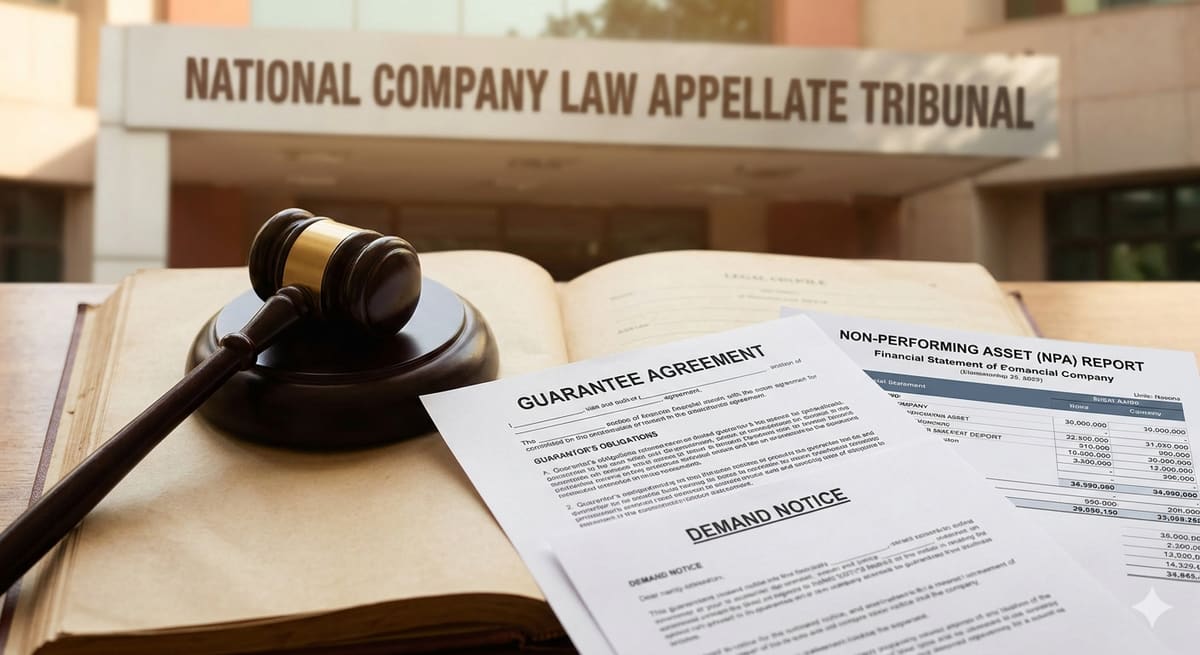
IBC Section 10A | Corporate Guarantor's Default Triggers Only Upon Guarantee Invocation, Not Principal Borrower's NPA : NCLAT
Case Law Analysis
|National Company Law Appellate Tribunal

IBC Section 10A | Corporate Guarantor's Default Triggers Only Upon Guarantee Invocation, Not Principal Borrower's NPA : NCLAT

NCLAT clarifies that a corporate guarantor's liability under the Insolvency and Bankruptcy Code arises solely upon invocation of the guarantee, not the principal borrower's default date. The ruling reinforces Section 10A's moratorium protection, shielding guarantors from insolvency proceedings until the creditor enforces the guarantee deed.

Section 5(8) IBC | Corporate Guarantees Constitute Financial Debt Even Without Disclosure or Proper Stamping: SC
Case Law Analysis
|Supreme Court of India

Section 5(8) IBC | Corporate Guarantees Constitute Financial Debt Even Without Disclosure or Proper Stamping: SC

The Supreme Court has ruled that corporate guarantees qualify as financial debt under Section 5(8) of the IBC irrespective of non-disclosure in financial statements or stamping irregularities, affirming that procedural defects cannot override substantive creditor rights. This strengthens the position of financial creditors in CIRP and curbs reliance on technicalities to defeat claims.

IBC Section 7 | No Objection Certificate (NOC) Alone Cannot Prove Debt Discharge; Financial Records Must Establish Default : NCLAT
Case Law Analysis
|National Company Law Appellate Tribunal

IBC Section 7 | No Objection Certificate (NOC) Alone Cannot Prove Debt Discharge; Financial Records Must Establish Default : NCLAT

The NCLAT has ruled that a No Objection Certificate for charge satisfaction does not equate to legal discharge of financial debt under IBC Section 7. Only verified financial statements and NeSL records can conclusively establish default, setting a critical precedent for creditors and resolution professionals relying on procedural documents over substantive evidence.