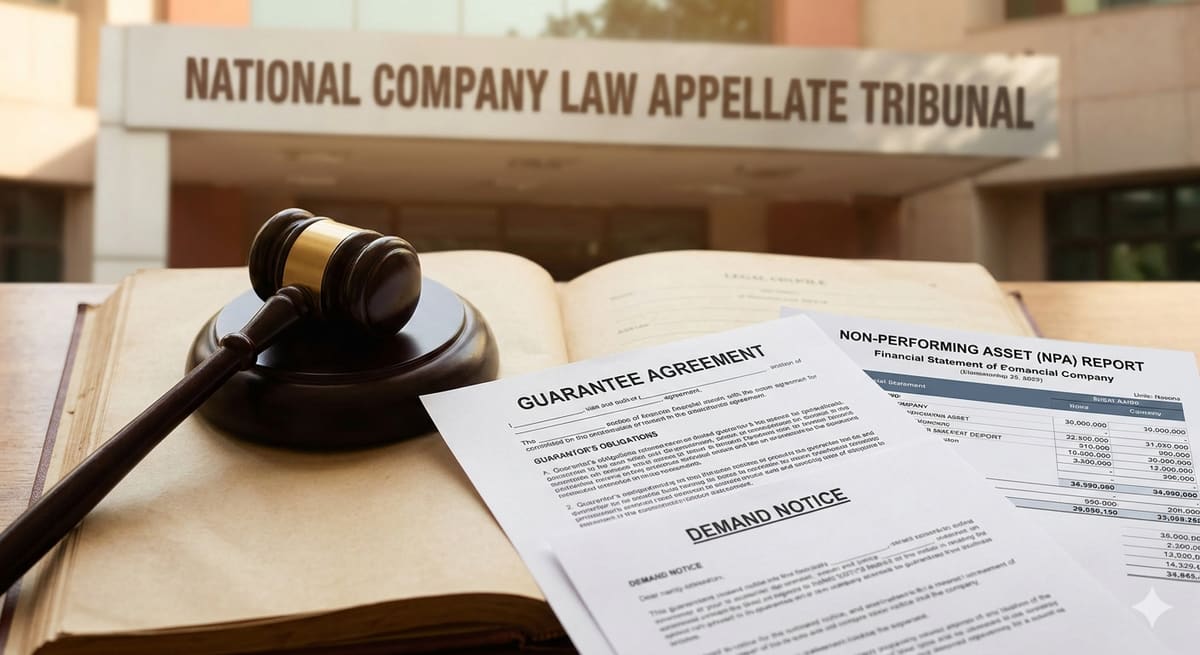
The National Company Law Appellate Tribunal has clarified a critical principle under the Insolvency and Bankruptcy Code: a corporate guarantor’s default cannot be equated with the principal borrower’s default. The Tribunal set aside an order admitting a Section 7 application against a corporate debtor, holding that the invocation of guarantee - rather than the NPA declaration of the principal borrower - determines the date of default. This judgment reinforces the necessity of precise contractual interpretation in insolvency proceedings.
Background & Facts
The Dispute
The dispute arose from a complex financial arrangement involving a consortium of banks led by Canara Bank, which extended term loans totaling Rs. 144.4 crore to M/s. Sinnar Thermal Power Limited (formerly Indiabulls Realtech Ltd.) for a power project in Nashik. Equinox India Developments Ltd. (formerly Indiabulls Real Estate Ltd.), the corporate debtor, was one of several corporate guarantors. The financial creditor sought to initiate corporate insolvency resolution against the corporate debtor under Section 7 of the IBC, relying on a corporate guarantee dated 30.06.2010 and a cost overrun undertaking dated 21.11.2016.
Key Facts
The principal borrower received a term loan of Rs. 100 crore on 26.02.2010, followed by additional loans of Rs. 15.57 crore on 26.03.2014 and Rs. 28.83 crore on 30.08.2016.
A corporate guarantee dated 30.06.2010 was executed by the corporate debtor and Indiabulls Power Limited, obligating them only to infuse equity share capital into the project, not to repay the principal loan.
A scheme of arrangement approved by the Delhi High Court on 17.10.2011 demerged the power business into RattanIndia Enterprises Limited, transferring all rights and liabilities of the corporate debtor.
A new guarantee deed dated 11.01.2012 replaced the 30.06.2010 guarantee, substituting RattanIndia Enterprises Limited and RattanIndia Power Limited as the primary guarantors and explicitly discharging the corporate debtor from its obligations under the earlier deed.
The account of the principal borrower was declared a Non-Performing Asset (NPA) on 28.09.2017.
On 30.09.2020, Canara Bank issued a recall notice invoking the 30.06.2010 guarantee and demanding payment of Rs. 202,03,39,436.49 within three days.
The corporate debtor was not notified of any default in equity infusion under the guarantee.
The financial creditor concealed the 11.01.2012 guarantee deed in its Section 7 application.
Additional undertakings - Share Retention and Management Undertaking (28.02.2015), Indemnity-cum-Undertaking (28.03.2015), Promoters’ Deed of Undertaking (28.03.2015), and Cost Overrun Undertaking (21.11.2016) - were relied upon by the creditor, but none imposed a direct obligation to repay the principal loan.
Procedural History
28.09.2017: Principal borrower’s loan account declared NPA.
30.09.2020: Financial creditor issued recall notice invoking guarantee and demanding payment from corporate debtor.
09.06.2021: SARFAESI notice issued to principal borrower and guarantors.
20.09.2021: Principal borrower submitted One-Time Settlement proposal.
09.06.2021: OA No. 72/2021 filed before DRT against principal borrower and guarantors.
20.01.2025: Section 7 application (C.P. (IB) No. 317/ND/2025) filed by Canara Bank against corporate debtor.
09.12.2025: NCLT, New Delhi (Court-IV) admitted the Section 7 application, holding that financial debt existed and default occurred on 28.09.2017.
11.12.2025: NCLAT stayed the NCLT order and issued notice in the appeal.
09.12.2025: NCLT dismissed a parallel Section 7 application (C.P. (IB) No. 204/ND/2025) against RattanIndia Enterprises Limited, holding no financial debt existed under the same guarantee.
11.12.2025: NCLAT stayed the NCLT order and issued notice in the appeal.
04.05.2026: NCLAT delivered judgment allowing the appeal.
The Parties' Positions
Appellant (Corporate Debtor): Argued that the 30.06.2010 guarantee only obligated it to infuse equity, not repay debt; that the 11.01.2012 guarantee discharged it; that the recall notice dated 30.09.2020 was unauthorized; and that the application was barred by Section 10A of the IBC as the default (if any) occurred between 30.09.2020 and 04.10.2020, within the moratorium period.
Respondent (Financial Creditor): Contended that the corporate debtor remained liable under the 30.06.2010 guarantee; that the 11.01.2012 deed did not discharge it; and that the NPA date of 28.09.2017 constituted the default, making Section 10A inapplicable. It also relied on the cost overrun undertaking and other deeds as creating financial debt.
Relief Sought
The appellant sought: (1) setting aside of the NCLT order dated 09.12.2025; (2) dismissal of the Section 7 application; (3) declaration that no financial debt existed against the corporate debtor; and (4) costs.
The Legal Issue
The central question was whether Section 10A of the Insolvency and Bankruptcy Code bars a Section 7 application when the corporate guarantor’s default arises during the moratorium period (25.03.2020 to 24.03.2021), and whether a corporate guarantee limited to equity infusion constitutes a financial debt under Section 5(8) of the IBC.
Arguments Presented
For the Appellant
The appellant relied on the express terms of the guarantee deed dated 30.06.2010, which limited liability to equity infusion, not debt repayment. It cited the 11.01.2012 guarantee deed, which explicitly discharged the corporate debtor and substituted new guarantors. It argued that the recall notice dated 30.09.2020 was the first and only invocation of guarantee, making the default date 04.10.2020 - within the Section 10A moratorium. It further relied on Pooja Ramesh Singh v. State Bank of India (2023 SCC OnLine NCLAT 193) to establish that a guarantor’s default arises only upon invocation, not on the principal’s NPA. It emphasized suppression of the 11.01.2012 deed and the inconsistent judgment against RattanIndia Enterprises Limited.
For the Respondent
The respondent contended that the corporate debtor remained liable under the 30.06.2010 guarantee despite the 11.01.2012 deed, citing Clause 11 of the latter as preserving liability. It argued that the NPA date of 28.09.2017 constituted the default, rendering Section 10A inapplicable. It relied on the cost overrun undertaking and other deeds as creating a financial obligation, asserting that the collective reading of documents established a contingent liability that became enforceable upon invocation.
The Court's Analysis
The Tribunal undertook a meticulous textual analysis of the guarantee deeds and undertakings. It held that the guarantee dated 30.06.2010 was strictly limited to equity infusion, as evidenced by Clause E, Clause 2, and Clause 10, which repeatedly refer to "Equity Share Capital" and "infusion of funds," not repayment of debt. The Tribunal emphasized that Section 5(8) of the IBC defines financial debt as a liability arising from a borrowing or guarantee of a financial obligation. Here, the corporate debtor never guaranteed the principal borrower’s debt; it guaranteed only equity contribution.
"The Corporate Guarantee dated 30.06.2010 in no manner can be said to guarantee by Corporate Guarantor to discharge the debt of principal borrower and guarantee was given only to infuse the equity in the project as per the Facility Agreement."
The Tribunal further held that the 11.01.2012 guarantee deed, particularly Clause G and Clause 11, explicitly discharged the corporate debtor from its obligations under the 30.06.2010 deed. The financial creditor’s suppression of this document in the Section 7 application was deemed a material irregularity.
Regarding the cost overrun undertaking dated 21.11.2016, the Tribunal noted that Clause 2.1(b) imposed liability on the corporate debtor only if RattanIndia Enterprises Limited and others failed to meet their obligations - a secondary, contingent obligation, not a direct guarantee of debt. The other undertakings (share retention, indemnity, promoters’ deed) were found to relate to corporate governance, not debt repayment.
On the issue of Section 10A, the Tribunal relied on Pooja Ramesh Singh to hold that the default of a guarantor arises only upon invocation of the guarantee. Since the recall notice was issued on 30.09.2020 and payment was demanded within three days, the default occurred on 04.10.2020 - within the moratorium period. The NPA date of 28.09.2017 was irrelevant to the guarantor’s liability.
The Tribunal also condemned the NCLT for issuing two contradictory orders on the same day: dismissing the Section 7 application against RattanIndia Enterprises Limited on the basis of no financial debt, while admitting the identical application against the corporate debtor. This inconsistency demonstrated non-application of mind and violated principles of consistency and fairness.
The Verdict
The appeal was allowed. The NCLT order dated 09.12.2025 admitting the Section 7 application was set aside. The Section 7 petition (C.P. (IB) No. 317/ND/2025) was dismissed. The Tribunal held that no financial debt existed against the corporate debtor under the guarantee deeds or undertakings, and that the application was barred by Section 10A of the IBC. Costs were awarded to the appellant.
What This Means For Similar Cases
Guarantee Invocation Defines Default Date
Practitioners must now establish that the default of a corporate guarantor arises only upon formal invocation of the guarantee, not on the principal borrower’s NPA date.
Section 7 applications must clearly identify the date of invocation and demonstrate that it falls outside the Section 10A moratorium.
NPA dates of principal borrowers are irrelevant to guarantor liability under Section 10A.
Financial Debt Requires Clear Obligation to Repay
A guarantee limited to equity infusion or cost overrun contribution does not constitute a financial debt under Section 5(8).
Any document purporting to create financial debt must contain an express obligation to repay the principal loan, not merely to fund project costs.
Courts will strictly interpret guarantee language; vague or conditional undertakings will not suffice.
Suppression of Material Documents Is Fatal
Concealment of subsequent guarantee deeds or discharging instruments in Section 7 applications will lead to dismissal.
Applicants must disclose all relevant agreements, even if they weaken their case.
Non-disclosure constitutes abuse of process and may attract costs.