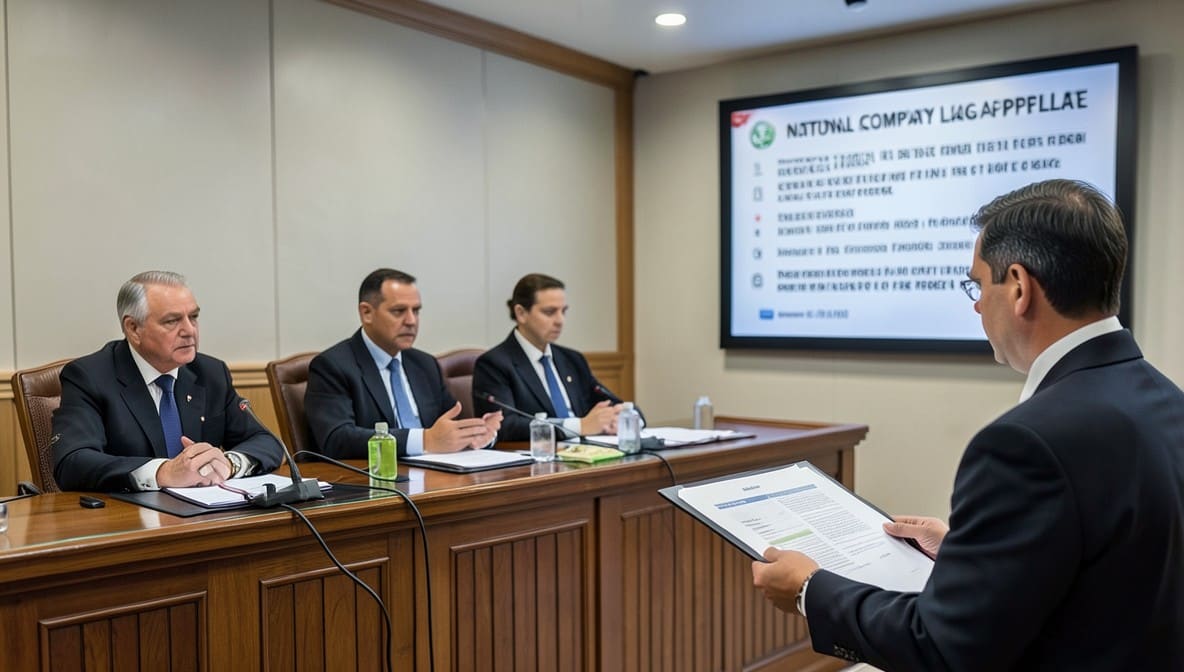
The National Company Law Appellate Tribunal has clarified that an interest-free loan advanced by a director to a corporate debtor may constitute a financial debt under Section 5(8) of the Insolvency and Bankruptcy Code, 2016, provided it meets the threshold of having the commercial effect of borrowing. This ruling reinforces the principle that substance prevails over form in insolvency proceedings, particularly where corporate books acknowledge the liability.
Background & Facts
The Dispute
The Appellant, Mr. Rajender Prasad Mittal, a former director of M/s Jaikrishan Estates Private Limited (the Corporate Debtor), filed an application under Section 7 of the Insolvency and Bankruptcy Code, 2016, seeking initiation of Corporate Insolvency Resolution Process (CIRP). He claimed to have advanced an interest-free loan of Rs. 6,86,44,042/- to the Corporate Debtor during the financial year 2014-15 from his personal Axis Bank account. The Corporate Debtor repaid Rs. 3 Crores but allegedly defaulted on the outstanding balance. The Appellant asserted that this amount was recorded in the Corporate Debtor’s balance sheets for FY 2016-17, 2018-19, 2020-21, and 2022-23 under the head "long term borrowing".
Key Facts
- The Appellant served as a Director of the Corporate Debtor from 16.01.2000 to 21.10.2022.
- The Corporate Debtor was incorporated in 1997 and underwent shareholding dilution in 2000, with the Appellant’s group acquiring 20% equity.
- Funds were infused by promoters/directors in proportion to shareholding to meet working capital needs.
- The Appellant transferred Rs. 6,86,44,042/- between 2014 and 2015 via bank transfers.
- The Corporate Debtor’s balance sheets consistently reflected this amount as "long term borrowing".
- No loan agreement, promissory note, or board resolution authorizing the loan was produced by the Appellant.
- The Appellant sent a demand notice dated 22.10.2021, followed by a legal notice dated 20.12.2021.
- On 19.07.2019, the Appellant executed an irrevocable gift deed in favor of his wife, assigning all rights to recover the amount.
- The Corporate Debtor’s reply to the demand notice acknowledged that funds were infused by promoters in proportion to shareholding.
- The Appellant resigned as director on 21.10.2022, citing "other engagements".
Procedural History
- 2014-15: Appellant disbursed Rs. 6,86,44,042/- to Corporate Debtor.
- 2016-17 to 2022-23: Corporate Debtor’s balance sheets show liability under "long term borrowing".
- 19.07.2019: Appellant executed gift deed in favor of his wife.
- 22.10.2021: Appellant issued demand notice for repayment.
- 20.12.2021: Corporate Debtor replied, characterizing funds as proportionate capital infusion.
- 21.10.2022: Appellant resigned as director.
- 2024: Section 7 application filed before NCLT (CP(IB) No. 850/ND/2024).
- 16.01.2025: NCLT rejected the application, holding no financial debt existed due to absence of interest, repayment terms, or board resolution.
- 28.03.2025: Appeal filed before NCLAT (Company Appeal (AT) (Ins.) No. 368 of 2025).
- 19.05.2026: NCLAT delivered judgment.
The Parties' Positions
Appellant’s Position: The loan, though interest-free, had the commercial effect of borrowing as it was disbursed to finance corporate operations, recorded as liability in books, and acknowledged by the Corporate Debtor. Relied on Orator Marketing, Shailesh Sangani, and Agarwal Polysacks to argue that interest is not mandatory.
Respondent’s Position: The funds were promoter contributions, not loans. No board resolution, loan agreement, or repayment terms existed. The transaction lacked consideration for time value of money. Relied on Anuj Jain, Phoenix ARC, and Neelkanth Township to argue that retrospective reclassification of capital infusion as debt is impermissible.
Relief Sought
The Appellant sought: (1) setting aside of the NCLT order dated 16.01.2025; (2) initiation of CIRP against the Corporate Debtor; (3) recognition of Rs. 6,86,44,042/- as financial debt under Section 5(8) of the IBC.
The Legal Issue
Can an interest-free loan advanced by a director to a corporate debtor, without a written agreement or board resolution, but recorded as long-term borrowing in the company’s balance sheets and acknowledged in correspondence, constitute a financial debt under Section 5(8) of the Insolvency and Bankruptcy Code, 2016?
Arguments Presented
For the Appellant
The Appellant relied on multiple NCLAT and Supreme Court precedents to argue that Section 5(8) does not mandate interest or formal documentation. He cited Orator Marketing Pvt. Ltd. v. Samtex Desinz Pvt. Ltd. to establish that "if any" in the definition of financial debt implies interest is optional. He emphasized that the commercial effect of borrowing is the core test, not the presence of interest. The balance sheet entries and the Corporate Debtor’s own admission in its reply that funds were "infused to meet working capital requirements" demonstrated acknowledgment of liability. He further argued that the gift deed and share purchase agreement were irrelevant to the existence of the debt.
For the Respondent
The Respondent contended that the transaction was a capital contribution, not a loan. It relied on Anuj Jain v. Axis Bank and Phoenix ARC v. Spade Financial to assert that financial debt requires consideration for time value of money, which was absent here. It highlighted the absence of board resolution, repayment schedule, or interest as fatal to the claim. The reply dated 20.12.2021 confirmed the funds were proportionate to shareholding, consistent with promoter contributions. The Respondent also cited Neelkanth Township to argue that directors cannot retrospectively convert equity infusions into debt. The gift deed, it argued, revealed the Appellant’s ulterior motive to recover funds post-resignation.
The Court's Analysis
The NCLAT acknowledged the Appellant’s reliance on precedents such as Orator Marketing and Shailesh Sangani, which held that interest-free loans by directors can qualify as financial debt if they have the commercial effect of borrowing. The Tribunal noted that the definition of financial debt under Section 5(8)(f) explicitly includes "any amount raised under any other transaction having the commercial effect of borrowing," and that the presence of interest is not a sine qua non.
"The definition of 'Financial Debt' in Section 5(8) of IBC does not expressly exclude an interest free loan. 'Financial Debt' would have to be construed to include interest free loan advanced to finance the business operations of a corporate body."
However, the Tribunal observed a critical factual distinction: in Orator Marketing and Shailesh Sangani, the corporate debtor had unequivocally acknowledged the transaction as a loan in its records and correspondence. In this case, while the balance sheets recorded the amount as "long term borrowing," the Corporate Debtor’s reply explicitly characterized the transaction as a proportionate capital infusion by promoters - a characterization that contradicts the nature of a loan.
The Tribunal further noted that the Appellant’s conduct - including the execution of a gift deed assigning the claim to his wife and the timing of the demand notice after resignation - raised serious questions about the bona fides of the claim. The absence of any contemporaneous documentation, board resolution, or repayment terms, despite the Appellant’s position as a director with authority to ensure proper governance, undermined the claim.
The Court emphasized that while balance sheet entries can constitute acknowledgment of debt under Asset Reconstruction Company v. Bishal Jaiswal, such entries must be read in context. Here, the context - the Respondent’s reply and the promoter-shareholding structure - indicated that the transaction was not intended as a loan at the time of disbursement.
The Tribunal concluded that the Adjudicating Authority erred in rejecting the application outright without examining the credibility of the balance sheet entries in light of the Respondent’s own admission. The matter required a deeper factual inquiry into whether the transaction, despite its characterization as capital infusion, could still be deemed to have the commercial effect of borrowing.
The Verdict
The NCLAT allowed the appeal in part. It set aside the order dated 16.01.2025 passed by the NCLT and remanded the matter to the Adjudicating Authority for fresh adjudication on merits. The Tribunal directed the Adjudicating Authority to examine: (1) the balance sheet entries in conjunction with the Respondent’s reply; (2) the nature of the transaction at the time of disbursement; and (3) whether the transaction, despite being labeled as capital infusion, had the commercial effect of borrowing. No costs were awarded.
What This Means For Similar Cases
Balance Sheet Entries Alone Are Not Conclusive
- Practitioners must now corroborate balance sheet entries with contemporaneous documentation or clear acknowledgment of debt.
- Mere accounting treatment as "loan" is insufficient if internal communications or corporate governance records indicate otherwise.
- The burden shifts to the creditor to prove the transaction’s commercial nature, not just its classification.
Promoter Contributions Are Not Automatically Financial Debt
- Directors or promoters advancing funds for working capital must document intent as a loan at the time of disbursement.
- Absence of board resolution, repayment terms, or interest may be fatal unless other evidence (e.g., correspondence, repayment history) establishes a creditor-debtor relationship.
- Post-resignation attempts to reclassify capital contributions as debt will face heightened scrutiny.
Timing and Conduct Matter in IBC Applications
- Actions such as executing gift deeds or assigning claims post-resignation may be viewed as indicia of ulterior motive.
- Delay in raising demand, inconsistent ledger entries, and lack of formalities weaken claims under Section 7.
- Tribunals will examine the totality of conduct - not just statutory definitions - to determine bona fides.