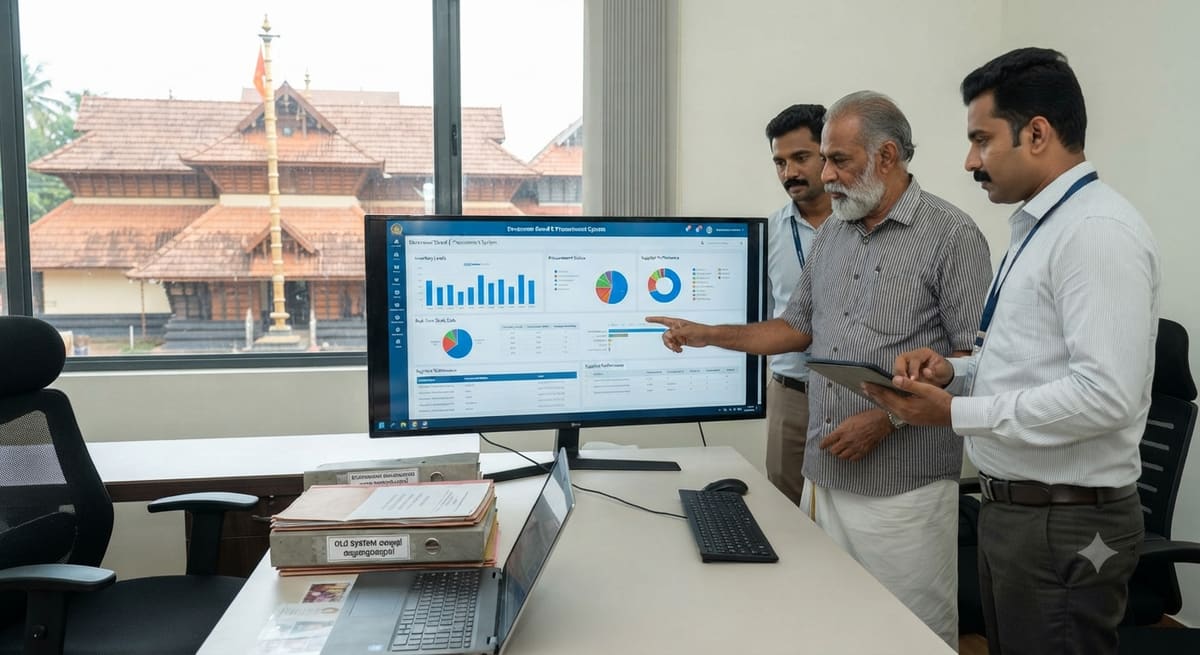
The Kerala High Court, in a suo motu proceeding, has underscored the critical importance of maintaining systematic inventory records for public assets. The judgment mandates the Travancore Devaswom Board to establish a comprehensive, digitised inventory management system, including Fixed Asset Registers, Stock Registers, and Maintenance Registers, to prevent ad hoc procurement and ensure financial accountability.
Background & Facts
The Dispute
The matter arose from a proposal by the Travancore Devaswom Board to award a contract for the supply of 1,000 double-decker mild steel cots for daily wage staff at Sabarimala. The total estimate for the procurement was ₹1,66,82,000, inclusive of 18% GST. The Audit Department raised objections, citing non-compliance with the Store Purchase Manual No. 3/2013/SPD dated 21.06.2013, which mandates estimation of annual requirements based on consumption patterns over the previous three to five years.
Key Facts
The Board sought administrative sanction for the procurement of 1,000 double-decker cots at an estimated cost of ₹1,66,82,000
The Audit Department objected to the procurement, noting the absence of photographs, technical specifications, and adherence to the Store Purchase Manual
The tender process was initiated at the eleventh hour, raising concerns about procedural compliance
The Store Purchase Manual mandates estimation of requirements based on past consumption patterns to prevent ad hoc procurement
Procedural History
23.02.2026: The Court took suo motu cognizance of the matter, noting deficiencies in the procurement process and the absence of a transparent inventory management system
The Court directed the Executive Engineer, Sabarimala Development Project, the Executive Officer, Sabarimala, and the Administrative Officer, Sabarimala, to produce complete particulars of the asset management system
13.07.2026: The matter was listed for final hearing, and the Court delivered the present order
Relief Sought
The Court sought to ensure compliance with statutory and administrative norms governing public procurement, including:
Maintenance of Fixed Asset Register, Stock Register, Dead Stock Register, and other relevant records
Periodic physical verification and updating of inventory records
Adherence to technical specifications and procedural safeguards in the procurement process
The Legal Issue
The central question was whether public procurement, particularly involving assets purchased using devaswom funds, can be undertaken without a transparent and verifiable inventory management system, and whether the absence of such a system violates principles of financial discipline, transparency, and accountability.
Arguments Presented
For the Travancore Devaswom Board
The learned Standing Counsel submitted that steps had already been initiated to prepare a comprehensive digitised inventory of all assets and records
It was stated that the exercise was expected to be completed before the commencement of the ensuing pilgrimage season
Technical specifications for the proposed cots were placed on record, along with details of existing stock and projected requirements
For the Audit Department
The Audit Department highlighted non-compliance with the Store Purchase Manual, particularly the failure to estimate requirements based on past consumption patterns
It was contended that the procurement process lacked transparency and violated procedural safeguards
The Court's Analysis
The Court emphasised that public procurement cannot be undertaken in the absence of a transparent and verifiable inventory management system. The judgment underscored that proper maintenance of inventory records is not merely a procedural formality but the foundation of sound financial administration and responsible public asset management.
"Proper maintenance of inventory records enables verification of expenditure, prevents duplication of purchases, facilitates periodic physical verification, ensures accountability of the officers entrusted with public property, and safeguards public funds from avoidable or unnecessary expenditure."
The Court observed that the Stock Book No.1/2010/SDP/SBLA produced by the Board was maintained in an unsatisfactory manner. The register contained broad entries relating to 93 categories of articles but lacked essential particulars such as:
Quantity purchased and present stock position
Location of deployment
Issue particulars
Maintenance history
Condition of assets
Physical verification details
Condemnation or disposal measures
The Court noted that even small commercial establishments maintain detailed inventories with greater precision, making it imperative for an institution like the Travancore Devaswom Board, which administers public assets of enormous value, to maintain inventory records of the highest standard.
"Such a system alone would inspire public confidence, facilitate effective auditing, eliminate unnecessary purchases, and ensure that public money is utilised with utmost prudence."
The Verdict
The Court disposed of the matter with the following directions:
The Chief Engineer and Executive Engineer, Sabarimala Development Project, shall ensure strict compliance with every statutory requirement, financial rule, and procedural safeguard governing public procurement before finalising the purchase of the proposed cots
The procurement shall be effected strictly in accordance with the approved technical specifications, the provisions of the Store Purchase Manual, and all other applicable norms
The Travancore Devaswom Board shall complete the digitisation of inventory records as part of the Enterprise Digital Transformation Programme, ensuring maintenance of:
Fixed Asset Register
Stock Register for Consumables and Non-Consumables
Dead Stock Register
Physical Verification Reports
Condemnation and Disposal Registers
Maintenance Registers
Issue Registers
The Board shall undertake periodical physical verification and update the records to reflect the exact position of every asset
What This Means For Similar Cases
Mandatory Inventory Management for Public Institutions
Public institutions, particularly those administering large-scale public funds, must maintain comprehensive and systematic inventory records
The absence of such records may lead to ad hoc procurement, duplication of purchases, and misuse of public funds
Courts may intervene to ensure compliance with financial rules and procedural safeguards even in the absence of a formal challenge
Transparency as a Cornerstone of Public Procurement
Technical specifications and detailed records must be maintained and produced before approving procurement proposals
Estimation of requirements must be based on past consumption patterns to prevent unnecessary expenditure
Periodic physical verification and updating of records are essential to ensure accountability
Digitisation as a Tool for Accountability
Institutions must adopt digitised inventory management systems to enhance transparency and efficiency
Such systems should include all relevant registers, maintenance histories, and deployment details
Digitisation facilitates effective auditing and public confidence in the management of public assets