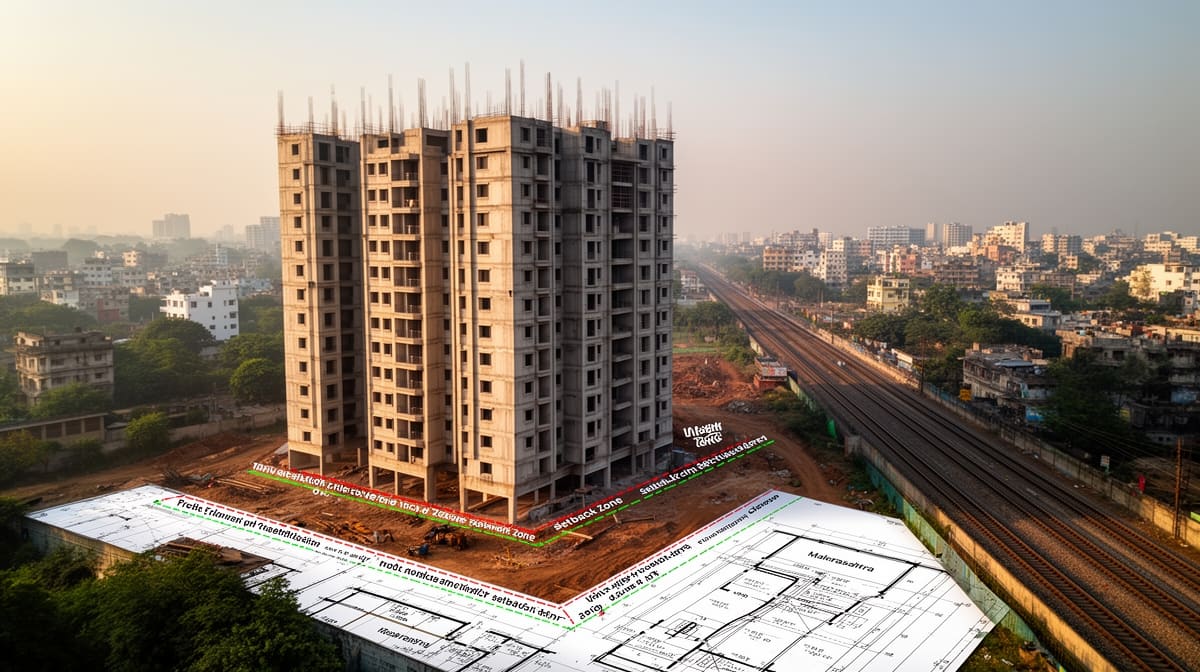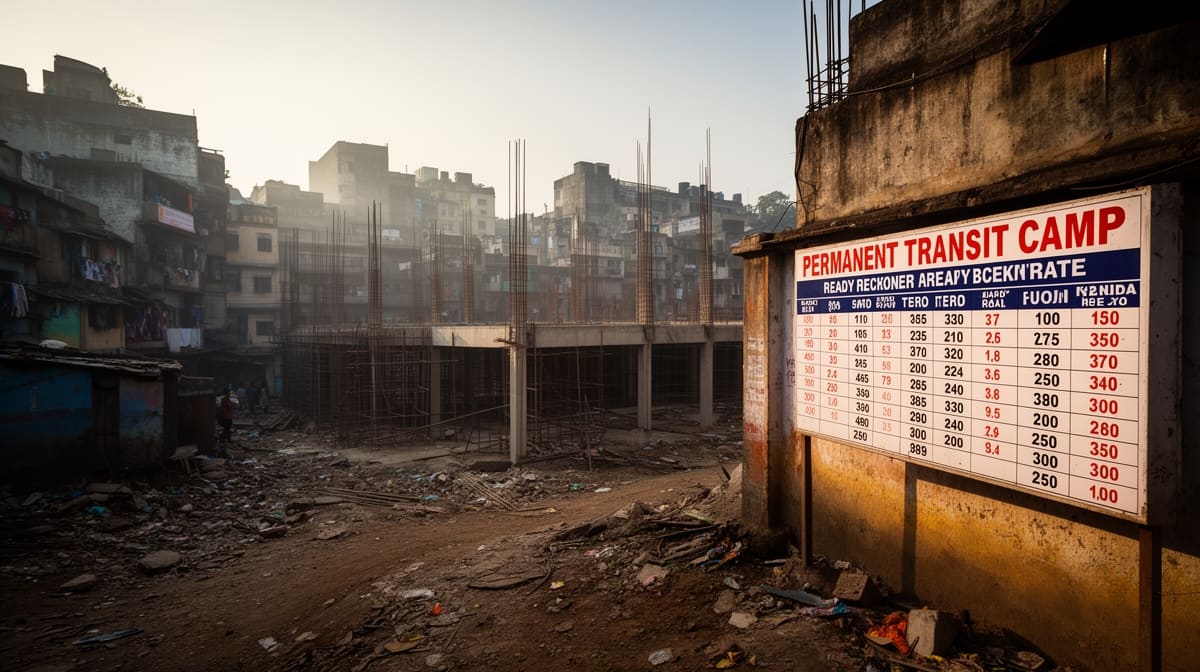
The Bombay High Court has delivered a pivotal clarification on the computation of stamp duty in slum redevelopment agreements, holding that the cost of constructing Permanent Transit Camp (PTC) cannot be treated as part of the consideration payable to the landowner. This ruling reinforces statutory interpretation principles under the Maharashtra Stamp Act and brings much-needed certainty to real estate transactions involving slum rehabilitation projects.
Background & Facts
The Dispute
The petitioner, Romell Real Estate Pvt. Ltd., entered into a draft Agreement for Sale with a landowner for a Slum Rehabilitation Project on land in Malad, Mumbai. The agreement was submitted for adjudication under Section 31 of the Maharashtra Stamp Act, 1958. The Collector of Stamps, relying on the Slum Rehabilitation Authority’s Letter of Intent (LOI), computed the stamp duty based on a market value of Rs. 63 crores and assessed duty at Rs. 3.15 crores, which the petitioner paid in March 2017. The agreement was duly registered in April 2017.
Procedural History
- January 19, 2017: Collector of Stamps issued Adjudication Order computing stamp duty at Rs. 3.15 crores.
- December 9, 2021: Collector issued a Demand Notice alleging a deficit of Rs. 1.01 crores, adding the cost of PTC construction (Rs. 20.33 crores) to the consideration.
- March 23, 2022: CCRA issued notice inviting objections to the original adjudication.
- May 25, 2022: Petitioner filed detailed reply challenging the revised computation.
- July 5, 2022: Petitioner requested involvement of Joint Director of Town Planning for valuation input - request ignored.
- December 21, 2023: Second Demand Notice issued, over six years after the original adjudication.
- June 20, 2024: CCRA passed Impugned Order confirming the enhanced duty.
Relief Sought
The petitioner sought quashing of the Demand Notices and the Impugned Order, arguing that the CCRA’s computation violated Guideline No. 26 of the Maharashtra Stamp (Determination of True Market Value of Property) Rules, 1995, and that the proceedings were time-barred under Section 53A of the Stamp Act.
The Legal Issue
The central questions were: (1) whether the cost of constructing the Permanent Transit Camp (PTC) can be added to the consideration for stamp duty under Guideline No. 26 of the Maharashtra Stamp Rules; and (2) whether the CCRA’s revision under Section 53A was valid when initiated and concluded beyond the six-year statutory deadline.
Arguments Presented
For the Petitioner
The petitioner relied on Shree Krishna Realtors v. CCRA to argue that Guideline No. 26 explicitly excludes the cost of PTC construction from the consideration. The petitioner contended that the PTC is a statutory obligation to be handed over to the SRA free of cost and forms no part of the consideration received by the landowner. The petitioner further argued that the ASR’s Guideline No. 26 mandates a two-part valuation: (a) value received by the landowner, and (b) value retained by the developer after deducting PTC costs. Adding PTC cost as consideration was legally untenable and contradicted the CCRA’s own prior position in Shree Krishna Realtors. The petitioner also emphasized that the CCRA’s failure to involve the Joint Director of Town Planning violated procedural fairness.
For the Respondent
The State, through the AGP, argued that the total economic benefit derived by the petitioner from the transaction must be taxed. It contended that the PTC component, though transferred to the SRA, represented a development right obtained by the petitioner and thus formed part of the consideration. The AGP relied on internal audit findings and asserted that the market value of the PTC area (8133.38 sq. m.) at Rs. 25,000 per sq. m. should be added to the Rs. 63 crore consideration. The State maintained that Section 53A only required initiation of proceedings within six years, not completion, and that the delay was justified due to the complexity of the audit.
The Court's Analysis
The Court undertook a meticulous textual and contextual analysis of Guideline No. 26 of the Maharashtra Stamp Rules, 1995, and Section 53A of the Stamp Act. It emphasized that the instrument in question was not a pure conveyance but a slum rehabilitation agreement, making Guideline No. 26 - and not general conveyance rules - the applicable standard.
"The assessment is broken into two parts. First, the consideration that would be received by the land-owner vendor... Second, the developed area that would be available to the developer from which the cost of rehabilitation is to be reduced has to be factored in."
The Court held that the CCRA’s approach fundamentally misread Guideline No. 26. The guideline does not treat the PTC as a value received by the developer; rather, it is a cost incurred by the developer to fulfill statutory obligations. The value to be considered under part (b) of the guideline is the net area available to the developer after deducting the PTC, not the gross value of the PTC added to the landowner’s consideration.
The Court further distinguished the State’s reliance on Sony Mony Electronics and Kolte Patil Developers, noting that both judgments unequivocally held that the six-year period under Section 53A encompasses the entire revision process - from initiation to final order. The Impugned Order was passed on June 20, 2024, nearly seven and a half years after the original adjudication on January 19, 2017. Even the first Demand Notice was issued after the six-year window closed.
The Court rejected the State’s argument that the deadline applied only to initiation, stating that such an interpretation would render the limitation meaningless and undermine the certainty required in property transactions. The CCRA’s failure to involve the Joint Director of Town Planning, despite a specific request, further tainted the proceedings.
The Verdict
The petitioner succeeded. The Court quashed the Demand Notices and the Impugned Order, holding that the cost of constructing the PTC cannot be added to the consideration for stamp duty under Guideline No. 26, and that the revision under Section 53A was time-barred. No re-assessment was directed.
What This Means For Similar Cases
PTC Costs Are Not Part of Consideration
- Practitioners must now argue that any attempt to include PTC construction costs in stamp duty computation is legally invalid under Guideline No. 26.
- Valuation must strictly follow the two-part formula: (a) value received by landowner, and (b) net developable area retained by developer after deducting PTC.
- The CCRA cannot retroactively reinterpret ASR guidelines to expand tax liability.
Six-Year Deadline Is Absolute
- All steps under Section 53A - notice, hearing, examination, and final order - must be completed within six years of the original adjudication.
- Delayed proceedings, even if initiated within six years, are void if the final order is passed after the deadline.
- Practitioners should immediately challenge any post-deadline demand notices under Article 226.
ASR Guidelines Are Binding, Not Advisory
- The Annual Statement of Rates (ASR) is not a mere guideline but a statutory instrument with binding force.
- Deviations from ASR guidelines without justification violate the principle of legitimate expectation.
- Petitioners should demand production of ASR justification documents and challenge arbitrary valuations.