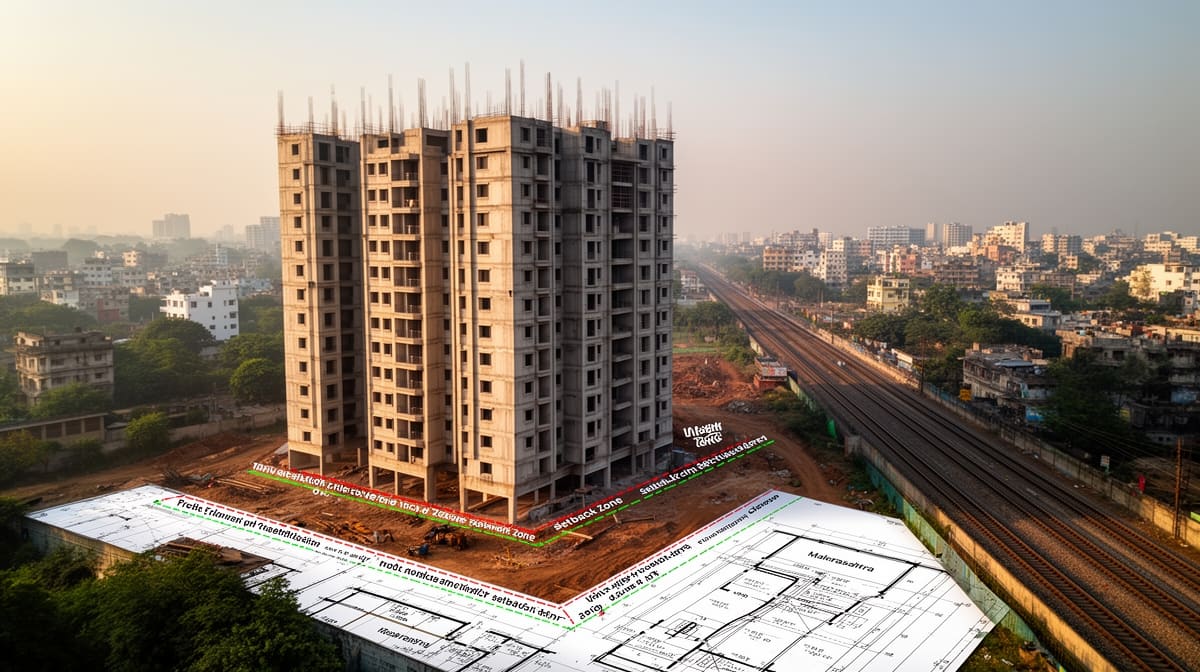
The Bombay High Court has quashed stamp duty orders that valued contingent future development rights as if they had vested on the date of execution of a Joint Development Agreement. The Court held that only rights presently transferred on 18 February 2014 could form the basis of valuation, directing a fresh determination within twelve weeks.
Background & Facts
The Dispute
The petitioners, Wadhwa Constructions & Infrastructure Private Limited and its director Navin Makhija, challenged the legality of orders passed by the Collector of Stamps, Raigad, and the appellate authority (Deputy Inspector General of Registration and Deputy Controller of Stamps, Konkan Division, Thane) determining deficit stamp duty on a Joint Development Agreement (JDA) executed on 18 February 2014 with Valuable Properties Pvt. Ltd. (VPPL). The petitioners had paid stamp duty of Rs.15,67,00,000 at registration. The authorities subsequently demanded additional duty, ultimately fixing the deficit at Rs.21,92,99,814.
Key Facts
- 10 March 2006: Government of Maharashtra issued Development Control Regulations for Special Township Scheme.
- 28 August 2009: Special Development Control Regulations notified for Township/Mega City Regulation.
- 18 February 2014: JDA executed between Petitioner No.1 and VPPL; Performance Guarantee issued same day. Stamp duty of Rs.15,67,00,000 paid on 20 February 2014.
- 5 August 2015: Notice under Section 33A issued by Joint Sub-Registrar, Panvel, alleging deficit stamp duty of Rs.16,23,35,800 (total duty Rs.31,90,35,800).
- 27 July 2015: Additional Director of Town Planning letter stating market value of property at Rs.797,58,95,000.
- 14 August 2015: Petitioner No.1 submitted reply contesting the deficit.
- 20 August 2015: Sub-Registrar forwarded notice and reply to Joint District Registrar.
- 9 October 2015 & 30 October 2015: Notices for hearing issued by Joint District Registrar.
- 6 November 2015: Petitioners filed detailed submissions with stamp duty calculation.
- 29 December 2015: Joint District Registrar issued demand notice for Rs.16,23,35,800 plus penalty within 15 days.
- 7 January 2016: Petitioner No.1 submitted written submissions with annexures.
- 20 January 2016: Notice for hearing issued.
- 8 February 2016: Submissions recorded in Roznama; petitioners contested FSI calculations.
- 19 March 2016: Collector of Stamps, Raigad passed order determining total stamp duty at Rs.37,69,13,224, deficit Rs.22,02,13,224 payable within 60 days.
- 2 April 2016: Corrigendum order correcting clerical errors.
- 16 May 2016: Appeal filed under Section 32B before Deputy Inspector General of Registration.
- 6 June 2016 & 20 June 2016: Appeal hearings; written submissions filed 20 June 2016.
- 12 July 2016: Appellate order confirming deficit of Rs.21,92,99,814, payable within 15 days with interest at 2% per month on default.
- 6 August 2016: Demand notice issued by Collector of Stamps for payment within 7 days.
- 29 August 2016: Petitioner No.1 replied, indicating intention to challenge orders.
- 19 September 2016: Present Writ Petition filed.
- 23 September 2016: Ad-interim order; statement recorded that no coercive steps would be taken.
Procedural History
- 18 February 2014: Execution of JDA and payment of stamp duty.
- 5 August 2015: Section 33A notice issued.
- 19 March 2016: Collector of Stamps order.
- 2 April 2016: Corrigendum order.
- 16 May 2016: Appeal filed under Section 32B.
- 12 July 2016: Appellate order by Deputy Inspector General of Registration.
- 6 August 2016: Demand notice by Collector of Stamps.
- 19 September 2016: Writ Petition No. 11115 of 2016 filed.
- 23 September 2016: Ad-interim relief granted.
- 31 August 2026: Judgment reserved.
- 7 September 2026: Judgment pronounced.
Relief Sought
The petitioners sought quashing of the orders dated 19 March 2016 and 12 July 2016, a declaration that only rights created and available on the date of execution shall form the basis of valuation, and a direction for fresh adjudication in accordance with law.
The Legal Issue
The central questions were: (1) Whether development rights in the Second Schedule land (50.23 acres), contingent upon a Swap Notice not yet issued, could be valued as presently vested rights for stamp duty on the date of execution; (2) Whether the authorities correctly applied the FSI, conversion factor, construction rate, and revenue-sharing provisions in determining market value under Article 5(g-a)(i) of the Maharashtra Stamp Act, 1958.
Arguments Presented
For the Petitioners
Mr. Girish Godbole, Senior Advocate, submitted that the JDA contained three distinct contingencies: (i) possible FSI increase from 0.1 to 0.3 before Swap Notice; (ii) VPPL's option to issue Swap Notice under Clause 6.1; (iii) VPPL's option to choose revenue sharing under Clause 7.1. Relying on Section 31 of the Indian Contract Act and judgments in MCX Stock Exchange Ltd. v. SEBI and Kesoram Industries & Cotton Mills v. Commissioner of Wealth Tax, he argued that contingent contracts do not create present unconditional obligations. The authorities erroneously assumed FSI of 0.5 instead of 0.1, applied a 1.5 multiplier instead of the ASR-prescribed 1.2, used the sale rate of Rs.24,000 per sq. metre instead of the agreed construction cost of Rs.8,500, and valued parking on an inflated area base. He relied on Shantibhusan v. State of U.P. for strict interpretation of taxing statutes and the review order in Kolte Patil Developers Ltd. directing valuation based on FSI available on execution date.
For the Respondent/State
Mr. Yatin Khochare submitted that the petitioners' claim of 0.1 FSI in G-1 Zone was contrary to Government Notification No. TPS-1213/1533/C.R.236/13/UD-12 dated 1 January 2014 (Modification No.6), which provided for basic FSI of 0.5. The JDA itself defined "VPPL Horizontal Entitlement" with reference to 0.5 FSI and required infrastructure sufficient for 0.5 FSI township. The definition of "Saleable Area" as usable carpet area x 1.5 justified using the 1.5 factor. Under ASR Guideline No.4, where the document mentions "saleable area", that area must be taken as built-up area. The appellate authority correctly examined four valuation methods (construction/revenue distribution, with/without Swap Notice) and adopted the highest. The Second Schedule land formed an inseparable part of the instrument, and Clause 4.6 contemplated additional FSI becoming available. The revenue-sharing provision under Clause 7.1 constituted consideration under Section 2(na) regardless of deferral.
The Court's Analysis
The Court framed the inquiry around what rights were transferred on 18 February 2014 versus what rights would come into operation only upon fulfilment of conditions. It emphasized that "a benefit which may arise in future cannot be included in valuation only because it is mentioned in the Agreement" while "a right which is created under the Agreement cannot be ignored only because its exercise is to take place later." The document must be read as a whole to identify the real nature of the instrument and the rights created immediately.
"The contingent nature of a right is relevant, but it is not the answer. The Court has to find what rights were created or transferred on the date of execution. If the instrument presently transfers an interest in immovable property, possession, control, development rights or authority to convey, such rights may have to be considered for stamp purposes. But if a particular right will come into existence only after a future event or separate conveyance, that future right cannot be treated as an existing right merely because the Agreement states what may happen if the condition is fulfilled."
On the First Schedule land (298 acres), the Court found that Recital D, Clauses 2.2 and 2.3, the definition of VPPL Land, immediate possession, and irrevocable Powers of Attorney (Clauses 5.1 and 5.2) demonstrated that substantial development rights vested immediately. Article 5(g-a)(i) applied, attracting conveyance-level duty on market value of the property.
On the Second Schedule land (50.23 acres), the Court held that the definition of VPPL Land expressly excluded this land unless a Swap Notice was issued. Clause 6.1 gave the option solely to VPPL, and Clause 6.2 made development rights operative only "upon VPPL giving Swap Notice." The Court concluded: "I therefore cannot hold that on 18 February 2014 WADHWA had the same present and exercisable development rights in respect of the 50.23 acres as it had in respect of the First Schedule land." The State could examine the later instrument upon Swap Notice but could not value the future right as presently vested.
On FSI, the Court accepted the State's contention that the applicable Notification (Modification No.6) provided for basic FSI of 0.5 in G-1 Zone, and the JDA's definitions consistently referenced 0.5 FSI. However, the authority could not adopt a future or maximum FSI not available on the execution date.
On the conversion factor, the Court distinguished the contractual "Saleable Area" factor of 1.5 from the ASR Guideline No.4 conversion factor of 1.2 for converting carpet area to built-up area. "The expression 'Saleable Area' used by the parties in the Agreement cannot, only because it is mentioned there, become the built-up area for the purpose of stamp duty." The 1.2 factor must apply.
On construction cost vs sale price, the Court held that Clause 3.1.2(ii) specified a construction obligation at Rs.790 per sq. ft. (approx. Rs.8,500 per sq. metre), distinct from the market sale rate of Rs.24,000. The construction component must be valued at construction cost under applicable ASR Guidelines.
On revenue sharing (Clause 7.1), the Court followed Kolte Patil Developers Ltd. that deferred revenue sharing can constitute consideration under Section 2(na). However, Clause 7.1 did not make VPPL unconditionally entitled to 35% of all gross revenues from the entire development from the execution date. It operated only in specific circumstances concerning Alternate Vertical Premises. The authority had to identify which development rights were presently granted and whether the 35% entitlement was consideration for those rights, computed on the basis of FSI and development potential available on 18 February 2014.
On parking, the calculation had to follow the development area available on the execution date. The figure of 3,383 spaces (based on Swap Notice scenario) was rejected; the no-Swap position of 1,750 spaces was the correct basis.
The Verdict
The petition was allowed in part. The Court quashed and set aside the orders dated 19 March 2016 (Collector of Stamps) and 12 July 2016 (Appellate Authority) to the extent they determined market value and stamp duty on the rejected valuation method. It declared that for stamp adjudication of the JDA (Instrument No. Panvel-3/1009/2014), only rights created and available on the date of execution shall form the basis of valuation. The 298 acres (First Schedule) were treated as part of the arrangement; the 50.23 acres (Second Schedule) were not a presently transferred development right. The Additional Vertical Entitlement dependent on Swap Notice or future FSI increase was excluded. FSI of 0.50 (not 0.10) was the applicable basic FSI. The conversion factor of 1.2 (not 1.5) must apply. The construction rate of Rs.8,500 per sq. metre (not Rs.24,000) must be used for the construction component. Revenue sharing under Clause 7.1 could not be treated as consideration where conditions had not occurred. Parking was to be recalculated on the no-Swap basis (1,750 spaces). The competent authority was directed to undertake fresh determination within twelve weeks of receiving the order, with no coercive steps for eight weeks thereafter. No order as to costs.
What This Means For Similar Cases
Contingent Rights Cannot Be Valued As Vested Rights
- Stamp authorities must distinguish between rights that vest immediately upon execution (possession, development authority, irrevocable PoA) and rights that become operative only upon a future event (Swap Notice, FSI increase, option exercise).
- Future contingent rights, even if quantified in the agreement, cannot be valued as if they had matured on the execution date.
- The State retains power to levy duty on the later chargeable transaction when the contingency occurs.
Valuation Must Anchor To The Execution Date
- FSI and development potential must be those available on the date of execution, not future or maximum potential contemplated by the parties.
- Conversion factors prescribed by ASR Guidelines (e.g., 1.2 for carpet-to-built-up) prevail over contractual conversion factors (e.g., 1.5 for saleable area).
- Construction consideration must be valued at construction cost rates, not retail sale prices, where the agreement specifies a construction obligation.
- Revenue-sharing provisions require clause-by-clause analysis: deferred consideration is includible only to the extent it is consideration for presently granted rights, computed on execution-date development potential.
Article 5(g-a)(i) Application Requires Rights-Based Analysis
- The mere label "Joint Development Agreement" does not determine stamp duty; the effect of the instrument governs.
- Where the agreement grants enforceable development interest, possession, construction rights, sale authority, and irrevocable PoA, Article 5(g-a)(i) attracts conveyance-level duty on the market value of the presently transferred rights.
- Authorities must identify each valuation component and give reasons for accepting or rejecting party submissions.