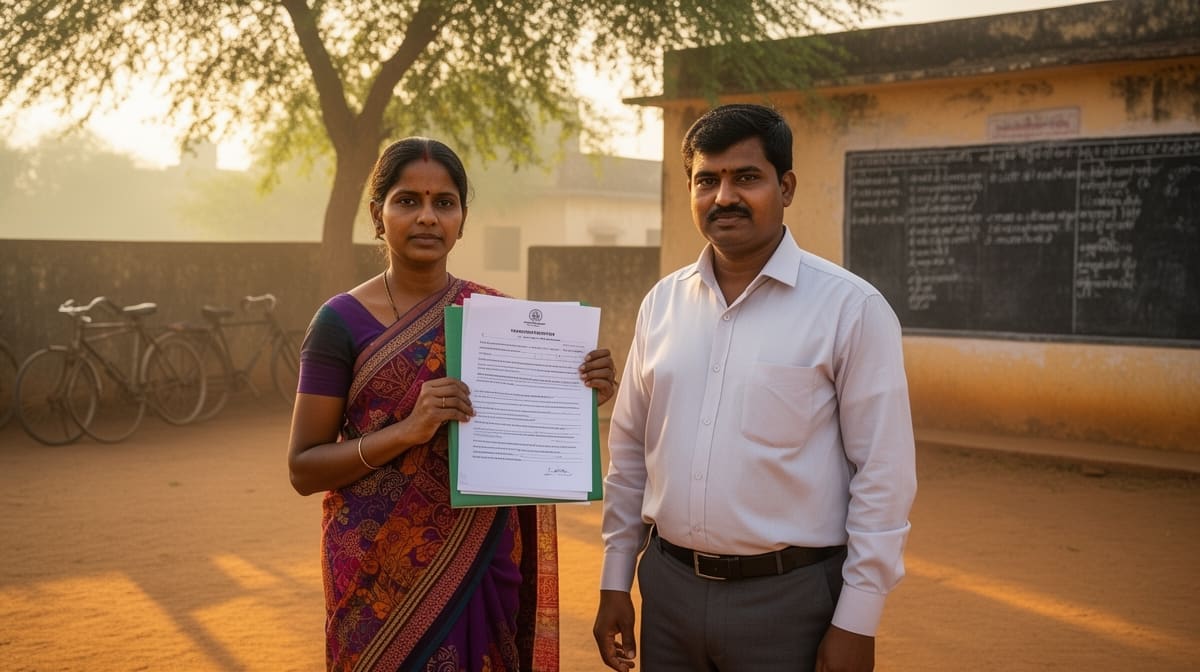
The Rajasthan High Court has affirmed that administrative discretion in government transfers must accommodate the legitimate hardship faced by married couples separated by official postings. This ruling reinforces the constitutional obligation to balance administrative exigency with the fundamental right to family life under Articles 14 and 21.
Background & Facts
The Dispute
The petitioner, a government school teacher, was transferred from Dausa to Mirjapur Baran in Baran district. His wife, also a government employee, remained posted at UAAM Railway Station in Dausa. The transfer resulted in a long-distance separation, creating significant personal and domestic hardship without any administrative justification for denying joint posting.
Procedural History
- The petitioner filed a writ petition before the High Court of Rajasthan at Jodhpur challenging the unilateral transfer.
- He contended that the respondents failed to explore the possibility of posting him and his wife in the same district, despite the availability of vacancies and the absence of any disciplinary or performance-related grounds.
- No representation had been formally considered by the competent authority prior to the transfer order.
Relief Sought
The petitioner sought quashing of the transfer order or, alternatively, a direction to the state to consider joint posting in the same district, subject to administrative feasibility.
The Legal Issue
The central question was whether the failure of administrative authorities to consider the hardship caused by separating spouses in government transfers violates the principles of natural justice and equality under Articles 14 and 21 of the Constitution.
Arguments Presented
For the Petitioner
The petitioner relied on State of Punjab v. Baldev Singh and Union of India v. Tarsem Singh to argue that administrative decisions affecting personal life must be guided by reasonableness and compassion. He emphasized that the state has a duty to minimize hardship to employees and their families, particularly when both spouses are in government service. The absence of any inquiry into joint posting options, he submitted, rendered the transfer arbitrary.
For the Respondent
The state contended that transfer orders are purely administrative and subject to exigencies of public service. It argued that the petitioner had no vested right to a particular posting and that the state cannot be compelled to accommodate personal circumstances unless explicitly mandated by service rules. The respondents cited K. Sankaran v. State of Tamil Nadu to assert that courts should not interfere unless malafide or illegality is proven.
The Court's Analysis
The Court acknowledged that while transfer orders are generally non-justiciable, they are not immune from judicial review when they result in manifest injustice. The Court observed that the state’s failure to even consider the possibility of joint posting, despite the petitioner’s long service and the absence of any operational constraint, amounted to a failure to apply its mind.
"The administrative authority cannot be permitted to act in a mechanical manner, ignoring the human dimension of service conditions, particularly when both spouses are government servants and separation causes demonstrable hardship."
The Court distinguished K. Sankaran on the ground that it involved a single employee without a spouse in service, whereas here, both spouses were employed by the state. The Court held that the principle of audi alteram partem requires at least a minimal inquiry into such humanitarian concerns before finalizing transfers. The Court further noted that the state’s own service rules encourage consideration of spousal postings, making the omission not merely negligent but legally untenable.
The Verdict
The petitioner succeeded. The Court held that administrative authorities must consider the possibility of joint posting for married government employees where feasible, and failure to do so violates the principles of natural justice. The Court directed the competent authority to examine the petitioner’s representation within ten days and issue orders within one month.
What This Means For Similar Cases
Spousal Hardship Cannot Be Ignored
- Practitioners must now raise spousal separation as a ground for challenging arbitrary transfers in service matters.
- Government departments must maintain a record of dual-service couples and proactively explore joint postings during transfer planning.
- Failure to consider such hardship may render transfer orders liable to quash under Article 14.
Procedural Fairness Is Mandatory
- A mere assertion of "administrative exigency" is insufficient to override humanitarian considerations.
- Petitioners should file representations before transfers are finalized to preserve the right to judicial remedy.
- Courts will now treat the absence of inquiry into spousal posting as a procedural flaw warranting intervention.
Judicial Restraint with Humanitarian Lens
- Courts will not substitute administrative discretion but will compel reasoned decision-making.
- This judgment aligns with Puttaswamy’s recognition of dignity and family life as integral to Article 21.
- Future cases involving relocation of employees with dependents may invoke this precedent to demand individualized assessment.