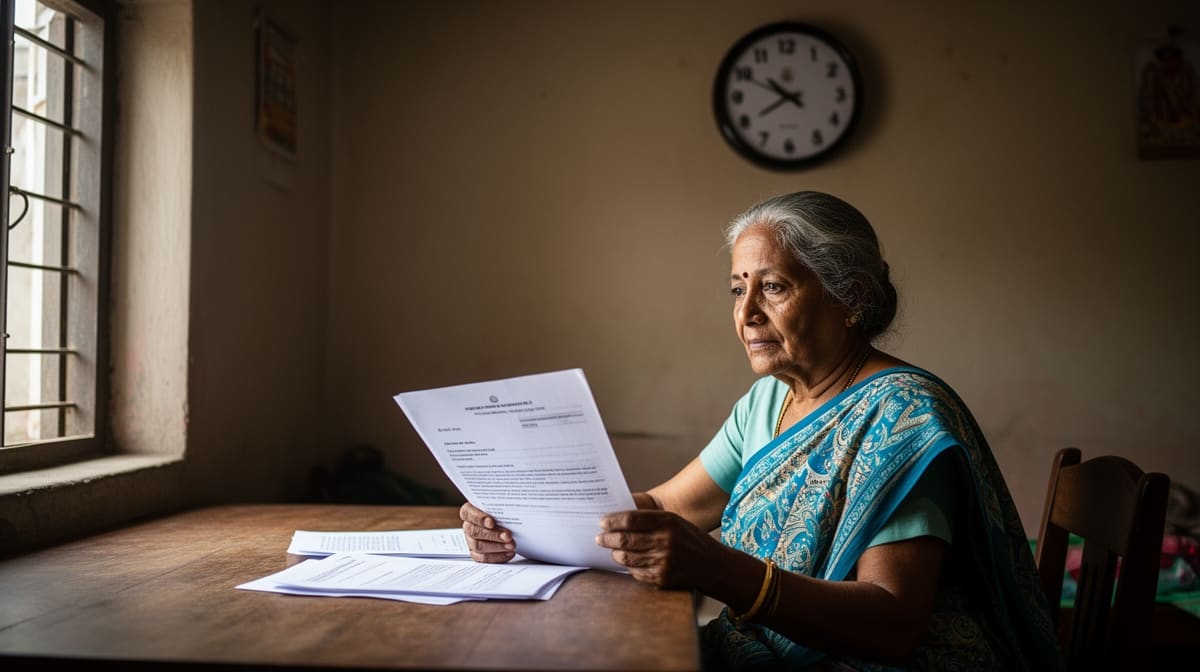
The Andhra Pradesh High Court has reinforced the constitutional imperative of timely justice in maintenance proceedings by directing a trial court to conclude a long-pending case without further delays. This order underscores that procedural inertia, particularly when caused by non-cooperation of the respondent, cannot be permitted to undermine the rights of vulnerable litigants under Section 125 Cr.P.C.
Background & Facts
The Dispute
The petitioner, a woman residing in Nellore, filed a maintenance petition under Section 125 Cr.P.C. in 2022 against her husband, Respondent No.1, seeking financial support after he ceased providing for her. The case has remained pending for over two years, with repeated adjournments attributed to the husband’s consistent absence from court proceedings.
Procedural History
- 2022: Maintenance petition (M.C.No.98 of 2022) filed before the Family Court-cum-VI Additional District and Sessions Judge, Nellore
- 2022 - 2024: Multiple hearings adjourned due to non-appearance of the husband
- June 2024: Petitioner sought direction for expeditious disposal through an interim application
- February 2026: Criminal Revision Case No.1123/2024 filed under Sections 397 and 401 Cr.P.C. challenging the delay
Relief Sought
The petitioner sought a direction to the trial court to conclude the maintenance case without further adjournments and to hold the respondent accountable for his non-cooperation.
The Legal Issue
The central question was whether Section 401 Cr.P.C. empowers the High Court to intervene and direct a trial court to expedite a pending maintenance proceeding when delay is caused by the deliberate non-appearance of the respondent.
Arguments Presented
For the Petitioner
Learned counsel for the petitioner relied on the right to speedy justice under Article 21 and the binding precedent in State of Haryana v. Bhagwan Das to argue that prolonged pendency in maintenance cases inflicts irreparable hardship on women, especially when the respondent is in a position to pay but refuses to appear. He emphasized that adjournments granted without justification violate the spirit of Section 125 Cr.P.C., which is a social welfare provision.
For the Respondent
Respondent No.1’s counsel did not contest the factual allegations of non-appearance but submitted that the matter should be left to the trial court’s discretion. He did not dispute the petitioner’s claim of delay but argued that no formal order had been passed against the husband for contempt or non-appearance.
The Court's Analysis
The Court examined the nature of maintenance proceedings under Section 125 Cr.P.C., noting that they are quasi-civil in character but grounded in the constitutional duty to protect vulnerable persons. The Court observed that the husband’s repeated absence was not merely negligent but constituted a pattern of obstruction.
"The right to maintenance is not a luxury but a statutory right designed to prevent destitution. When the respondent deliberately avoids court proceedings, the trial court must not permit the matter to languish indefinitely."
The Court held that Section 401 Cr.P.C. grants the High Court inherent supervisory jurisdiction to ensure that subordinate courts discharge their duties expeditiously, particularly in cases involving economic vulnerability. The Court distinguished this from routine case management, noting that the delay here was not due to judicial backlog but due to the respondent’s conduct.
The Court further emphasized that the trial court’s failure to impose consequences for non-appearance - such as drawing adverse inferences under Section 114(e) of the Evidence Act or initiating contempt proceedings - had enabled the delay.
The Verdict
The petitioner succeeded. The High Court held that delay in maintenance cases caused by respondent non-cooperation violates the right to speedy justice and directed the trial court to conclude M.C.No.98 of 2022 without further adjournments, reporting progress to the Registrar (Judicial) by 01.04.2026.
What This Means For Similar Cases
Adjournments Cannot Be Granted Casually
- Practitioners must now move for specific directions against habitual non-appearance in maintenance cases
- Courts are expected to record reasons for every adjournment and consider adverse inferences under Section 114(e) Evidence Act
- Failure to comply with court directives may warrant contempt proceedings under Section 12 Cr.P.C.
Judicial Oversight Is Mandatory in Delayed Maintenance Matters
- High Courts may invoke Section 401 Cr.P.C. proactively in cases where delay exceeds 18 - 24 months without substantive progress
- Petitioners in maintenance cases may now seek interim directions for interim maintenance while the main case is pending
- Trial judges must report progress to higher authorities in cases flagged for delay
Enforcement of Maintenance Orders Is Now a Priority
- This judgment reinforces that Section 125 Cr.P.C. is not a mere procedural formality but a tool for social justice
- Lawyers should routinely file applications for direction to attach salary or property if the respondent is employed or owns assets
- Courts must treat maintenance cases as urgent matters under the Family Courts Act, 1984