
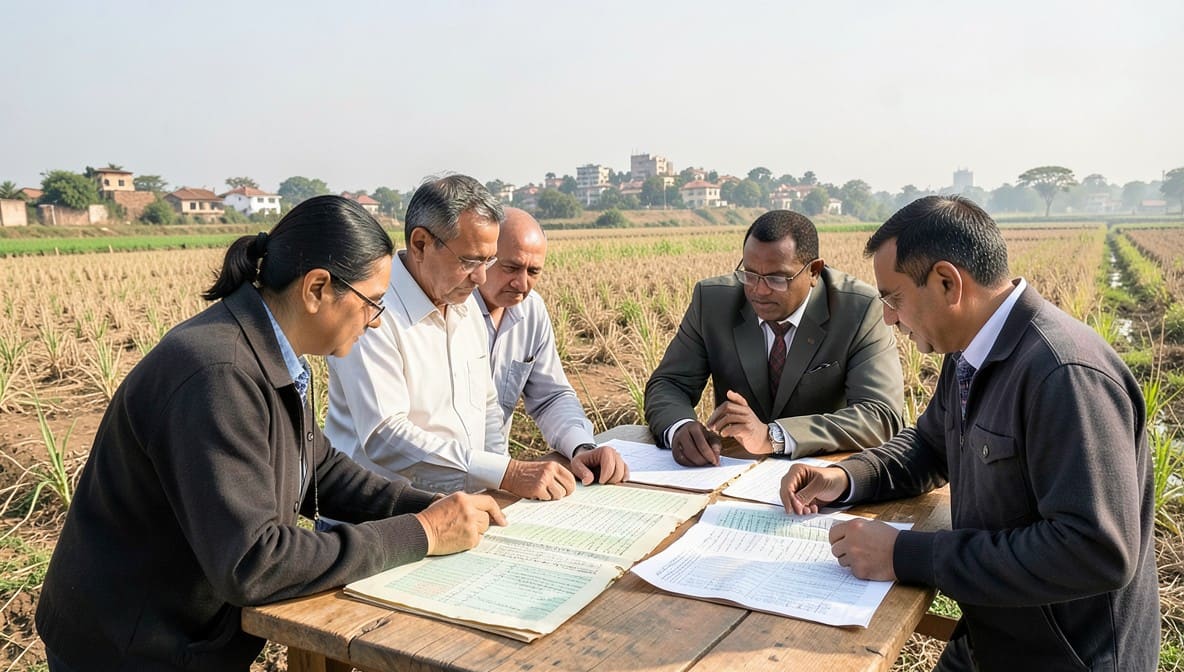
The Supreme Court set aside a Punjab and Haryana High Court judgment and confirmed that land recorded as shamilat deh vests in the gram panchayat under Section 2(g)(1) of the 1961 Act, thereby validating a 1955 mutation in favour of the Gram Panchayat, Wazirabad (now the Municipal Corporation, Gurgaon).
Background & Facts
The Dispute
The appellants, led by Suraj Bhan, claimed ownership of 436 bighas 18 biswas of land in the uninhabited village of Haiderpur, Gurgaon Tehsil, Haryana. The respondents, including Ashvarya Estate Pvt. Ltd., argued that the land formed part of the pattis Chitru, Ramrattan, Medha, Sadasukh and Ahmed Ali Khan and therefore did not vest in the gram panchayat. The core question was whether the land was "shamilat deh" (common village land) or private pattidari land.
Key Facts
- 1966: State of Haryana created, adopting Punjab’s land laws.
- 10.03.1954: Punjab Government letter authorising mutation of the land to Gram Panchayat, Wazirabad.
- 13.09.1955: Mutation (No. 131) effected in favour of Gram Panchayat, Wazirabad.
- 11.09.1985: Suit (Case No. 18/DRO) filed by four residents of Wazirabad under Section 13A of the Act of 1961, claiming ownership on behalf of the pattis.
- 28.07.1990: Assistant Collector partially decreed in favour of plaintiffs for 179 bighas 6 biswas, holding that shamilat deh exceeded 25% of village area.
- 18.12.1991: Collector set aside the partial decree and remanded for fresh consideration.
- 02.04.1998: Revision filed; Commissioner stayed the operation of the lower orders.
- 02.03.1998: Collector dismissed the appeal, reaffirming that the land was not shamilat deh.
- 05.08.2005: Commissioner allowed revisions and restored the 13.09.1955 mutation.
- 24.08.2007: Punjab and Haryana High Court Division Bench allowed writ petitions and set aside the mutation.
- 25.01.2008: Supreme Court stayed the High Court judgment.
- 03.08.2026: Supreme Court delivered the present judgment.
Procedural History
- 11.09.1985: Original suit filed before Assistant Collector, Gurgaon (Case No. 18/DRO).
- 28.07.1990: Assistant Collector partially decreed in favour of plaintiffs.
- 18.12.1991: Collector set aside the partial decree.
- 02.04.1998: Revision filed before Commissioner, Gurgaon; stay order issued.
- 02.03.1998: Collector dismissed the appeal.
- 05.08.2005: Commissioner allowed revisions and restored mutation.
- 24.08.2007: Division Bench of Punjab and Haryana High Court reversed the Commissioner’s order.
- 25.01.2008: Supreme Court stayed the High Court judgment.
- 03.08.2026: Supreme Court delivered the final judgment.
The Parties' Positions
- Appellants (Suraj Bhan and others): Asserted that the land was recorded as shamilat deh in the Jamabandi and Sharat-wajib-ul-arz, invoking Section 2(g)(1) of the 1961 Act which vests such land in the gram panchayat irrespective of its use. They contended that the mutation of 13.09.1955 was valid and that the limitation period under Section 13A was satisfied.
- Respondents (Ashvarya Estate Pvt. Ltd. and others): Maintained that the land belonged to the pattis, that it was used in private cultivating possession, and that the mutation was effected without notice, rendering it void. They relied on the High Court’s finding that the land was not used for common purposes and argued that the 25 % threshold and exclusion clauses should apply.
Relief Sought
The appellants sought confirmation of the 1955 mutation, declaration that the land is shamilat deh and therefore vested in the gram panchayat (now Municipal Corporation, Gurgaon), and an order that the High Court judgment be set aside. The respondents sought reversal of the mutation and restoration of their alleged private ownership.
The Legal Issue
Whether land described as "shamilat deh" in the revenue records vests automatically in the gram panchayat under Section 2(g)(1) of the Punjab and Haryana Common Lands (Regulation) Act, 1961, notwithstanding claims of private pattidari ownership and the High Court’s finding that the land was not used for common purposes.
Arguments Presented
For the Appellant
The appellants relied on the presumption of truth attached to entries in the Jamabandi and Sharat-wajib-ul-arz, arguing that the land was unequivocally recorded as shamilat deh. They cited Shiv Charan Singh v. Gram Panchayat Narike and Patram v. Gram Panchayat Katwar for the proposition that a revenue entry of shamilat deh vests the land in the panchayat under Section 2(g)(1) without the need to prove actual communal use. They also highlighted the repeal of the 1953 Act and the continuation of the shamilat law under Section 2(h) of the 1961 Act, emphasizing that the omission of the proviso in the 1992 amendment eliminated the 25 % limitation.
For the Respondent
The respondents argued that the land formed part of the pattis and that the Jamabandi entries showing "makbuja malkan" indicated private cultivating possession, not common ownership. They invoked Patram v. Gram Panchayat Katwar to stress that where land is described as shamilat patti or shamilat taraf, the court must examine whether it is used for common purposes under Sections 2(g)(3) or 2(g)(v). They contended that the mutation was effected without notice, violating procedural fairness, and that the High Court correctly applied the exclusion clauses of Section 2(g)(5).
The Court's Analysis
The Court began by interpreting the language of Section 2(g) of the 1961 Act. It held that the phrase "shamilat deh" in the ownership column of the revenue records triggers the operation of Section 2(g)(1) which vests such land in the gram panchayat, irrespective of any description of use. The Court rejected the respondents’ reliance on the "use" test, noting that the statute expressly distinguishes between lands described merely as shamilat deh (covered by 2(g)(1)) and those described as shamilat patti, taraf, panna or thola (covered by 2(g)(3) or 2(g)(v)).
"The land was shown as shamilat deh in the Jamabandi and Sharat-wajib-ul-arz; therefore Section 2(g)(1) applies and no further inquiry into communal use is required."
The Court examined the legislative history, emphasizing that the 1953 and 1954 Acts had transferred all shamilat deh to gram panchayats without exception, and that the 1961 Act merely codified this scheme. The omission of the proviso in the 1992 Haryana amendment meant that the 25 % ceiling no longer applied. Consequently, the Court found that the mutation of 13.09.1955 was valid and could not be set aside on the ground of lack of notice.
The Court also addressed the limitation argument under Section 13A. It observed that the suit was filed on 11.09.1985, within the five-year period prescribed after the amendment, and therefore was timely. The Court further noted that the plaintiffs had failed to produce any evidence of partition or individual cultivating possession before 26.01.1950, a prerequisite for exclusion under Sections 2(g)(3) and 2(g)(viii).
Finally, the Court dismissed the High Court’s reliance on the 25 % threshold and the alleged non-use of the land, holding that those considerations are irrelevant where the land is categorised as shamilat deh under Section 2(g)(1). The Court restored the mutation, affirmed the vesting of the 436 bighas 18 biswas in the gram panchayat (now Municipal Corporation, Gurgaon), and set aside the High Court judgment.
The Verdict
The Supreme Court allowed the appeals, set aside the Punjab and Haryana High Court judgment of 24.08.2007, and confirmed the mutation dated 13.09.1955 in favour of the Gram Panchayat, Wazirabad (now Municipal Corporation, Gurgaon). The land of 436 bighas 18 biswas was held to be shamilat deh and therefore vested in the panchayat under Section 2(g)(1) of the Act of 1961. All other pending applications were dismissed and each party was ordered to bear its own costs.
What This Means For Similar Cases
Revenue Records Are Conclusive Evidence
- A entry of "shamilat deh" in the Jamabandi creates a statutory presumption that the land vests in the gram panchayat.
- Parties must produce clear evidence of partition or individual cultivating possession before 26.01.1950 to rebut this presumption.
Section 2(g)(1) Overrides Exclusion Clauses
- The omission of the 1992 proviso eliminates the 25 % limitation; therefore, any land recorded as shamilat deh automatically vests in the panchayat.
- Exclusion clauses in Sections 2(g)(3) and 2(g)(v) apply only when the land is described as shamilat patti, taraf, panna or thola.
Municipal Corporations Inherit Panchayat Rights
-
When a gram panchayat is subsumed into a municipal corporation, the corporation inherits the panchayat’s vested rights over shamilat deh.
-
Practitioners should verify the successor-in-interest status of local bodies before challenging mutations.
-
Ensure that any claim of private ownership over land recorded as shamilat deh is supported by partition orders or cultivation records predating 26.01.1950.
-
When contesting a mutation, raise the lack of statutory notice only if the land falls outside Section 2(g)(1).





