The Customs, Excise and Service Tax Appellate Tribunal (CESTAT) Kolkata has delivered a significant ruling clarifying the scope of service tax liability on residential construction and the evidentiary standards required to sustain tax demands. The judgment reinforces that statutory thresholds must be strictly applied and that revenue authorities cannot rely on mechanical comparisons of returns and bank statements to impose tax liabilities without independent verification.
Background & Facts
The Dispute
The appellant, M/s. Laxmi Projects, was engaged in construction activities during the financial years 2009-10 to 2012-13. The Department initiated an audit of the appellant’s operations and issued a Show Cause Notice (SCN) dated 20.10.2014, demanding service tax of Rs. 15,20,324 (inclusive of E.Cess and S&HE Cess), along with interest and penalties, for alleged non-payment of service tax on two categories: (a) commercial and industrial construction services, and (b) construction of residential complexes.
Key Facts
- The appellant was registered under the service tax regime and filed ST-3 returns regularly.
- On 15.05.2013, the Department issued a letter requesting documents for audit purposes.
- On 10.06.2013, the appellant responded, informing the Department that it had ceased operations after 2010-11 and had taken temporary registration solely to facilitate the audit.
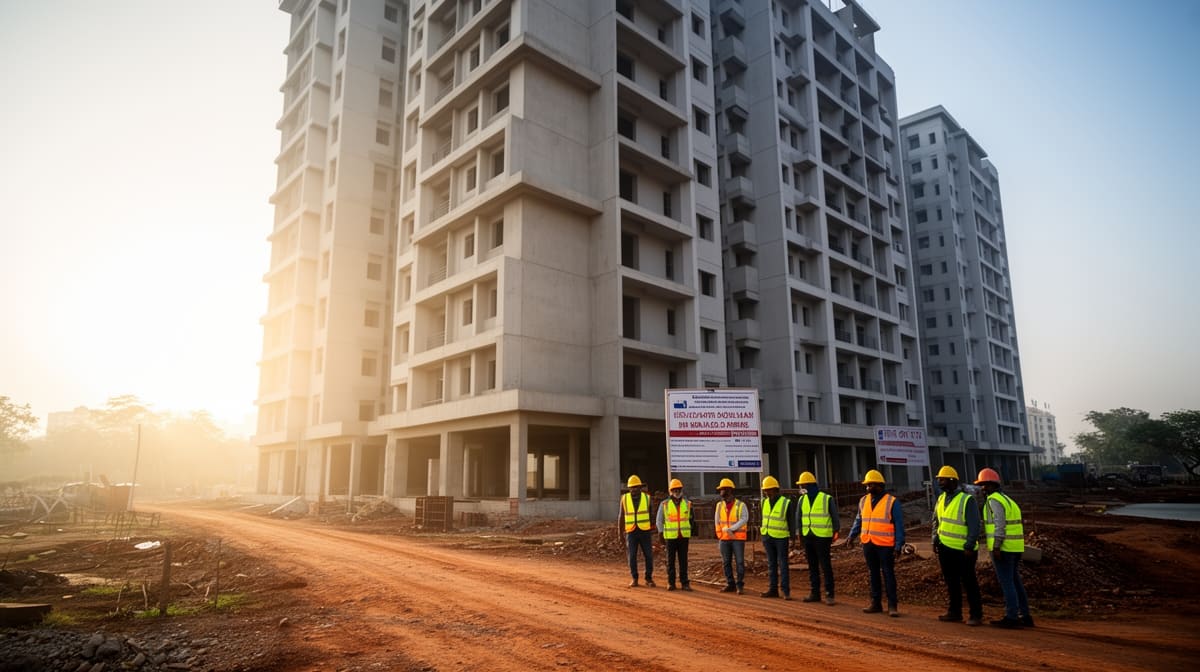
- The appellant constructed a residential complex comprising only four flats, as per the Agreement for Development dated 19.02.2010.
- A Chartered Accountant’s Certificate dated 28.07.2016 certified that the appellant had discharged all service tax liabilities on commercial and industrial construction services, with a short payment of Rs. 4,26,522 which was voluntarily paid on 22.12.2014 via Challan No. 00006.
- The Department’s demand was computed solely by comparing ST-3 returns with bank statements, without verifying the nature of services rendered.
Procedural History
- 29.02.2016: Order-in-Original No. 79/ADC/ST-I/Kol/2015-16 passed by the Additional Commissioner, Service Tax-I, Kolkata, confirming demand of Rs. 15,20,324, interest, and penalties under Sections 77(1), 77(2), and 78 of the Finance Act, 1994.
- 29.09.2017: Order-in-Appeal No. 246/S.Tax-I/KOL/2017 passed by the Commissioner of C.G.S.T. & C.X. (Appeal-I), Kolkata, upholding the demand.
- 24.03.2026: Appeal filed before CESTAT Eastern Zonal Bench, Kolkata, heard and decided.
The Parties' Positions
For the Appellant:
- The residential complex comprised only four flats, falling outside the statutory definition of "residential complex" under Section 65(91a) of the Finance Act, 1994.
- Service tax on commercial and industrial construction services had been fully discharged, including the short payment of Rs. 4,26,522, supported by a Chartered Accountant’s Certificate.
- The demand was raised beyond the normal limitation period under Section 73, without proof of wilful suppression or fraud.
- The entire demand was based on an unverified comparison of ST-3 returns and bank statements, which is legally insufficient.
For the Respondent:
- The appellant failed to appear before lower authorities and did not submit documents sought during audit.
- The demand was validly raised under the extended period of limitation.
- The comparison of ST-3 returns and bank statements was a legitimate method to detect discrepancies.
Relief Sought
The appellant sought:
- Setting aside of the entire demand of service tax, interest, and penalties.
- Recognition that construction of four flats is not taxable as a "residential complex".
- Cancellation of penalties for the short-paid amount of Rs. 4,26,522, given its voluntary payment.
- Declaration that the demand beyond the admitted amount is time-barred and unsupported by evidence.
The Legal Issue
The central questions were: (1) Whether construction of a residential complex with fewer than twelve units attracts service tax under Section 65(91a) of the Finance Act, 1994? (2) Whether a tax demand can be sustained solely on the basis of comparison between ST-3 returns and bank statements, without independent verification of the nature of services rendered? (3) Whether the extended period of limitation under Section 73 was validly invoked in the absence of evidence of wilful suppression?
Arguments Presented
For the Appellant
The appellant relied on the statutory definition of "residential complex" under Section 65(91a), which explicitly requires more than twelve residential units. It submitted documentary proof of the four-flat construction and a Chartered Accountant’s Certificate verifying tax payments. It further cited multiple precedents holding that mechanical comparison of ST-3 returns and bank statements cannot substitute for substantive verification of service taxability. The appellant emphasized its regular compliance, timely disclosure of cessation of operations, and voluntary payment of the admitted short payment, negating any allegation of fraud.
For the Respondent
The Revenue contended that the appellant had not cooperated during the audit and had failed to produce documents. It argued that the comparison of ST-3 returns and bank statements was a standard audit tool and that the extended period of limitation was justified due to alleged suppression. It did not produce any evidence to contradict the appellant’s claim regarding the number of flats or the payment of service tax.
The Court's Analysis
The Tribunal undertook a rigorous statutory interpretation of Section 65(91a), which defines a "residential complex" as one comprising "more than twelve residential units." The Agreement for Development dated 19.02.2010 clearly specified the construction of only four flats. The Tribunal held that the statutory threshold is not a mere procedural formality but a substantive condition for taxability. "The legislature has drawn a clear line. Where the number of units is twelve or less, the activity falls outside the levy. To impose tax here would be to rewrite the statute."
Regarding the commercial and industrial construction services, the Tribunal accepted the Chartered Accountant’s Certificate as credible evidence, noting the absence of any rebuttal from the Revenue. The voluntary payment of Rs. 4,26,522 before adjudication demonstrated bona fide intent. The Tribunal observed: "A taxpayer who voluntarily rectifies a short payment, especially after being alerted by audit, cannot be penalized as a defaulter."
On the evidentiary issue, the Tribunal reviewed a catena of decisions, including CCE v. M/s. S.K. Industries and CCE v. M/s. R.K. Constructions, which held that "comparison of bank statements and ST-3 returns alone cannot form the basis of a tax demand." The Tribunal emphasized: "The Department must ascertain whether the receipts correspond to taxable services. A bank credit does not equate to a taxable service."
On limitation, the Tribunal noted the appellant’s regular filing of returns and its explicit communication of cessation of operations in 2013. The Revenue failed to establish wilful suppression or fraud under the proviso to Section 73. "Without proof of intent to evade, the extended period cannot be invoked. The Department’s knowledge of the appellant’s activities negates any claim of concealment."
The Verdict
The appeal was allowed. The Tribunal set aside the entire demand of service tax, interest, and penalties relating to construction of residential complexes. The demand relating to commercial and industrial construction services was reduced to zero, as the admitted short payment of Rs. 4,26,522 was deemed fully discharged. The penalties imposed under Sections 77(1), 77(2), and 78 were dropped in full. The demand beyond the admitted amount was set aside on grounds of limitation and lack of evidence. The appellant was granted full relief.
What This Means For Similar Cases
Residential Construction Below Threshold Is Exempt
- Practitioners must now assert that any residential construction involving twelve or fewer units is categorically outside the scope of service tax, regardless of revenue departmental assumptions.
- Audit notices targeting small residential projects must be challenged on statutory grounds, not procedural ones.
Mechanical Comparisons Are Legally Insufficient
- Revenue authorities cannot rely on ST-3 and bank statement comparisons as standalone evidence for tax demands.
- Practitioners should demand written verification of service nature, contract terms, and invoice analysis before any assessment is finalized.
- Any assessment based solely on financial data without service classification is liable to be set aside.
Voluntary Payment Precludes Penalty
- Voluntary payment of admitted shortfalls before adjudication negates the requirement for penalty under Section 78.
- Taxpayers should document and communicate voluntary payments promptly to strengthen their position in appeals.
- The Tribunal’s recognition of bona fide conduct sets a precedent for leniency where compliance is demonstrated.
Limitation Requires Proof of Fraud
- Extended limitation under Section 73 cannot be invoked merely due to delay or oversight.
- The burden is on the Revenue to prove wilful suppression or fraud with concrete evidence.
- Regular filing of returns and transparency in communication with authorities will defeat claims of concealment.