The Delhi High Court clarified that writ jurisdiction under Article 226 of the Constitution cannot be invoked to bypass the statutory appellate remedy when the grievance pertains to factual disputes over service of notices and personal hearing, which are curable by the Appellate Authority. The Court dismissed the petitions challenging a GST penalty of Rs. 27,11,59,404, holding that the petitioners must appeal under Section 107 of the CGST Act, 2017.
Background & Facts
The Dispute
The petitioners, directors of M/s Sterne India Private Limited, challenged an Order-in-Original dated 31.03.2026 passed by the Commissioner of CGST, Delhi West Commissionerate, which imposed a penalty of Rs. 27,11,59,404 under Section 122(1A) of the Central Goods and Services Tax Act, 2017 for alleged fraudulent availment of input tax credit through fake invoices. They sought issuance of a writ of certiorari to quash the said order.
Key Facts
- The Petitioners Company was engaged in trading of mobile phones and electronic goods, registered under the Act of 2017 at various places.
- Investigation by Directorate General of GST Intelligence (DGGI), Gurugram Zonal Unit revealed that several firms shown as suppliers were non-existent at their declared places.
- Physical verification confirmed that these bogus firms had no genuine inwards supplies and were created to pass on fraudulent input tax credit without actual movement of goods.
- Summons dated 22.02.2022 and 10.03.2022 issued to Petitioner No.2 at the Delhi address were returned undelivered; a further summons on 28.03.2022 was issued at the Karnataka registered address.
- The Petitioners Company submitted ledgers, purchase orders and bank particulars via email on 04.04.2022 and 05.04.2022; verification showed the account details belonged to a different supplier, indicating no genuine payment against the invoices on which input tax credit was claimed.
- Petitioner No.2 appeared on 07.06.2022 pursuant to summons dated 02.06.2022 but declined to have his statement recorded when confronted with investigation material.
- Tracing of IMEI numbers through manufacturers (Apple India Pvt Ltd, Samsung India Electronics Pvt Ltd, Savex Technologies Pvt Ltd, Infiniti Retail Pvt Ltd) showed that goods covered by the disputed invoices were supplied to different entities or sold directly to B2C customers, not passing through the Petitioners Company’s suppliers.
- Consequently, Petitioner No.2 was arrested on 07.06.2023.
- Summons dated 22.05.2023 were issued to both Petitioners in their capacity as Directors.
- Statements of Petitioner No.1 and Petitioner No.2 were recorded on 12.06.2023 and 07.06.2023 respectively.
- A Show Cause Notice (SCN) dated 21.03.2025 was issued against the Company and the Petitioners individually.
- In response, the Petitioners Company filed a reply dated 26.03.2026, stating that the Company was undergoing Corporate Insolvency Resolution Process and a moratorium under Section 14 of the Insolvency and Bankruptcy Code, 2016 was subsisting.
- Personal hearings fixed on 28.01.2026, 16.02.2026 and 23.03.2026 were attended only by the Resolution Professional; no separate appearance by the Petitioners in their individual capacity was recorded.
- The Impugned Order was passed on 31.03.2026, imposing the penalty of Rs. 27,11,59,404.
Procedural History
- 22.02.2022 & 10.03.2022: Summons issued to Petitioner No.2 (Delhi address) - returned undelivered.
- 28.03.2022: Summons issued to Petitioner No.2 (Karnataka address).
- 04.04.2022 & 05.04.2022: Email submission of ledgers, purchase orders and bank particulars by Petitioners Company.
- 02.06.2022: Summons issued to Petitioner No.2 for appearance on 07.06.2022.
- 07.06.2022: Petitioner No.2 appeared but declined to record statement.
- 07.06.2023: Arrest of Petitioner No.2.
- 22.05.2023: Summons issued to both Petitioners as Directors.
- 12.06.2023 & 07.06.2023: Statements of Petitioner No.1 and Petitioner No.2 recorded.
- 21.03.2025: Show Cause Notice issued against Company and Petitioners individually.
- 26.03.2026: Reply filed by Petitioners Company highlighting CIRP and moratorium under Section 14 of IBC, 2016.
- 28.01.2026, 16.02.2026, 23.03.2026: Personal hearing dates attended only by Resolution Professional.
- 31.03.2026: Impugned Order passed, penalty of Rs. 27,11,59,404 imposed under Section 122(1A) of CGST Act, 2017.
- 15.09.2026: Judgment of the High Court dismissing the writ petitions.
Relief Sought
The petitioners sought quashing of the Order-in-Original dated 31.03.2026, a direction that the penalty proceedings be held void, and consequential relief including refund of any amount paid, if applicable.
The Legal Issue
The central question was whether the High Court should exercise its writ jurisdiction under Article 226 of the Constitution to quash the GST penalty order when the petitioners alleged non-service of the show cause notice and denial of personal hearing, despite the availability of an alternative remedy of appeal under Section 107 of the Central Goods and Services Tax Act, 2017.
Arguments Presented
For the Appellant/Petitioner
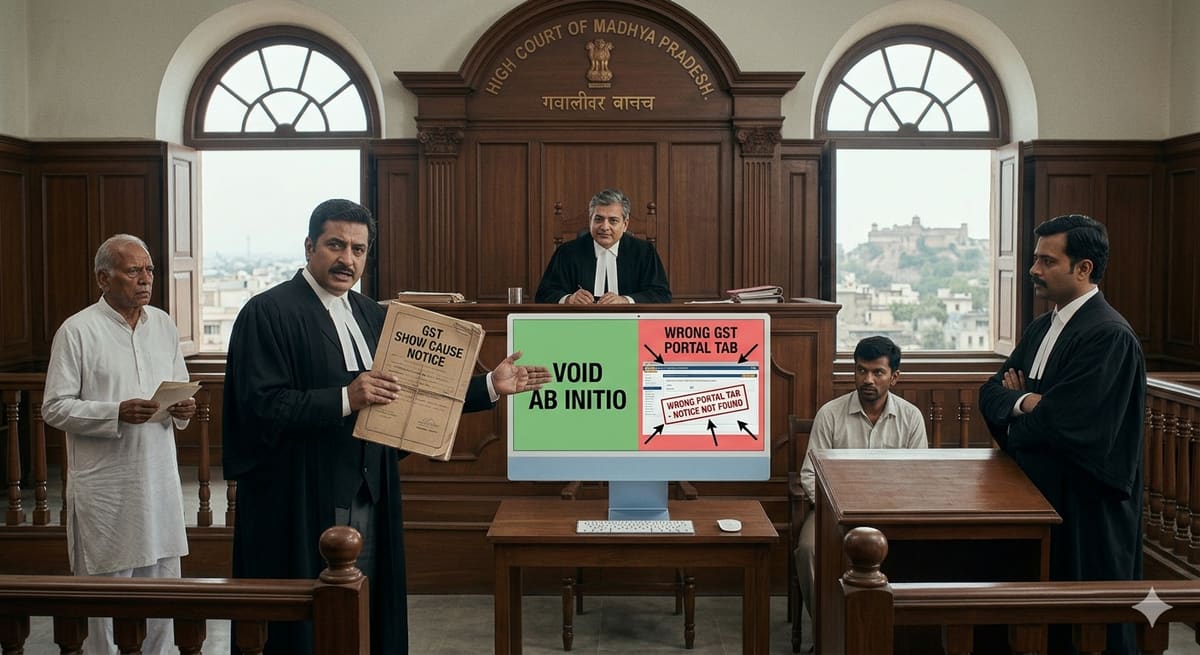
The petitioners contended that no show cause notice was ever issued to them in their individual capacity, rendering the penalty proceedings jurisdictionally defective. They argued that the Appellate Authority lacks the power to remand the matter for fresh consideration, making an appeal ineffective. Furthermore, they asserted that the notices for personal hearing were either not served or were addressed only to the Company, leading them to believe the proceedings concerned the Company alone.
For the Respondent/State
The respondents maintained that an alternative remedy of appeal under Section 107 of the CGST Act, 2017 was available and adequate. They submitted that the show cause notice dated 21.03.2025 named both petitioners as noticees in their individual capacity, and that the question of service and personal hearing was a factual issue to be determined by the Appellate Authority. They also argued that the power to decide an appeal on merits is distinct from the power to remand, and the absence of the latter does not deprive the Authority of jurisdiction to entertain the appeal.
The Court's Analysis
The Court began by noting the trite principle that the mere availability of an alternative remedy does not oust writ jurisdiction where there is a breach of natural justice or a want of jurisdiction, but such exception must be invoked sparingly. > "It is trite law that the mere availability of an alternative remedy does not oust the writ jurisdiction of this Court, particularly where there is a breach of natural justice or a want of jurisdiction."
Applying this to the facts, the Court observed that while the show cause notice named both petitioners as noticees, the dispute over whether the notice was actually served and whether the opportunity of personal hearing was afforded in substance were questions of fact. > "Insofar as the denial of personal hearing is concerned, and whether the opportunity of hearing was, in substance, denied to the Petitioners in their individual capacity, would require a close scrutiny of the hearing notices actually issued, the manner and mode of their service, and the timeline in which they came to be issued and received."
The Court held that such factual inquiries necessitate examination of the underlying notices and allied material, which is more appropriately undertaken by the Appellate Authority. > "In the opinion of this Court, the aforesaid, is essentially a question of fact, the determination of which would necessitate examination of the underlying notices and allied record, to be produced by the parties, and is not a matter that ought to be adjudicated for the first time in the exercise of writ jurisdiction."
Even if the grievance regarding personal hearing were accepted, the infirmity is curable and does not go to the root of jurisdiction, thus not warranting bypass of the statutory appellate remedy.
Regarding the contention that the Appellate Authority cannot remand the matter, the Court clarified that the power to decide an appeal on merits, upon a fresh and independent appreciation of the record, is distinct from the power to remand, and the want of the latter does not translate into an incapacity to exercise the former. Consequently, the petitioners must avail of the appeal remedy under Section 107 of the CGST Act, 2017.
The Verdict
The Court dismissed the writ petitions, upheld the penalty of Rs. 27,11,59,404 imposed under Section 122(1A) of the Central Goods and Services Tax Act, 2017, and held that the petitioners must avail of the statutory appeal under Section 107 of the Act, with liberty to seek exclusion of delay under Section 14 of the Limitation Act, 1963. No costs were awarded.
What This Means For Similar Cases
Factual Grievances Do Not Trigger Writ Jurisdiction
Where the challenge to an order is based on alleged defects in service of notices or denial of personal hearing, and such issues are capable of being resolved by the Appellate Authority, the High Court will not entertain a writ petition under Article 226. Practitioners must first raise these objections before the appellate forum.
Alternative Remedy Precludes Interference When Curable
The mere existence of an appeal remedy under Section 107 of the CGST Act, 2017 suffices to oust writ jurisdiction when the grievance is factual and not going to the root of jurisdiction. Lawyers should advise clients to exhaust the statutory appeal before approaching the High Court on such grounds.
Service and Hearing Issues Are for Appellate Authority
Questions concerning the actual service of a show cause notice, the manner of service, and the adequacy of personal hearing opportunities are factual in nature. The Appellate Authority is the appropriate forum to examine the record, hear the parties, and determine whether procedural irregularities exist, thereby ensuring a efficacious remedy without overburdening the writ jurisdiction.