A significant procedural safeguard has been affirmed by the Calcutta High Court for taxpayers caught off-guard by GST orders hidden on non-default portal tabs. In a ruling that balances administrative efficiency with substantive justice, the Court permitted an appeal despite a three-year delay, provided the taxpayer deposits 20% of the disputed tax. This decision reinforces the principle that technical defaults should not extinguish statutory remedies when the taxpayer’s lack of awareness is reasonably explained.
Background & Facts
The Dispute
The petitioner, Shanta Chandak, challenged an order dated 06.11.2023 issued by the Assistant Commissioner of State Tax, Siliguri, under Section 73 of the West Bengal Goods and Services Tax Act, 2017 (read with CGST Act, 2017), demanding tax for the period July 2017 to March 2018. The order resulted in the attachment of the petitioner’s bank account on 06.03.2026 under Form GST DRC-13.
Key Facts
- The petitioner is a regular business operator who files monthly GST returns and actively monitors the GST portal for compliance
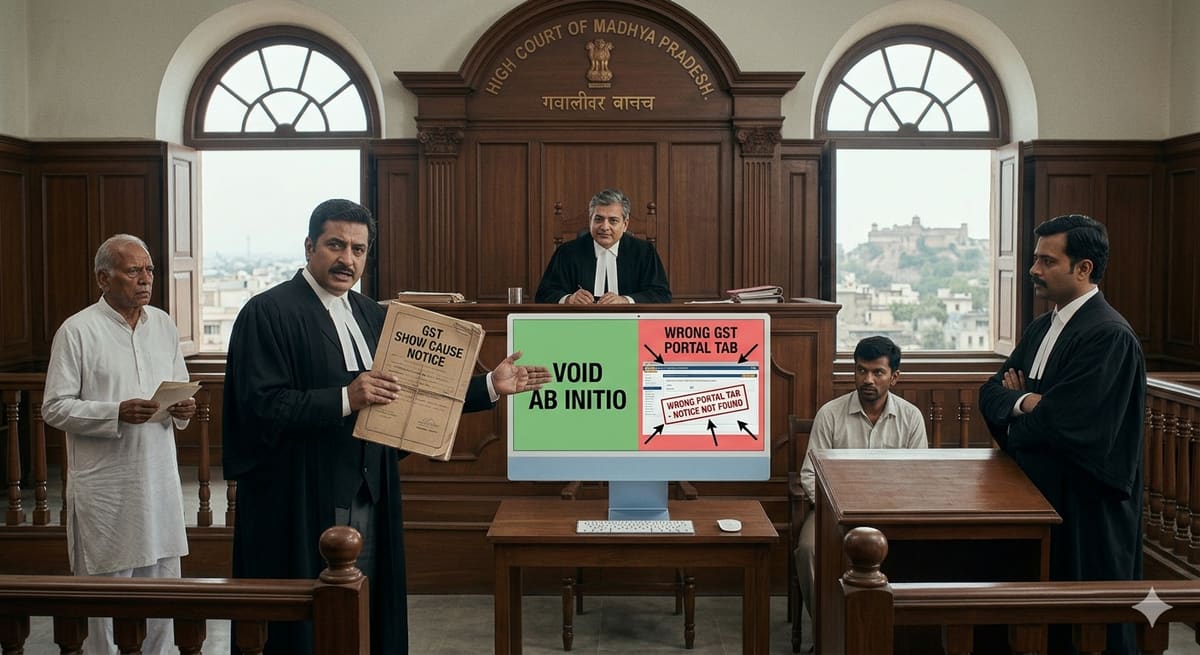
- The impugned order dated 06.11.2023 was uploaded on the portal under the tab ‘View Additional Notices and Orders’ - a section distinct from the default ‘View Notices and Orders’ tab
- The petitioner claims she never accessed the ‘Additional Notices’ tab and remained unaware of the order until her bank account was attached on 06.03.2026
- The respondents do not dispute that the portal has since been restructured to merge all notice tabs into a single ‘View Notices and Orders’ interface, making such orders more visible
- No evidence was presented that the petitioner received physical notice, email, or SMS intimation of the order
Procedural History
- 06.11.2023: Order under Section 73 issued by Assistant Commissioner of State Tax, Siliguri
- 06.03.2026: Bank account of petitioner attached via Form GST DRC-13
- 2026: Writ Petition (WPA 512 of 2026) filed before the Calcutta High Court, Circuit Bench at Jalpaiguri
- 08.04.2026: Hearing conducted before Justice Raja Basu Chowdhury
Relief Sought
The petitioner sought quashing of the order dated 06.11.2023 and the attachment order dated 06.03.2026, and requested an opportunity to file an appeal under Section 107 of the CGST/WBGST Act without being barred by limitation.
The Legal Issue
Can a taxpayer be denied the statutory right to appeal under Section 107 of the CGST Act merely because an adjudicatory order was published on a non-default tab of the GST portal, and the taxpayer remained unaware of it for over three years?
Arguments Presented
For the Petitioner
The petitioner’s counsel argued that the GST portal’s design - with separate tabs for ‘Additional Notices’ - created a procedural trap. The petitioner, a diligent filer of returns, had no reason to suspect that critical orders would be hidden in a non-standard tab. The attachment of bank accounts without prior notice violated principles of natural justice. Reliance was placed on the principle that statutory remedies must remain accessible, and technicalities should not defeat substantive rights.
For the Respondent
The State contended that the order was duly uploaded on the portal, and under Rule 142 of the CGST Rules, deemed service is complete upon portal publication. The petitioner’s failure to check all tabs constituted negligence. The delay of over three years in challenging the order was fatal to any claim of inadvertence.
The Court's Analysis
The Court acknowledged that while portal publication generally satisfies the requirement of notice under Rule 142, the structure of the portal at the relevant time created a genuine risk of non-accessibility for users who relied on the default ‘View Notices and Orders’ tab. The Court noted that the petitioner was not a defaulting taxpayer but a regular filer, and there was no evidence of deliberate avoidance.
"It is difficult to accept that the petitioner was unaware with regard to an order for three several years despite the order being on the portal though on a different tab. I, however, find that... now the order is being reflected under the view notices and orders tab under the portal."
The Court emphasized that Section 107 provides a multi-tiered adjudicatory mechanism designed to ensure fairness. Denying access to appeal on technical grounds, especially after asset attachment, would render the remedy illusory. The Court held that the petitioner’s explanation, while not fully convincing, was sufficient to warrant a procedural reset - not dismissal.
The Court balanced the State’s interest in revenue collection with the taxpayer’s right to be heard. It declined to quash the order but created a pathway for redressal by conditioning appeal rights on a modest deposit.
The Verdict
The writ petition was disposed of with directions. The petitioner is permitted to file an appeal under Section 107 of the CGST/WBGST Act if she deposits 20% of the disputed tax amount within four weeks from the date of judgment. Upon such deposit, the appellate authority shall admit the appeal without requiring any further pre-deposit and decide it on merits. The bank account attachment shall remain in abeyance pending the appeal.
What This Means For Similar Cases
Portal Design Cannot Override Statutory Rights
- Practitioners must now argue that if a tax authority publishes critical orders in non-default portal tabs, and the taxpayer is a regular user who relies on standard interfaces, the doctrine of deemed service under Rule 142 may not apply
- Courts may treat such cases as procedural anomalies, not deliberate non-compliance
Deposit as a Gateway, Not a Barrier
- A 20% deposit requirement is now a recognized procedural mechanism to preserve appeal rights despite delay
- This sets a precedent for other tax jurisdictions to adopt similar conditional relief - not outright dismissal
- The ruling implies that appellate authorities must now admit appeals filed under this condition without imposing additional pre-deposits
Natural Justice Trumps Technical Compliance
- The judgment reinforces that notice must be effective, not merely formal
- Tax authorities must consider portal usability and user behavior when relying on deemed service
- Future notices should be published in the primary tab or accompanied by SMS/email alerts to satisfy natural justice