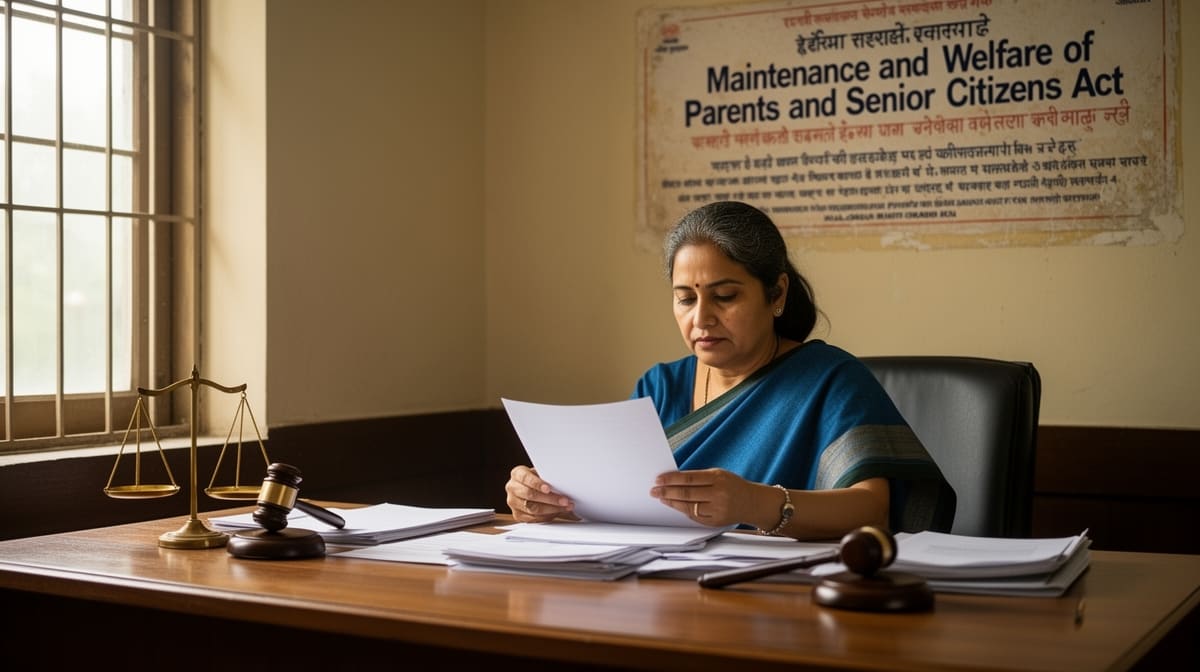
The Bombay High Court at Nagpur has clarified that the absence of an explicit prayer for maintenance in an application under the Senior Citizens Act, 2007 does not render the proceeding non-maintainable. This ruling reinforces the protective intent of the statute and curbs procedural technicalities that could deprive elderly persons of their statutory rights.
Background & Facts
The Dispute
The petitioner, Smt. Radhabai Madanlal Mandhane, filed an application before the Sub-Divisional Officer and Maintenance Tribunal, Mehkar, under the Maintenance and Welfare of Parents and Senior Citizens Act, 2007 (Senior Citizens Act, 2007), seeking relief against her children for failure to provide maintenance. The Tribunal passed an order on 29/04/2025 in Senior Citizen Case No.11/Lonar/2024-2025, granting maintenance. The respondents appealed this order before the District Collector, acting as Appellate Tribunal under Section 16 of the Act.
Key Facts
- The petitioner is a senior citizen, aged above 60 years, and a resident of Buldhana district, Maharashtra
- The application was filed under Section 5 of the Senior Citizens Act, 2007, seeking maintenance from her children
- The application did not contain a specific prayer for a monetary amount or fixed monthly maintenance
- The Sub-Divisional Officer, acting as Maintenance Tribunal, interpreted the application as seeking maintenance and passed an order accordingly on 29/04/2025
- The Appellate Authority, District Collector, Buldhana, set aside the Tribunal’s order on 16/02/2026 on two grounds: (i) absence of prayer for maintenance, and (ii) failure to bring legal representatives on record
- The petitioner challenged the appellate order via this writ petition filed on 05/03/2026
Procedural History
- 29/04/2025: Sub-Divisional Officer (Maintenance Tribunal) passed order granting maintenance in Senior Citizen Case No.11/Lonar/2024-2025
- 16/02/2026: District Collector, acting as Appellate Tribunal, quashed the Tribunal’s order and remanded the matter
- 05/03/2026: Writ Petition No.3868/2026 filed before the Bombay High Court, Nagpur Bench
- 08/05/2026: Judgment delivered by Justice Rohit W. Joshi
The Parties' Positions
Petitioner (Smt. Radhabai Madanlal Mandhane): Argued that the application, though lacking a formal prayer for a specific amount, clearly sought maintenance under the Act. The omission was procedural, not substantive, and did not defeat the jurisdiction of the Tribunal. The Act is remedial and should be interpreted liberally in favor of senior citizens.
Respondents (District Collector and others): Contended that the application was non-maintainable because it did not contain an explicit prayer for maintenance, and that legal representatives of the senior citizen should have been brought on record, despite the senior citizen being alive.
Relief Sought
The petitioner sought quashing of the Appellate Authority’s order dated 16/02/2026, restoration of the Tribunal’s order dated 29/04/2025, and direction to decide the matter on merits without procedural impediments.
The Legal Issue
The central question was whether an application under the Senior Citizens Act, 2007 is non-maintainable solely because it lacks an explicit prayer for maintenance, and whether the Appellate Authority was justified in remanding the matter on the ground that legal representatives were not brought on record when the senior citizen is alive.
Arguments Presented
For the Petitioner
The petitioner’s counsel, Mr. S.P. Bhandarkar, argued that the Senior Citizens Act, 2007 is a welfare statute designed to ensure dignity and subsistence for elderly persons. The absence of a formal prayer for a specific amount does not negate the substance of the claim, especially when the application clearly invokes Section 5 and alleges neglect by children. The Appellate Authority erred in treating a procedural infirmity as a jurisdictional defect. Furthermore, since the senior citizen is alive, the ground of non-joinder of legal representatives is legally untenable.
For the Respondent
The Additional Government Pleader, Mrs. Sneha Dhote, contended that the application was defective under the procedural rules governing maintenance proceedings. She relied on technical interpretations of pleadings, arguing that without a specific prayer, the Tribunal lacked the basis to determine quantum and thus could not grant relief. She also defended the remand on the ground of non-joinder of legal heirs, despite the senior citizen being alive.
The Court's Analysis
The Court undertook a purposive interpretation of the Senior Citizens Act, 2007, emphasizing its humanitarian and remedial character. Justice Rohit W. Joshi observed that the Act was enacted to provide a simple, speedy, and inexpensive remedy to senior citizens who are abandoned or neglected by their children. The Court held that requiring a formal prayer for maintenance in the application would defeat the very object of the statute, particularly given that many senior citizens are unrepresented and unaware of legal formalities.
"The requirement of a specific prayer for maintenance is not a statutory precondition under Section 5 of the Act. The application, when read as a whole, clearly seeks maintenance under the Act, and the Tribunal was duty-bound to determine the quantum based on evidence and circumstances."
The Court further rejected the second ground of remand - that legal representatives were not brought on record - as legally unsustainable. Since the senior citizen is alive and has filed the application herself, there is no legal basis to require joinder of legal heirs. The Appellate Authority’s reliance on this ground was not only erroneous but also contrary to the plain language of the Act.
The Court emphasized that the Appellate Authority, being a statutory tribunal, had the power and duty to decide the issue of maintainability on merits. Remanding the matter on such grounds was an abdication of judicial responsibility. The Court cited Jitendra Gorakh Megh v. Additional Collector and Bholenath Mevalal Nishad v. Shyamdulari Mevalal Nishad as binding precedents affirming that procedural defects should not override substantive rights under the Act.
The Verdict
The writ petition was allowed. The Court quashed and set aside the order dated 16/02/2026 passed by the District Collector, acting as Appellate Tribunal. The Appellate Authority is directed to decide the appeal on merits in accordance with law, taking into account the precedents in Jitendra Gorakh Megh v. Additional Collector and another and Bholenath Mevalal Nishad v. Shyamdulari Mevalal Nishad. All contentions are kept open. There shall be no order as to costs.
What This Means For Similar Cases
Maintenance Applications Need Not Contain Formal Prayer
- Practitioners may now file applications under the Senior Citizens Act, 2007 without a specific prayer for monetary relief - the substance of the claim suffices
- Tribunals must interpret applications liberally, especially when filed by elderly persons without legal representation
- Courts will not permit technical objections to defeat substantive rights under this welfare statute
Legal Representatives Are Not Required When Senior Citizen Is Alive
- The presence of a living senior citizen as applicant renders joinder of legal heirs irrelevant
- Appellate authorities must not use this ground to delay or dismiss proceedings
- Any order remanding on this basis is liable to be set aside as legally unsustainable
Procedural Remand Is Not a Substitute for Merits-Based Adjudication
- Appellate authorities must decide questions of maintainability themselves; remand is not a default remedy
- Tribunals under the Act are empowered to determine quantum of maintenance even if the application lacks precision
- This judgment reinforces the principle that procedural compliance must not override substantive justice in welfare legislation