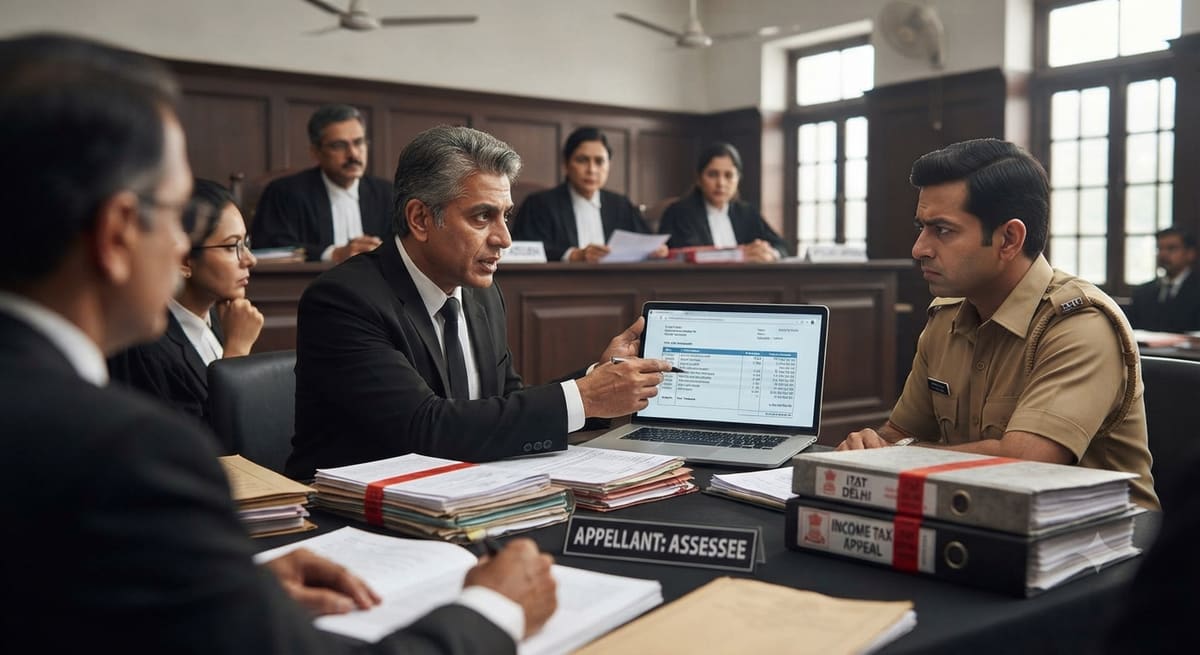
The Income Tax Appellate Tribunal (ITAT), Delhi, has reaffirmed that additions under Sections 68, 69A, and 69C of the Income Tax Act, 1961 cannot be sustained on mere presumptions or generalized statements about accommodation entries. The Tribunal emphasized the need for concrete evidence to establish unexplained money, expenditure, or ownership of assets, setting a critical precedent for tax assessments involving alleged shell entities.
Background & Facts
The Dispute
The case involves Jai Healthcare Pvt. Ltd. (the assessee), which was subjected to reassessment under Section 147 of the Income Tax Act, 1961, following a search conducted on 17.11.2021 under Section 132 of the Act. The search targeted the Galaxy Group, Shri Pradeep Indra Prasad Agrawalla, and entry providers Shri Deepak Agarwal and Shri Himanshu Verma. The Assessing Officer (AO) alleged that the assessee had obtained accommodation entries of Rs. 1,00,00,000 from entities controlled by these entry operators, namely M/s Arti Securities and Services Ltd and M/s Mysore Finlease Pvt. Ltd.
Key Facts
- The assessee filed its original return of income for Assessment Year (A.Y.) 2016-17 on 29.09.2015, declaring 'nil' income.
- A revised return was filed on 19.04.2017, also declaring 'nil' income.
- The case was reopened under Section 148 on 30.03.2023 based on information gathered during the search.
- The assessee filed a return in response to the notice under Section 148 on 04.05.2023, again declaring 'nil' income.
- Notices under Sections 143(2) and 142(1) were issued on 22.06.2023, 15.12.2023, and 26.02.2024.
- The AO assessed the assessee's income at Rs. 1,04,16,280 under Sections 143(3)/147, comprising:
- Rs. 1,00,00,000 as unexplained money under Section 68.
- Rs. 3,00,000 as presumptive commission under Section 69C.
- Rs. 1,16,284 as unexplained interest expenditure under Section 69C.
Procedural History
- 27.03.2024: Assessment order passed by the JCIT (OSD), Central Circle-27, New Delhi.
- 29.10.2025: Commissioner of Income Tax (Appeals) [CIT(A)] deleted the additions, holding that the AO failed to provide concrete evidence.
- ITA No. 1241/Del/2026: Revenue appealed against the CIT(A)'s order.
- CO No. 141/Del/2026: Assessee filed cross-objections supporting the CIT(A)'s order.
- 19.05.2026: Hearing conducted before ITAT Delhi.
- 29.06.2026: ITAT dismissed the Revenue's appeal and the assessee's cross-objections as infructuous.
Relief Sought
The Revenue sought to uphold the additions of Rs. 1,00,00,000 under Section 68, Rs. 3,00,000 as commission under Section 69C, and Rs. 1,16,284 as interest under Section 69C. The assessee, through its cross-objections, sought confirmation of the CIT(A)'s order deleting these additions.
The Legal Issue
The central question was whether additions under Sections 68, 69A, and 69C of the Income Tax Act can be sustained based on mere presumptions about accommodation entries, without concrete evidence establishing:
- The assessee's ownership of unexplained money under Section 69A.
- The actual incurrence of unexplained expenditure under Section 69C.
- The genuineness of transactions under Section 68.
Arguments Presented
For the Revenue
The Revenue contended that:
- Shri Himanshu Verma and Shri Deepak Agarwal are known entry operators, and their entities are mere conduits for non-genuine transactions.
- The entities' existence at stated addresses could not be verified, indicating their sham nature.
- The AO's additions were justified as the assessee failed to discharge the burden of proving the genuineness of the transactions.
- The CIT(A)'s order was perverse and unsustainable in law.
For the Assessee
The assessee argued that:
- The loans of Rs. 50,00,000 each from M/s Arti Securities and Services Ltd and M/s Mysore Finlease Pvt. Ltd were repaid entirely through banking channels, with full documentation.
- The AO ignored that the money was recorded in the books of account, and Section 69A targets only unrecorded or unexplained money.
- Legal precedents, such as Jagmag Builders and Habitat Infrastructure, affirm that once repayment and documentation are complete, such sums cannot be taxed as unexplained.
- The AO failed to provide evidence of a cheque-cash nexus or that the assessee possessed unexplained money.
- The presumptive commission addition of 3% was arbitrary, as no evidence of actual payment was found.
- The interest paid on the loans was allowable, as it was paid through banking channels and TDS was duly complied with.
The Court's Analysis
The ITAT meticulously examined the statutory requirements under Sections 68, 69A, and 69C and the evidentiary burden on the Revenue:
Section 69A: Unexplained Money
"The Section 69A requires that the assessee must be 'found to be the owner of' unexplained money, bullion, jewellery, or valuable article, and such ownership must be supported by facts and evidence. In the present case, the AO has not brought any concrete evidence on record to show that any unexplained cash accrued to the appellant as a result of repayments to the alleged shell companies. The formation of a mere presumption, unbacked by evidence, is not a valid basis for invoking Section 69A."
The Tribunal noted that the assessee had repaid the loans through banking channels, and the transactions were recorded in its books. The AO's reliance on the shell nature of the lenders did not override the evidence of identity, creditworthiness, and repayment. The Tribunal emphasized that Section 69A cannot be invoked without proof of ownership of unexplained assets.
Section 69C: Unexplained Expenditure
"It is established legal position that for invocation of section 69C, it is mandatory for the AO to have concrete evidence of actual expenditure incurred by the assessee. Mere modus operandi statements about general practices by entry operators do not suffice as direct proof of commission payment in the specific case at hand."
The Tribunal held that the AO failed to discharge the onus of proving that the assessee incurred unexplained expenditure. The addition of Rs. 3,00,000 as commission was based on a mere presumption, without any evidence of actual payment. The Tribunal relied on precedents stating that additions under Section 69C cannot be sustained based on unverified or generalized statements, especially without cross-examination or corroborative evidence.
Section 68: Cash Credits
The Tribunal observed that the AO did not question the receipt of loans but treated their repayment as bogus. However, the assessee had repaid the loans through banking channels, and the AO failed to establish a cheque-cash nexus. The Tribunal upheld the CIT(A)'s deletion of the addition under Section 68, as the AO did not provide concrete evidence to disprove the genuineness of the transactions.
The Verdict
The ITAT dismissed the Revenue's appeal and upheld the CIT(A)'s order deleting the additions. Specifically:
- The addition of Rs. 1,00,00,000 under Section 68/69A was deleted.
- The addition of Rs. 3,00,000 as commission under Section 69C was deleted.
- The addition of Rs. 1,16,284 as interest under Section 69C was deleted.
- The assessee's cross-objections were dismissed as infructuous.
What This Means For Similar Cases
Evidentiary Burden on Revenue Is Non-Negotiable
- The judgment reaffirms that the Revenue must provide concrete evidence to sustain additions under Sections 68, 69A, and 69C.
- Mere presumptions about accommodation entries or shell entities are insufficient.
- The AO must establish a direct nexus between the assessee and the alleged unexplained money or expenditure.
Recorded Transactions Trump Presumptions
- Assessees can rely on documented transactions (bank statements, ledgers, TDS compliance) to rebut allegations of unexplained money or expenditure.
- The Tribunal emphasized that Section 69A targets only unrecorded assets, and Section 69C requires proof of actual expenditure.
- Generalized statements about entry operators' modus operandi are inadequate without specific evidence linking the assessee to the alleged transactions.
Cross-Examination and Natural Justice
- The judgment underscores the importance of cross-examination and corroborative evidence in tax proceedings.
- Additions based on unverified statements or without affording the assessee an opportunity to rebut are unsustainable.
- Practitioners should challenge additions where the AO relies on mere presumptions without discharging the evidentiary burden.