
The Supreme Court has held that the embargo created by Section 98(2) of the Gujarat Prohibition Act is not absolute and that a seized conveyance may be released on interim custody under Section 451 of the Code of Criminal Procedure, provided the court is satisfied with appropriate security and other safeguards.
Background & Facts
The Dispute
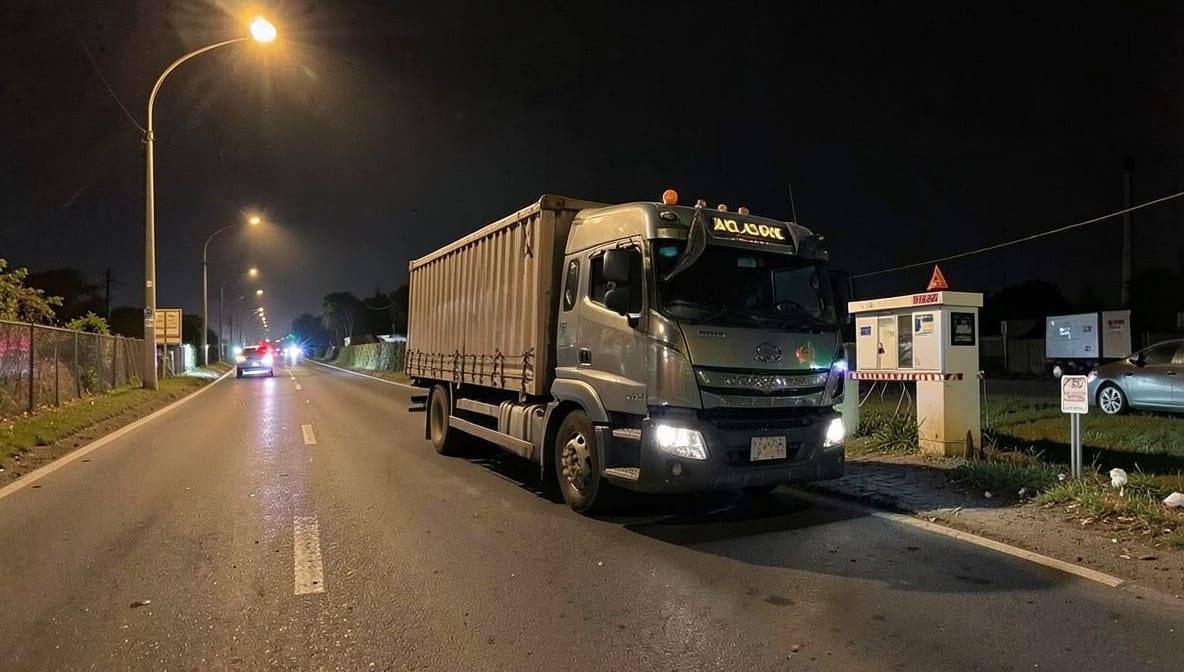
The appellant, M/S ABC EXPRESS, owned an Ashok Leyland truck (registration RJ-14-GQ-22692) that was intercepted on the night of 04-05 January 2025 while travelling from Modasa to Vadodara via Lunawada. The police alleged that the vehicle was transporting prohibited Indian-Made Foreign Liquor (IMFL) concealed as miscellaneous goods.
Key Facts
- 05.01.2025: FIR registered as CR No. 11187006250007/2025 at Police Station Lunawada, District Mahisagar.
- The driver, identified as Qasid Mohammad Khan, claimed the goods belonged to the appellant.
- Police seized the truck and discovered 8,064 bottles of IMFL (approximately 22,532.253 litres) valued at Rs 17,02,656, along with edible transport goods worth Rs 98,66,552.
- 01.03.2025: Charge-sheet filed charging four persons, including the driver, under Sections 65(a), 65(e), 98(2), 81, 116(b) and 83 of the Gujarat Prohibition Act.
- 22.05.2025: Muddamal Application No. 7 of 2025 filed before the Chief Judicial Magistrate, Lunawada, seeking interim custody of the vehicle under Section 497 of the Bharatiya Nagarik Suraksha Sanhita, 2023; application rejected.
- 07.08.2025: Sessions Judge, Mahisagar, affirmed the magistrate’s order in Criminal Revision No. 35/2025.
- 09.09.2025: High Court of Gujarat, Ahmedabad, dismissed the Special Criminal Application (Possession of Muddamal) No. 12264/2025 filed under Articles 226 and 227 of the Constitution.
- 02.09.2026: Supreme Court allowed the appeal (Criminal Appeal No. 4172 of 2026).
Procedural History
- 05.01.2025 - FIR registered (CR No. 11187006250007/2025).
- 01.03.2025 - Charge-sheet filed.
- 22.05.2025 - Muddamal Application rejected by Chief Judicial Magistrate.
- 07.08.2025 - Sessions Judge affirmed rejection.
- 09.09.2025 - High Court dismissed revision application.
- 02.09.2026 - Supreme Court delivered judgment.
The Parties' Positions
- Appellant argued that the truck is a business vehicle, the owner is not a participant in the offence, the trial will take several years, the vehicle is deteriorating in police custody, and that he is ready to furnish a bond of Rs 15,00,000.
- Respondent (State) contended that Section 98(2) of the Prohibition Act imposes an absolute embargo on releasing the conveyance when the seized liquor exceeds the prescribed quantity.
Relief Sought
The appellant sought interim custody of the seized truck pending trial, conditioned upon furnishing a personal bond and security.
The Legal Issue
The central question was whether Section 98(2) of the Gujarat Prohibition Act imposes an absolute bar on the release of a seized conveyance containing a large quantity of prohibited liquor, or whether a court may, under Section 451 of the Code of Criminal Procedure, order interim custody of the vehicle upon satisfaction of appropriate safeguards.
Arguments Presented
For the Appellant
- The appellant relied on Sunderbhai Ambalal Desai v. State of Gujarat and Khengarbhai Lakhabhai Dambhala to argue that the “but” clause in Section 98(2) is not an absolute embargo and must be read harmoniously with the provisions of the CrPC.
- Emphasised the owner’s right to avoid loss of livelihood and the risk of vehicle deterioration.
- Submitted that the amendment effective 31.07.2024 altered the statutory landscape, allowing discretion.
For the Respondent
- Cited the plain wording of Section 98(2) that the conveyance “shall not be released on bond or surety till the final judgment of the Court where the quantity of the seized liquor is exceeding the quantity as may be prescribed by the rules.”
- Asserted that allowing release would defeat the purpose of the prohibition regime and could facilitate concealment of evidence.
The Court's Analysis
The Court began by examining the textual structure of Section 98(2). It noted that the provision is split by the conjunctive “but”, creating two distinct parts. The first part deals with confiscation of receptacles and related conveyances; the second part, introduced by “but”, was interpreted by the Gujarat legislature as an embargo against release when the seized quantity exceeds the prescribed limit.
"When the conjunction ‘but’ is used in a provision, after the punctuation mark ‘comma’, it is deemed that such conjunction is used to carve out an exception or proviso to the main provision."
The Court held that the “but” clause, while indicating a restriction, is not an absolute bar because the statute also empowers courts under Section 451 CrPC to pass appropriate orders regarding the custody of seized property. Citing Basavva Kom Dyamangouda Patil (Smt.) v. State of Mysore and General Insurance Council v. State of Andhra Pradesh, the Court emphasized that the legislative intent behind Sections 451, 457, 458 and 459 CrPC is to prevent unnecessary detention of seized items and to balance the interests of the State with those of the owner.
The Court further observed that the amendment to Section 98(2) effective 31.07.2024 was “not very happily worded” and therefore required a harmonious construction with the CrPC provisions. It rejected the High Court’s narrow reading that the embargo was absolute, noting that such a view would lead to vehicles being kept in police stations for years, causing loss of livelihood and deterioration, contrary to the purpose of the law.
Relying on Khengarbhai Lakhabhai Dambhala and the earlier Sunderbhai Ambalal Desai decisions, the Court clarified that the proper forum for seeking interim custody is the criminal court under Section 451 CrPC, not a special constitutional application under Articles 226/227. The Court therefore concluded that the appellant was entitled to interim release of the vehicle upon furnishing a sufficient bond and complying with procedural safeguards.
The Verdict
The Supreme Court allowed the civil appeal, set aside the orders of the High Court, the Sessions Judge and the Chief Judicial Magistrate, and directed that the seized truck be placed under interim custody of the appellant subject to the following conditions: (i) the appellant shall furnish a personal bond and security of Rs 15,00,000; (ii) the truck shall be produced before the investigating officer or trial court when directed; (iii) the appellant shall not alienate or create any third-party interest in the vehicle during the trial; (iv) a detailed panchnama, photographs and videography of the vehicle shall be recorded in the presence of the appellant’s representative and two independent witnesses; (v) if the vehicle is ultimately confiscated, the trial court may forfeit the security and pass further orders, including auction; and (vi) the appellant shall comply with any additional conditions the trial court may impose.
What This Means For Similar Cases
Statutory Embargo Is Not Absolute
- Courts must interpret Section 98(2) in harmony with the CrPC, recognizing that the “but” clause does not create an unassailable bar.
- Owners can seek interim release even when large quantities of prohibited liquor are seized, provided they satisfy the court’s discretion.
Section 451 CrPC Powers Must Be Invoked Directly
- Applications for interim custody should be filed under Section 451 CrPC before the trial court, not through special constitutional applications.
- The court will assess factors such as the owner’s livelihood, risk of deterioration, length of trial, and security offered.
Security and Procedural Safeguards Are Key
- A substantial personal bond (e.g., Rs 15 lakhs) and detailed documentation of the seized item are now standard prerequisites.
- Failure to comply with the conditions may result in forfeiture of the bond and possible confiscation.
Take-away for practitioners:
- Draft interim-custody petitions under Section 451 CrPC, citing the harmonious construction approach.
- Emphasise the owner’s interest and propose a concrete security package.
- Request a panchnama, photographs and videography to preserve evidentiary value while protecting the owner’s property.





