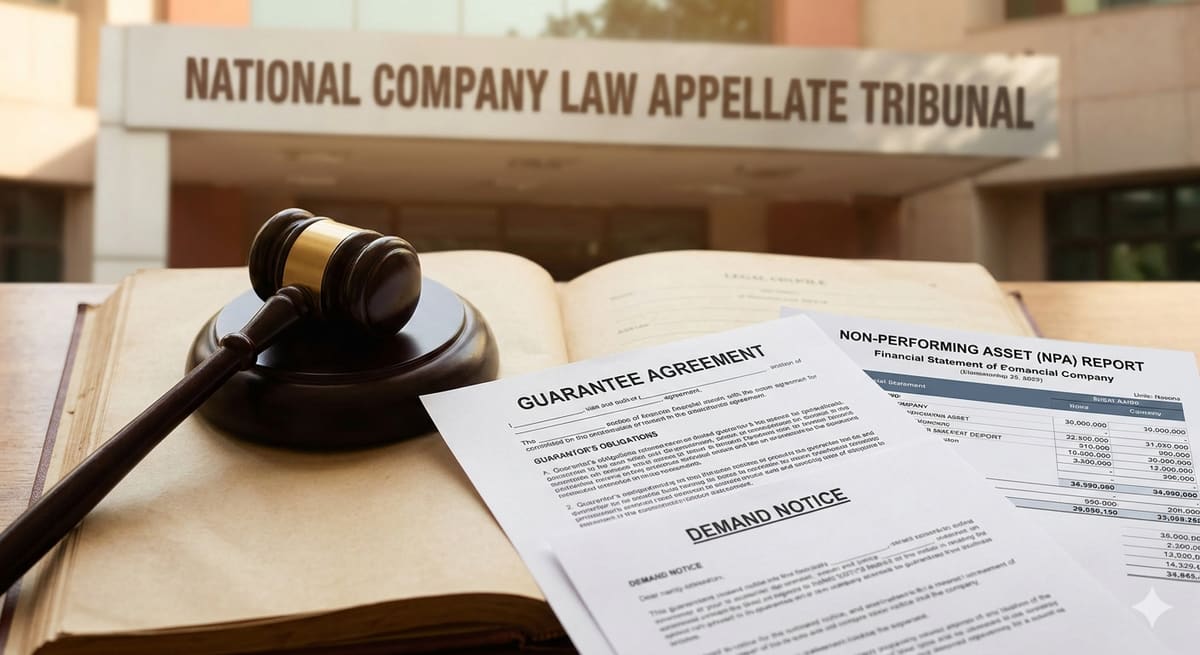
The National Company Law Appellate Tribunal has clarified that the limitation period for initiating insolvency proceedings against a personal guarantor under Section 95 of the Insolvency and Bankruptcy Code begins only upon a clear and unambiguous invocation of the guarantee, not from earlier communications expressing intent or default. This ruling provides critical doctrinal clarity for creditors and guarantors navigating the procedural thresholds of personal insolvency.
Background & Facts
The Dispute
The Appellant, Mr. M. Chandra Bushanaswamy Reddy, is a personal guarantor to M/s. Smaat India Pvt. Ltd. (Corporate Debtor), which availed a term loan of Rs. 6.39 crores from the National Bank of Agriculture and Rural Development (NABARD). The Appellant executed a Personal Guarantee Deed on 11.01.2013 to secure the loan, which was sanctioned under a Loan Agreement dated 26.12.2012. Although the Appellant resigned as a Non-Executive Director of the Corporate Debtor on 01.04.2013, his liability as a personal guarantor remained unaffected.
Key Facts
- Loan sanctioned: 26.12.2012
- Personal Guarantee Deed executed: 11.01.2013
- Appellant resigned as Director: 01.04.2013
- Corporate Debtor defaulted on repayment obligations
- Outstanding debt as of 04.08.2020: Rs. 5,57,47,862/-
- Principal outstanding as of 04.08.2020: Rs. 3,18,12,594/-
- Interest outstanding as of 04.08.2020: Rs. 2,39,35,268/-
Procedural History
- 29.01.2016: NABARD sent a letter (Ref. No. NB.KN./UPNRM-12-SMAAT/993/2015-16) to the Corporate Debtor’s Managing Director, referencing breach of loan terms and stating its right to recall the loan. A copy was sent to the Appellant via letter dated 27.01.2016 (Ref. No. 994).
- 30.11.2018: NABARD sent a letter (Ref. No. NB.KA/UPNRM-12-SMAAT-3232-2018-19) to the Appellant, stating that if the dues were not paid under the guarantee, legal action would be initiated.
- 03.08.2020: NABARD sent a formal letter (Ref. No. NB.KA(UPNRM-Smaat)-/715/2020-21) to the Appellant, explicitly invoking the guarantee dated 11.01.2013 and demanding payment of Rs. 3,18,12,594/- plus Rs. 2,39,35,268/- in interest.
- 09.02.2023: NABARD filed an application under Section 95 of the I & B Code before the Adjudicating Authority seeking initiation of insolvency resolution process against the Appellant as personal guarantor.
- 20.02.2025: Adjudicating Authority admitted the application.
- 256/2025: Appellant filed Company Appeal before NCLAT challenging the admission on grounds of limitation.
Relief Sought
The Appellant sought dismissal of the Section 95 application on the ground that it was barred by limitation, contending that the limitation period commenced either on 29.01.2016 or 30.11.2018, making the 09.02.2023 filing time-barred under Article 137 of the Limitation Act.
The Legal Issue
The central question was whether the limitation period for initiating insolvency proceedings against a personal guarantor under Section 95 of the Insolvency and Bankruptcy Code commences upon the first intimation of default or only upon a clear, unequivocal invocation of the personal guarantee.
Arguments Presented
For the Appellant
The Appellant’s Senior Advocate contended that the letters dated 29.01.2016 and 30.11.2018 constituted sufficient notice of default and intent to enforce the guarantee, thereby triggering the limitation period under Article 137 of the Limitation Act. He argued that since the Section 95 application was filed on 09.02.2023 - more than three years after both dates - the proceedings were time-barred. He relied on the principle that any communication indicating a creditor’s intention to enforce a guarantee must be treated as the starting point of limitation.
For the Respondent
NABARD’s Advocate countered that neither the 29.01.2016 nor the 30.11.2018 communications satisfied the statutory requirement under Section 95(4)(b) of the I & B Code, which mandates a formal demand notice prior to filing. The 29.01.2016 letter was addressed to the Corporate Debtor, not the guarantor, and merely expressed a right to recall. The 30.11.2018 letter was a warning of future action, not a demand. Only the 03.08.2020 letter constituted a valid invocation of the guarantee, making the 09.02.2023 filing well within the three-year limitation period.
The Court's Analysis
The NCLAT undertook a detailed textual and contextual analysis of the correspondence, emphasizing that Section 95(4)(b) requires a notice that clearly invokes the guarantee and demands payment. The Tribunal held that a mere expression of intent, a reference to default, or a threat of future legal action does not constitute a valid invocation.
"The communication dated 29.01.2016... may not be treated as to be a loan recall notice... it only expressed an intention for recall."
"The correspondence of 30.11.2018... was yet again neither a loan recall notice, nor it was a notice as contemplated under Section 95(4)(b)..."
The Tribunal distinguished between informational notices and enforceable demands. It noted that the 03.08.2020 letter contained explicit language: "We therefore, hereby invoke the aforesaid guarantee dated 11.01.2013... and call upon you to pay... immediately." This constituted a clear, unambiguous invocation under the guarantee deed and satisfied the statutory precondition under Section 95(4)(b).
The Court further held that Article 137 of the Limitation Act, which prescribes a three-year period for suits where no specific period is provided, applies to Section 95 proceedings. The limitation period commenced only on 03.08.2020, the date of valid invocation, making the filing on 09.02.2023 well within time.
The Tribunal rejected the Appellant’s attempt to rely on earlier communications as triggering limitation, stating that such an interpretation would undermine the statutory requirement for a formal demand and create uncertainty for guarantors.
The Verdict
The Company Appeal was dismissed. The NCLAT held that the insolvency proceedings under Section 95 of the I & B Code were not barred by limitation. The invocation of the guarantee occurred on 03.08.2020, and the application filed on 09.02.2023 was within the three-year limitation period under Article 137 of the Limitation Act. All pending interlocutory applications were closed.
What This Means For Similar Cases
Invocation Must Be Explicit and Unambiguous
- Practitioners must ensure that notices under Section 95(4)(b) contain clear, direct language invoking the guarantee and demanding payment.
- Vague statements like "legal action will be taken" or "we reserve our rights" do not constitute valid invocation.
- Creditors should avoid relying on prior correspondence as triggering limitation unless it meets the statutory threshold.
Guarantors Cannot Rely on Pre-Invocation Notices to Claim Limitation
- Personal guarantors cannot argue that limitation commenced upon receipt of default notices or warnings.
- The burden is on the creditor to prove a formal invocation; mere knowledge of default is insufficient.
- Courts will examine the substance, not the form, of the communication to determine if it constitutes a demand.
Timing of Filing Under Section 95 Is Critical
- The three-year limitation period begins only from the date of valid invocation, not from the date of default or first notice.
- Creditors should maintain a clear audit trail of invocation notices to avoid challenges on limitation.
- Guarantors must respond promptly to formal invocation letters, as delay may be construed as acquiescence.