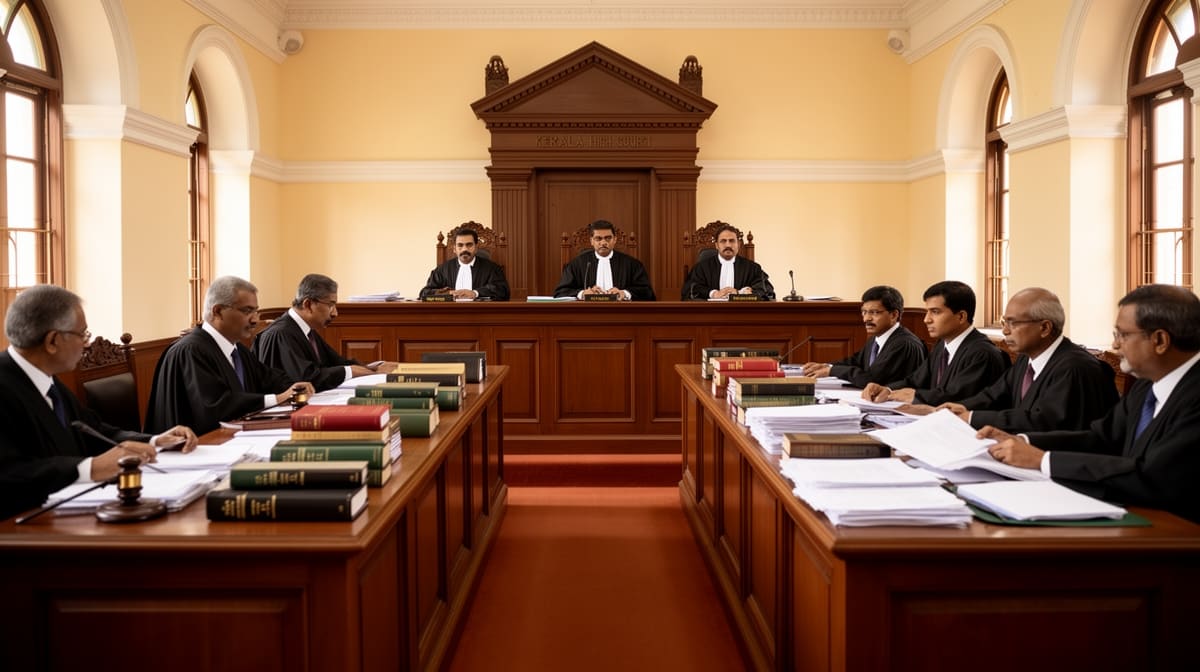
The Kerala High Court has clarified that petitions under Article 227 of the Constitution cannot be used to challenge interlocutory orders of the Waqf Tribunal when a statutory appellate remedy is available under the Waqf Act, 1995, as amended in 2025. This ruling reinforces the principle that special tribunals with exclusive jurisdiction must be exhausted before invoking supervisory jurisdiction.
Background & Facts
The Dispute
The petitioner, Jamal Mohammed @ Manu, is a party to two proceedings before the Waqf Tribunal, Kozhikode: W.O.A. No. 173 of 2025 and O.S. No. 36 of 2025. The petitioner sought to reopen evidence in W.O.A. No. 173 of 2025 and to consolidate it with O.S. No. 36 of 2025, arguing that both matters involved overlapping claims over waqf property. The Tribunal dismissed both applications by orders dated 10.04.2026, holding that joinder of the two proceedings was not permissible under the Waqf Act.
Key Facts
- The petitioner filed I.A. No. 3 of 2026 and I.A. No. 4 of 2026 in W.O.A. No. 173 of 2025 on 04.04.2026 seeking reopening of evidence and joint trial.
- The Waqf Tribunal dismissed both applications by orders dated 10.04.2026 (Exts. P9 and P10).
- The petitioner filed this original petition under Article 227 on 08.06.2026, challenging the Tribunal’s orders.
- The petitioner’s claims relate to rights over waqf property, including possession, management, and income application.
- The dispute originated from prior orders: Ext. P1 (EC No. 12/2014 dated 30.03.2021), Ext. P2 (W.O.A. No. 8/2021 dated 24.09.2022), and Ext. P3 (C.R.P. (Waqf) 42/2022 dated 30.01.2025).
- O.S. No. 36 of 2025 was filed on 20.06.2025; W.O.A. No. 173 of 2025 was filed on 31.07.2025.
Procedural History
- 30.03.2021: Order issued in EC No. 12/2014 (Ext. P1)
- 24.09.2022: Order in W.O.A. No. 8/2021 (Ext. P2)
- 30.01.2025: Order in C.R.P. (Waqf) 42/2022 (Ext. P3)
- 20.06.2025: O.S. No. 36 of 2025 filed before Waqf Tribunal
- 31.07.2025: W.O.A. No. 173 of 2025 filed before Waqf Tribunal
- 04.04.2026: I.A. No. 3 and I.A. No. 4 filed seeking evidence reopening and joint trial
- 10.04.2026: Tribunal dismissed both applications (Exts. P9 and P10)
- 08.06.2026: Original Petition filed under Article 227 before Kerala High Court
Relief Sought
The petitioner sought quashing of the Tribunal’s orders dated 10.04.2026 and directions to allow reopening of evidence and joint trial of the two proceedings.
The Legal Issue
The central question was whether a petitioner aggrieved by an interlocutory order of the Waqf Tribunal may bypass the statutory appellate remedy under Section 83(9) of the Waqf Act, 1995, as amended in 2025, and directly invoke the supervisory jurisdiction of the High Court under Article 227 of the Constitution.
Arguments Presented
For the Petitioner
The petitioner’s counsel argued that the Tribunal’s refusal to allow joint trial and reopening of evidence amounted to a denial of natural justice and procedural fairness. They contended that Article 227 jurisdiction is inherent and cannot be ousted by statutory provisions, especially where the Tribunal’s order was allegedly arbitrary and caused irreparable prejudice.
For the Respondent
The Standing Counsel for the Kerala State Waqf Board submitted that the Waqf (Amendment) Act, 2025, explicitly introduced a statutory right of appeal to the High Court under Section 83(9) for any person aggrieved by a Tribunal order, including interlocutory ones. The amendment replaced the prior bar on appeals with a 90-day appellate window, making the appellate route the exclusive remedy. Invoking Article 227 in such circumstances, they argued, would undermine the legislative intent to create a specialized, self-contained adjudicatory framework for waqf disputes.
The Court's Analysis
The Court undertook a detailed examination of the legislative changes introduced by the Waqf (Amendment) Act, 2025, particularly to Section 83(9) of the Waqf Act, 1995. Prior to the amendment, Section 83(9) barred all appeals against Tribunal orders, but permitted the High Court to call for records under its supervisory powers. The 2025 amendment replaced this with a clear appellate mechanism: "any person aggrieved by the order of the Tribunal may appeal to the High Court within a period of ninety days from the date of receipt of the order."
The Court emphasized that the amendment was not merely procedural but substantive, reflecting Parliament’s intent to establish a comprehensive, exclusive appellate structure for waqf disputes. The Court observed:
"The substitution of sub-section (9) of Section 83 by the Waqf (Amendment) Act, 2025, was a deliberate legislative choice to provide a statutory remedy against all Tribunal orders, including interlocutory ones, thereby excluding the need for resort to Article 227."
The Court further held that Article 227 cannot be used as a substitute for a statutory appeal, especially when the legislature has created a specific, time-bound remedy. The principle that "where a special remedy is provided, it must be exhausted" was applied strictly. The Court noted that even if the Tribunal’s order was erroneous, the petitioner’s recourse lay in filing an appeal within 90 days, not in filing a writ petition.
The Court also rejected the argument that the Tribunal’s refusal to allow joint trial or reopen evidence amounted to a jurisdictional error warranting Article 227 intervention. It held that such decisions are within the Tribunal’s discretionary authority under the Act and do not constitute a patent illegality or violation of fundamental principles of justice.
The Verdict
The petition was dismissed. The Court held that the petitioner’s remedy lies in filing an appeal under Section 83(9) of the Waqf Act, 1995, as amended by the Waqf (Amendment) Act, 2025, within 90 days of the order dated 10.04.2026. The dismissal is without prejudice to the petitioner’s right to file such an appeal. No costs were awarded.
What This Means For Similar Cases
Appellate Remedy Is Exclusive for Waqf Tribunal Orders
- Practitioners must file appeals under Section 83(9) within 90 days of any Tribunal order - including interim or procedural ones - and cannot circumvent this by filing Article 227 petitions.
- Any attempt to challenge procedural rulings (e.g., refusal to reopen evidence, reject joinder) via writ jurisdiction will be dismissed on grounds of maintainability.
Legislative Intent Overrides Judicial Supervision
- Courts will not entertain Article 227 petitions where a specific appellate mechanism exists, even if the order appears erroneous.
- The 2025 amendment to the Waqf Act establishes a closed-loop system: Tribunal → Appeal to High Court → No further writs.
Strategic Implications for Waqf Litigation
- File appeals promptly: The 90-day window is now the only avenue for challenging Tribunal decisions.
- Do not delay: Missing the appeal deadline forfeits all remedies.
- Avoid filing parallel writ petitions: They will be dismissed, wasting time and costs.