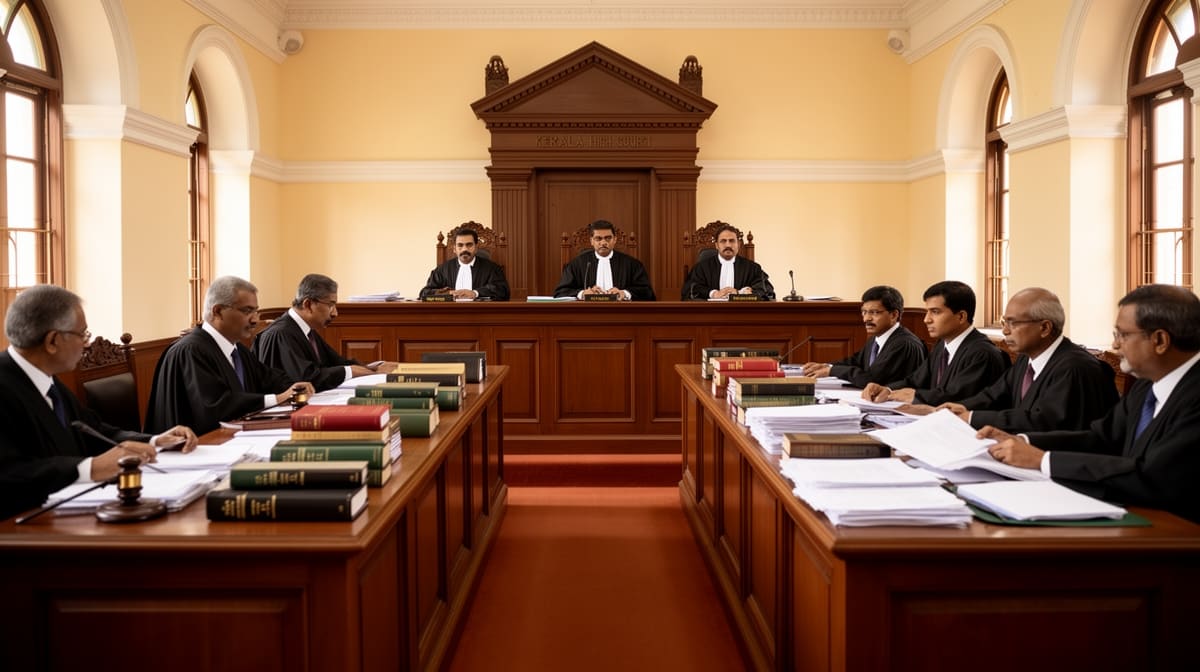
The Kerala High Court has clarified that invoking supervisory jurisdiction under Article 227 of the Constitution is impermissible when a specific statutory appeal mechanism exists to challenge orders of the Waqf Tribunal. This ruling reinforces the principle that extraordinary remedies must yield to adequate statutory alternatives, setting a critical precedent for practitioners navigating tribunal disputes.
Background & Facts
The Dispute
The petitioner, Karadan Kunhimoiden, was the third defendant in W.O.S. No. 7 of 2022 before the Waqf Tribunal, Kozhikode. The dispute arose from a civil suit concerning ownership and management rights over a waqf property. The petitioner filed an interlocutory application (I.A. No. 3 of 2025) seeking certain reliefs, which the Tribunal rejected by its order dated 15.12.2025 (Ext.P10). Aggrieved by this order, the petitioner directly approached the High Court through an original petition under Article 227.
Procedural History
- 2019: Original suit (O.S. No. 502/2019) filed before the Waqf Tribunal
- 2022: Suit renumbered as W.O.S. No. 7 of 2022
- 2025: Petitioner filed I.A. No. 3 of 2025 seeking interim relief
- 15.12.2025: Waqf Tribunal dismissed I.A. No. 3 of 2025 via Ext.P10 order
- 10.02.2026: Petitioner filed O.P.(Wakf) No. 2 of 2026 before the Kerala High Court under Article 227
Relief Sought
The petitioner sought quashing of Ext.P10 order dated 15.12.2025, alleging procedural irregularities and violation of natural justice. No prayer was made for interim relief or stay.
The Legal Issue
The central question was whether a petitioner aggrieved by an order of the Waqf Tribunal can bypass the statutory appellate remedy under Section 83(9) of the Waqf Act, as amended in 2025, and directly invoke the supervisory jurisdiction of the High Court under Article 227.
Arguments Presented
For the Petitioner
The petitioner contended that the Tribunal’s order was arbitrary and violated principles of natural justice. It was argued that Article 227 confers inherent supervisory power on the High Court to correct patent errors or jurisdictional overreach, irrespective of the existence of an alternative remedy. Reliance was placed on L. Chandra Kumar v. Union of India to assert that constitutional jurisdiction cannot be ousted by statutory provisions.
For the Respondent
The respondents argued that the Waqf (Amendment) Act, 2025, explicitly introduced a statutory right of appeal to the High Court under Section 83(9), which provides a comprehensive and adequate remedy. They contended that the petitioner’s attempt to circumvent this mechanism amounted to an abuse of process. The State Waqf Board emphasized that Parliament’s intent was to channel all appeals through the designated appellate route, thereby ensuring uniformity and expertise in waqf adjudication.
The Court's Analysis
The Court undertook a detailed examination of the legislative intent behind the Waqf (Amendment) Act, 2025, particularly the substitution of Section 83(9), which now provides a clear 90-day window for appeals against Tribunal orders. The Court held that the existence of a specific statutory remedy operates as a bar to the invocation of Article 227, unless the order is patently illegal or passed without jurisdiction.
"Where a statutory remedy is available and efficacious, the High Court will not entertain a petition under Article 227 merely because the petitioner is dissatisfied with the outcome."
The Court distinguished L. Chandra Kumar by noting that it dealt with the ouster of High Court jurisdiction over tribunals in the context of administrative law, not the exclusion of constitutional remedies where a statutory appeal is expressly provided. The Court emphasized that Article 227 is not a substitute for a statutory appeal and that the legislature’s creation of a dedicated appellate mechanism reflects a deliberate policy choice to ensure specialized adjudication.
The Court further observed that the petitioner had not demonstrated any jurisdictional error, mala fide intent, or violation of fundamental principles of law that would justify bypassing the statutory route. The mere fact that an order is contested does not convert it into a jurisdictional flaw warranting constitutional intervention.
The Verdict
The petition was dismissed. The Court held that the remedy under Section 83(9) of the Waqf Act, as amended in 2025, is adequate and efficacious, and therefore, an original petition under Article 227 is not maintainable. The petitioner is not barred from filing a regular MFA (Waqf) within the prescribed 90-day period.
What This Means For Similar Cases
Statutory Appeal Prevails Over Constitutional Writ
- Practitioners must first exhaust the statutory appeal under Section 83(9) before approaching the High Court under Article 227
- Filing a writ petition prematurely will result in dismissal without prejudice to the statutory remedy
- Courts will now routinely examine whether a statutory alternative exists before entertaining Article 227 petitions in tribunal matters
No Automatic Exception for Alleged Procedural Irregularities
- Allegations of procedural lapse or violation of natural justice do not automatically justify bypassing statutory appeal
- Only orders that are per se illegal, ultra vires, or passed without jurisdiction may warrant Article 227 intervention
- Petitioners must plead and prove jurisdictional error, not mere error of fact or law
Waqf Tribunal Orders Now Subject to Structured Appellate Review
- The Waqf (Amendment) Act, 2025, has effectively created a two-tier appellate structure: Tribunal → High Court (MFA)
- This enhances predictability and reduces forum shopping in waqf disputes
- Legal teams must now prioritize timely filing of MFA(Waqf) within 90 days, with strict attention to service and receipt dates