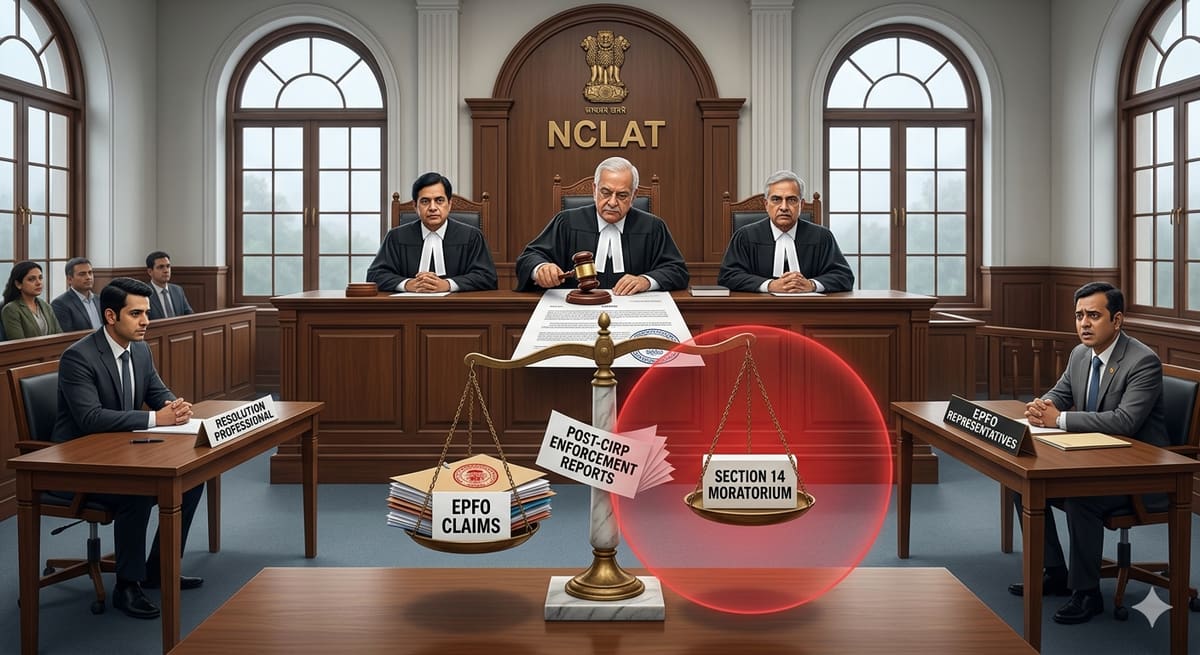
The Bombay High Court set aside an Employees' Provident Fund assessment order issued during the insolvency moratorium, clarifying that pre-resolution claims are extinguished under the amended Section 31(6) of the IBC.
Background & Facts
The Dispute
The petitioner, M/s Dolphin Offshore Enterprises (India) Limited, a corporate debtor, challenged an order dated 24 February 2023 passed by the Employees' Provident Fund Organization (Respondent No.2) under Section 7A of the Employees' Provident Fund & Miscellaneous Provisions Act, 1952. The order assessed PF dues of Rs.1,22,48,716 and directed payment within 15 days, invoking recovery, interest, damages and prosecution provisions.
Key Facts
- 22 October 2018: A creditor filed a petition under Section 9 IBC, initiating insolvency proceedings against Dolphin Offshore.
- 16 July 2020: The National Company Law Tribunal (NCLT) ordered the commencement of the Corporate Insolvency Resolution Process (CIRP) and appointed an Interim Resolution Professional (IRP).
- 22 July 2020: Public announcement inviting claims from all creditors.
- 7 May 2021: EPFO submitted a claim of Rs.2,24,98,772, which was verified and admitted by the IRP.
- 7 February 2022: Committee of Creditors approved the resolution plan submitted by M/s Deep Industries Limited.
- 29 September 2022: NCLT approved the resolution plan; management of Dolphin Offshore was transferred to the resolution applicant.
- 10 January 2023: The Resolution Professional informed EPFO that the claim had been settled for Rs.2,250 as per the resolution plan and the amount was paid.
- 24 February 2023: EPFO issued the impugned assessment order under Section 7A, demanding Rs.1,22,48,716.
- 8 October 2020, 19 October 2020, 4 December 2020, 27 April 2021: EPFO sought documents from the IRP despite the moratorium.
- 12 May 2021: Area Enforcement Officer filed deposition.
- 26 May 2026: The Insolvency and Bankruptcy Code (Amendment) Act, 2026 introduced Section 31(6) with retrospective effect.
- 24 July 2026: The petition was reserved.
- 1 September 2026: Judgment pronounced.
Procedural History
- 22 October 2018: Petition under Section 9 IBC filed, leading to CIRP initiation.
- 16 July 2020: CIRP commenced by NCLT order.
- 7 May 2021: EPFO claim admitted.
- 29 September 2022: Resolution plan approved by NCLT.
- 24 February 2023: EPFO assessment order issued under Section 7A.
- 2023: Writ Petition No. 6845 of 2023 filed under Article 227 of the Constitution challenging the EPFO order.
- 24 July 2026: Petition reserved.
- 1 September 2026: Judgment delivered.
Parties' Positions
- Petitioner (Dolphin Offshore Enterprises): Argues that the moratorium under Section 14 IBC barred continuation of the EPFO inquiry and that Section 31(6) extinguishes any pre-approval claim not incorporated in the resolution plan.
- Respondent No.2 (Employees' Provident Fund Organization): Contends that the claim of Rs.2,250 approved in the resolution plan is enforceable and that EPFO’s assessment of the larger amount is permissible under Sections 18 and 36 IBC, which exclude employee dues from the liquidation estate.
Relief Sought
The petitioner seeks quashing of the EPFO assessment order dated 24 February 2023, declaration that the claim is extinguished under Section 31(6) IBC, and a direction that no recovery proceedings be instituted against the corporate debtor.
The Legal Issue
Whether, after the imposition of the moratorium under Section 14 of the Insolvency and Bankruptcy Code, the Employees' Provident Fund Organization could continue its Section 7A inquiry and issue a recovery order, and whether the claim, not incorporated in the approved resolution plan, is extinguished by the amendment to Section 31(6) of the IBC.
Arguments Presented
For the Petitioner
- The moratorium under Section 14 IBC prohibits continuation of any proceeding that creates a new liability for the corporate debtor.
- Section 31(6) (introduced by the 2026 amendment) expressly extinguishes all claims existing prior to the approval of the resolution plan, unless the plan provides otherwise.
- Reliance on Ghanashyam Mishra & Sons Pvt. Ltd. v. Edelweiss Asset Reconstruction Co. Ltd. and the “clean-slate” principle that post-approval claims must be frozen.
- The EPFO’s assessment was made after the resolution plan was approved, rendering it non-est.
For the Respondent
- The claim of Rs.2,250 was approved in the resolution plan; therefore, EPFO is entitled to enforce that amount.
- Under Section 18 IBC, assets held by a third party in trust of the corporate debtor are excluded from liquidation, allowing EPFO to claim the dues.
- Section 36 IBC excludes employee dues from the liquidation estate, but does not bar assessment of statutory dues.
- Cites Employees’ Provident Fund Organization v. Jaykumar Pesumal Arlani (NCLAT) that EPFO may continue assessment after moratorium, provided it does not seek recovery.
The Court's Analysis
The Court first examined the statutory framework of the IBC. Section 14 imposes a moratorium that “freezes” all suits, proceedings or actions against the corporate debtor until the adjudicating authority either approves a resolution plan or orders liquidation. The Court noted that the EPFO’s summons dated 24 October 2019 and subsequent document requests (8 Oct 2020, 19 Oct 2020, 4 Dec 2020, 27 Apr 2021) were issued after the CIRP was initiated on 16 July 2020, thereby violating the moratorium.
"In view of the statutory freeze under Section 14 IBC, no assessment proceeding can be continued by the EPFO during the moratorium period."
The Court then turned to the amendment introduced by Section 31(6) of the IBC (effective 26 May 2026). The provision states that, unless the resolution plan provides otherwise, any claim existing prior to the date of approval is extinguished and no proceeding may be continued or instituted on its basis. The Court emphasized the retrospective effect of the amendment, citing the legislative intent to give effect to the “clean-slate” principle articulated in Ghanashyam Mishra.
The Court distinguished the respondent’s reliance on Employees’ Provident Fund Organization v. Jaykumar Pesumal Arlani, observing that the NCLAT decision dealt with assessment proceedings that did not culminate in a recovery action, whereas the impugned order expressly directed recovery, interest, damages and prosecution - actions prohibited by the moratorium.
Further, the Court rejected the argument that the claim of Rs.2,250 saved the EPFO’s right to assess the larger amount. It held that the resolution plan expressly limited the EPFO’s claim to Rs.2,250; any attempt to recover a higher sum amounts to a fresh claim, which is barred by Section 31(6).
The Court also addressed the respondent’s reliance on Sections 18 and 36 IBC, noting that those provisions exclude certain assets from the liquidation estate but do not override the moratorium or the extinguishment clause of Section 31(6). Consequently, the EPFO’s assessment order was unsustainable.
The Verdict
The petition succeeded. The Court quashed and set aside the EPFO assessment order dated 24 February 2023, holding that the inquiry continued during the moratorium was prohibited and that the claim of Rs.1,22,48,716 is extinguished under Section 31(6) of the IBC. Only the Rs.2,250 amount approved in the resolution plan remains payable. The rule is made absolute.
What This Means For Similar Cases
Moratorium Bars Statutory Assessments
Practitioners must ensure that any statutory authority seeking assessment of dues against a corporate debtor refrains from proceeding after the CIRP is initiated. The moratorium under Section 14 IBC is a blanket freeze that includes tax, customs and provident fund assessments that lead to recovery.
- File a stay application immediately after CIRP commencement.
- Challenge any post-moratorium notice as ultra vires.
Section 31(6) Extinguishes Pre-Resolution Claims
The amendment gives a retrospective shield to the corporate debtor. Claims not incorporated in the approved resolution plan are dead and cannot be revived, even if the authority later seeks a larger amount.
- Verify that all statutory dues are expressly included in the resolution plan.
- Advise creditors to lodge claims before the moratorium and ensure they are reflected in the plan.
Operational Debt Remains Outside the Resolution Plan
While employee dues may be excluded from the liquidation estate under Section 36 IBC, they cannot be pursued as recovery actions during moratorium. The distinction between assessment and recovery is critical.
- Structure employee-related claims as operational debt only if they are part of the plan.
- Avoid reliance on Sections 18 and 36 to bypass the moratorium.