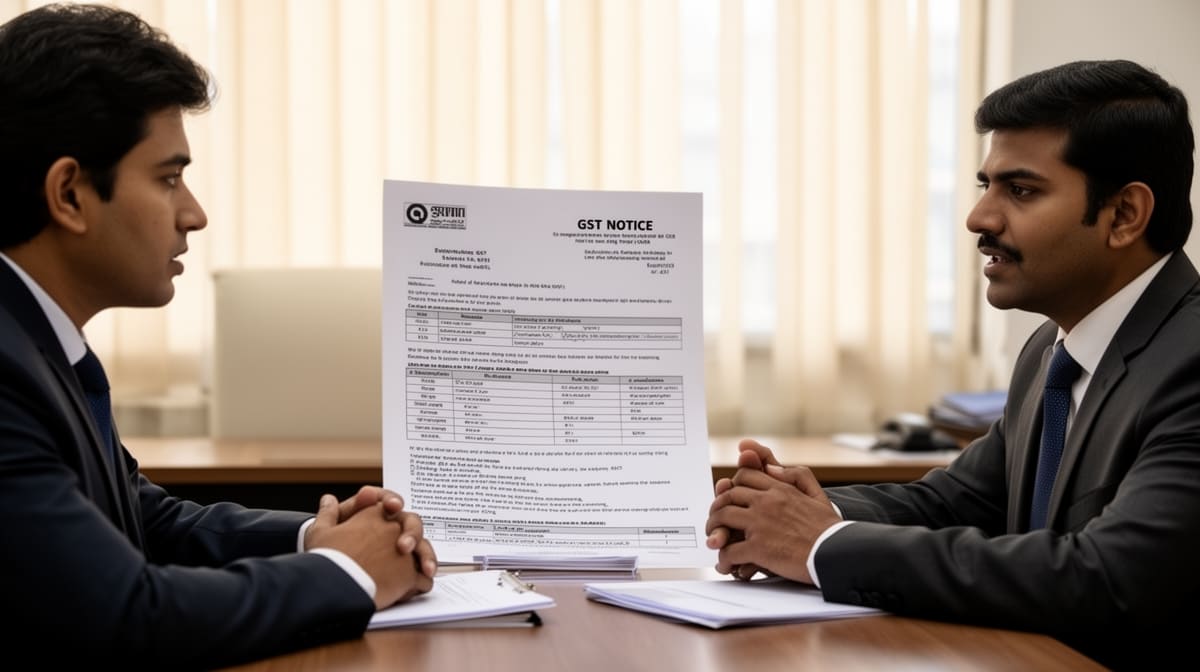
The Karnataka High Court has reaffirmed that procedural fairness under the CGST Act cannot be sacrificed merely because a taxpayer has not filed a reply to a show-cause notice. In a significant ruling, the Court set aside an adjudication order passed under Section 74, emphasizing that the right to be heard is inviolable even when the taxpayer remains silent.
Background & Facts
The Dispute
The petitioner, MICRO TECH CNC, a partnership firm engaged in manufacturing and selling CNC machinery, received a show-cause notice dated 15.09.2024 from the Respondent, the Assistant Commissioner of Commercial Taxes (Audit) - 6.7, DGSTO-6. The notice alleged irregularities in input tax credit availed during the financial year 2022-23, and proposed demand of Rs. 18,75,000 under Section 74 of the Central Goods and Services Tax Act, 2017, for alleged fraud or suppression of facts.
Key Facts
- The show-cause notice (SCN) was issued on 15.09.2024 under Section 74 of the CGST Act, 2017
- The petitioner did not file any written reply to the SCN within the stipulated 30-day period
- The petitioner requested a personal hearing on 20.10.2024, which was granted on 12.11.2024
- During the personal hearing on 12.11.2024, the petitioner orally submitted that the demand was erroneous and requested time to file a written reply
- The hearing officer recorded the oral submissions but did not grant additional time to file a written reply
- An adjudication order bearing No. ACCT(AUDIT)-6.7/S74/AO-04/2024-25 was passed on 31.12.2024 (Annexure-A), confirming the demand of Rs. 18,75,000 with interest and penalty
- Recovery proceedings under Section 79 were initiated on 05.01.2025 (Annexure-B)
Procedural History
- 15.09.2024: Show-cause notice issued under Section 74 CGST Act
- 20.10.2024: Petitioner requests personal hearing
- 12.11.2024: Personal hearing held; petitioner seeks time to file written reply
- 31.12.2024: Adjudication order passed under Section 74 (Annexure-A)
- 05.01.2025: Recovery proceedings initiated (Annexure-B)
- 20.02.2025: Writ Petition No. 8247 of 2026 filed before Karnataka High Court
- 27.03.2026: Hearing before Justice S. Sunil Dutt Yadav
Relief Sought
The petitioner sought quashing of the adjudication order dated 31.12.2024 and the recovery proceedings initiated on 05.01.2025, and prayed for remittal of the matter to the authority for fresh adjudication with full opportunity to file a reply.
The Legal Issue
The central question was whether Section 74 of the CGST Act, 2017 permits an adjudication order to be passed without affording the assessee a meaningful opportunity to file a written reply, even after a personal hearing has been granted.
Arguments Presented
For the Petitioner
Learned counsel for the petitioner argued that the right to be heard is a fundamental principle of natural justice under Article 14 of the Constitution. The petitioner had appeared for personal hearing and explicitly requested time to file a written reply, which was denied. The mere grant of a personal hearing does not substitute for the statutory right to submit a written reply. Reliance was placed on M/s. Mysore Cements Ltd. v. Union of India and State of U.P. v. Mohammad Noor, which hold that opportunity to be heard must be real and effective.
For the Respondent
The Additional Government Advocate contended that the petitioner had ample opportunity to respond to the SCN but chose not to file any reply. The personal hearing was conducted, and the petitioner’s oral submissions were recorded. The authority was entitled to proceed on the basis of available material. Reliance was placed on Commissioner of Central Excise v. M/s. S. R. Industries, where the Court held that failure to file a reply does not invalidate proceedings if the opportunity was given.
The Court's Analysis
The Court examined the procedural sequence and found that while the petitioner was granted a personal hearing, the opportunity to file a written reply was neither explicitly denied nor explicitly granted. The hearing officer recorded oral submissions but did not extend the time for filing a reply, effectively treating the hearing as the sole opportunity to respond.
"The right to be heard is not a hollow formality. It requires the opportunity to present one’s case in writing, especially in complex tax matters involving technical arguments on input credit eligibility and suppression of facts."
The Court distinguished S. R. Industries on the ground that in that case, the assessee had been given multiple opportunities to file replies, whereas here, the petitioner had only one chance - and that too, without clarity on whether a written reply would be accepted. The Court held that the failure to allow a written reply, after the petitioner had sought it, rendered the hearing incomplete and procedurally defective.
The Court further noted that Section 74, being a penal provision requiring proof of fraud or suppression, demands a higher standard of procedural fairness than Section 73. The absence of a written reply cannot be equated with waiver of rights, particularly when the taxpayer has actively participated in the hearing.
The Verdict
The petitioner succeeded. The Court set aside the adjudication order dated 31.12.2024 (Annexure-A) and the recovery proceedings initiated on 05.01.2025 (Annexure-B). The matter was remitted to the Respondent authority for fresh adjudication. The petitioner was directed to file a written reply to the show-cause notice by 27.04.2026. The authority was permitted, if satisfied on merits, to convert the proceedings to one under Section 73. All contentions on the merits were kept open.
What This Means For Similar Cases
Written Reply Is Not Optional Under Section 74
- Practitioners must now insist on written reply opportunities even after personal hearings
- Authorities cannot treat oral submissions as complete compliance with the right to be heard
- Failure to allow a written reply renders the order voidable, not merely irregular
Procedural Defects Cannot Be Waived by Silence
- Taxpayers who do not file replies are not automatically deemed to have waived their rights
- If a taxpayer requests time to file a reply, the authority must either grant it or record a reasoned refusal
- This applies equally to Section 73 and Section 74 proceedings
Strategic Implication for Tax Litigation
- Always file a written reply even if a hearing is granted
- If denied a written reply, immediately raise the issue in writing during the hearing and seek recording of the denial
- In writ petitions, focus on the procedural defect - not the merits - to secure remittal