The Bombay High Court has set aside orders passed by the Maharashtra Revenue Tribunal, Sub-Divisional Officer, and Tahsildar in a long-standing tenancy dispute under Section 70(b) of the Maharashtra Tenancy and Agricultural Lands Act, 1948. The Court directed a fresh inquiry into whether the predecessors of the respondents were lawfully cultivating the disputed land, emphasizing that mutation entry alterations alone cannot determine tenancy rights without proper evidence.
Background & Facts
The Dispute
The petitioner, Smt. Hausabai Shripat Patil, an 82-year-old agriculturist, challenged the tenancy claims of the respondents, who are alleged legal heirs of Dunkar Vithu Patil (deceased). The dispute centers around Survey No. 106, Hissa No. 5B, admeasuring 1-32-50 HRP plus Potkharaba 0-08-0 HRP in village Davdi, Taluka Kalyan. The petitioner sought a negative declaration under Section 70(b) of the Maharashtra Tenancy Act that the respondents’ predecessors were not tenants of the land and their names should be deleted from the revenue records.
Key Facts
The petitioner’s husband, Shripat Harshu Patil, originally owned the land. Upon his death on 13.09.1972, the petitioner’s name was entered in the 7/12 extracts as the legal heir (Mutation Entry No. 411).
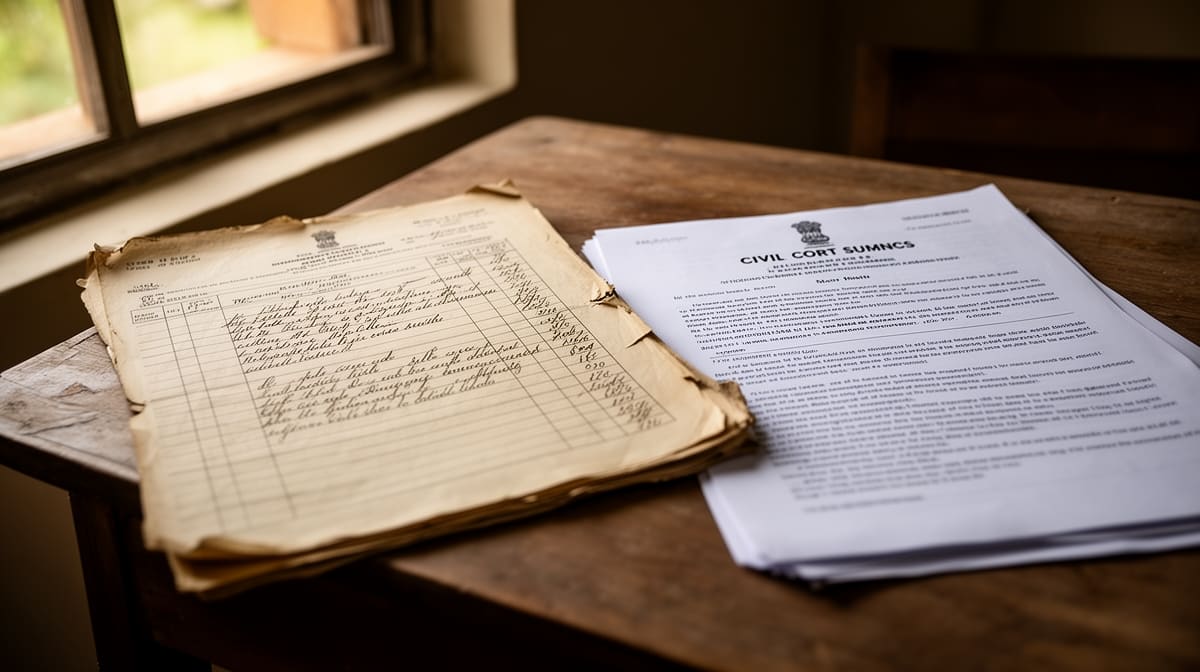
Mutation Entry No. 245 (dated 20.01.1955) recorded the names of Sudam Parshuram Patil and Dunkar Vithu as ordinary tenants. However, the entry shows interpolation: the name "Dunkar Dhondu" was bracketed and "Vithu" was inserted.
The crop cultivation column of the revenue records for 1955-1956 reflects the name of Dunkar Dhondu, not Dunkar Vithu. From 1956-1957 to 1980-1981, the column shows Sudam Parshuram Patil and Dunkar Dhondu as cultivators, and from 1981-1982 onwards, Dunkar Vithu is recorded, with the crop shown as grass.
The petitioner claimed that the land was not cultivated by the respondents’ predecessors and that the grass was naturally growing. No rent was paid, and the land was allegedly cultivated by the petitioner with the help of her nephew.
The respondents contended that Dunkar Dhondu and Dunkar Vithu are the same person, relying on documents from a Civil Suit No. 143 of 2019 (filed by a third party) to substantiate this claim.
Procedural History
14.01.2019: Tahsildar dismissed the petitioner’s application, noting discrepancies in Mutation Entry No. 245 and the lack of evidence to prove that Dunkar Dhondu and Dunkar Vithu are the same person.
20.11.2019: Sub-Divisional Officer dismissed the appeal, holding that the respondents failed to prove lawful cultivation or tenancy. The Officer also rejected the applicability of Section 32-F of the Tenancy Act (pertaining to widows) and noted the unexplained delay in instituting proceedings under Section 32-G (fixation of purchase price).
30.09.2022: Maharashtra Revenue Tribunal allowed the respondents’ revision applications, setting aside the orders of the Tahsildar and Sub-Divisional Officer. The Tribunal relied on additional documents (from Civil Suit No. 143 of 2019) to conclude that Dunkar Dhondu and Dunkar Vithu are the same person.
2022: The petitioner filed Writ Petition No. 13401 of 2022 challenging the Tribunal’s order.
Relief Sought
The petitioner sought:
Quashing of the Tribunal’s order dated 30.09.2022, the Sub-Divisional Officer’s order dated 20.11.2019, and the Tahsildar’s order dated 14.01.2019.
Restoration of the application under Section 70(b) for fresh inquiry into whether the respondents’ predecessors were lawfully cultivating the land.
The Legal Issue
The central question was whether the authorities erred in determining tenancy rights based solely on mutation entries and interpolation, without conducting a proper inquiry into:
Whether Dunkar Dhondu and Dunkar Vithu are the same person.
Whether the respondents’ predecessors were lawfully cultivating the land as required under Section 4 of the Tenancy Act.
Whether the Tribunal could permit additional evidence in revisional proceedings without remanding the matter for fresh inquiry.
Arguments Presented
For the Petitioner
The mutation entry (No. 245) shows interpolation, raising suspicion about the identity of Dunkar Vithu.
The crop cultivation column reflects grass, not active cultivation, and the petitioner claimed to remove and sell the grass herself.
The respondents failed to produce evidence before the Tahsildar or Sub-Divisional Officer to prove that Dunkar Dhondu and Dunkar Vithu are the same person.
The Tribunal exceeded its revisional powers by permitting additional evidence for the first time, which should have been remanded for fresh inquiry.
The petitioner relied on the Supreme Court’s decision in Panpoi Dharmal Sansthan Dhotaarkherda v. Bhagwant and Ors. (2000 (9) SCC 307), which held that Section 70(b) applications are not barred by limitation as unlawful possession constitutes a continuing wrong.
For the Respondents
Mutation Entry No. 245 reflects the names of their predecessors, and the interpolation does not negate their tenancy rights.
Dunkar Dhondu and Dunkar Vithu are the same person, as established by documents from Civil Suit No. 143 of 2019.
The revenue records from 1954-1955 to 1981-1988 show cultivation by Sudam Parshuram and Dunkar Dhondu/Vithu, supporting their claim.
The petitioner’s application under Section 70(b) was filed after 63 years, and the authorities rightly rejected it due to the long-standing entries in the revenue records.
The Court's Analysis
The Court examined the following key aspects:
Scope of Inquiry Under Section 70(b):The Court noted that Section 70(b) requires a determination of whether a person was a tenant, protected tenant, or permanent tenant at any time in the past. This necessitates proof of lawful cultivation under Section 4 of the Tenancy Act, which defines "cultivation" as tilling or husbanding land to raise agricultural produce. The authorities failed to inquire whether the land was being lawfully cultivated or merely had naturally growing grass.
Mutation Entry Alteration:The Court observed that the Mutation Entry No. 245 shows interpolation, with the name "Dunkar Dhondu" bracketed and "Vithu" inserted. While the respondents relied on this entry, the petitioner disputed the identity of Dunkar Vithu, arguing that the alteration raises suspicion. The Court held that the authorities erred by focusing solely on the mutation entry without conducting a proper inquiry into the identity of the tenant and lawful cultivation.
Additional Evidence in Revisional Proceedings:The respondents produced documents from Civil Suit No. 143 of 2019 for the first time before the Tribunal, to which the petitioner was not a party. The Court held that the Tribunal exceeded its revisional powers by permitting this additional evidence without remanding the matter for fresh inquiry. The appropriate course would have been to remand the application to the Tahsildar for a fresh determination after allowing both parties to adduce evidence.
Failure to Conduct Necessary Inquiry:The Tahsildar and Sub-Divisional Officer failed to determine whether the respondents’ predecessors were lawfully cultivating the land. Instead, they focused on the suspicious nature of the mutation entry. The Court emphasized that the inquiry should have addressed:
Whether Dunkar Dhondu and Dunkar Vithu are the same person.
Whether the land was being lawfully cultivated or merely had naturally growing grass.
The extent of the land cultivated by the respondents’ predecessors, as the revenue records show cultivation by both Sudam Parshuram and Dunkar Vithu/Dhondu.
Revenue Records and Tenancy Rights:The Court noted that the revenue records did not show exclusive cultivation by Dunkar Vithu, yet the Tribunal’s order declared the respondents as tenants of the entire land. This was held to be erroneous, as the records reflect cultivation by multiple parties, and the petitioner’s application sought deletion of the respondents’ names from the revenue records.
"The adjudication required to be carried out for purpose of Section 70(b) of Tenancy Act is whether a person is or was at any time in the past, a tenant or a protected tenant or a permanent tenant. For purpose of Section 4 of Tenancy Act, it must be shown that the person was lawfully cultivating the land belonging to the landlord. The inquiry to be conducted is as regards the person who was lawfully cultivating the land for the purpose of being considered a tenant and the extent of the land being cultivated as the crop cultivation columns shows cultivation by Sudam Patil and Dunkar Vithu/Dunkar Dhondu."
The Verdict
The Court allowed the writ petition and set aside:
The Tribunal’s order dated 30.09.2022.
The Sub-Divisional Officer’s order dated 20.11.2019.
The Tahsildar’s order dated 14.01.2019.
The Tenancy Application No. 20 of 2017 under Section 70(b) was restored to the file of the Tahsildar for fresh inquiry. The parties were permitted to place additional evidence on record, and the Tahsildar was directed to conduct the inquiry afresh, without being influenced by the earlier orders. The parties were directed to appear before the Tahsildar on 22.07.2026 at 11:00 AM.
What This Means For Similar Cases
Mutation Entries Alone Are Not Conclusive
Courts and revenue authorities cannot rely solely on mutation entries to determine tenancy rights, especially where alterations or interpolations exist.
A fresh inquiry is necessary to establish the identity of tenants and the nature of cultivation, particularly when entries are disputed.
Lawful Cultivation Must Be Proved
Section 4 of the Tenancy Act requires proof of lawful cultivation for a person to be considered a tenant. Mere entries in revenue records or naturally growing grass do not suffice.
Practitioners must adduce evidence (e.g., rent receipts, agreements, witness statements) to prove active cultivation and tenancy rights.
Revisional Powers Cannot Bypass Procedural Fairness
Tribunals exercising revisional powers cannot permit additional evidence for the first time without remanding the matter for fresh inquiry. This violates principles of natural justice and procedural fairness.
If additional evidence is essential, the matter must be remanded to the original authority for a fresh determination after allowing both parties to present their case.