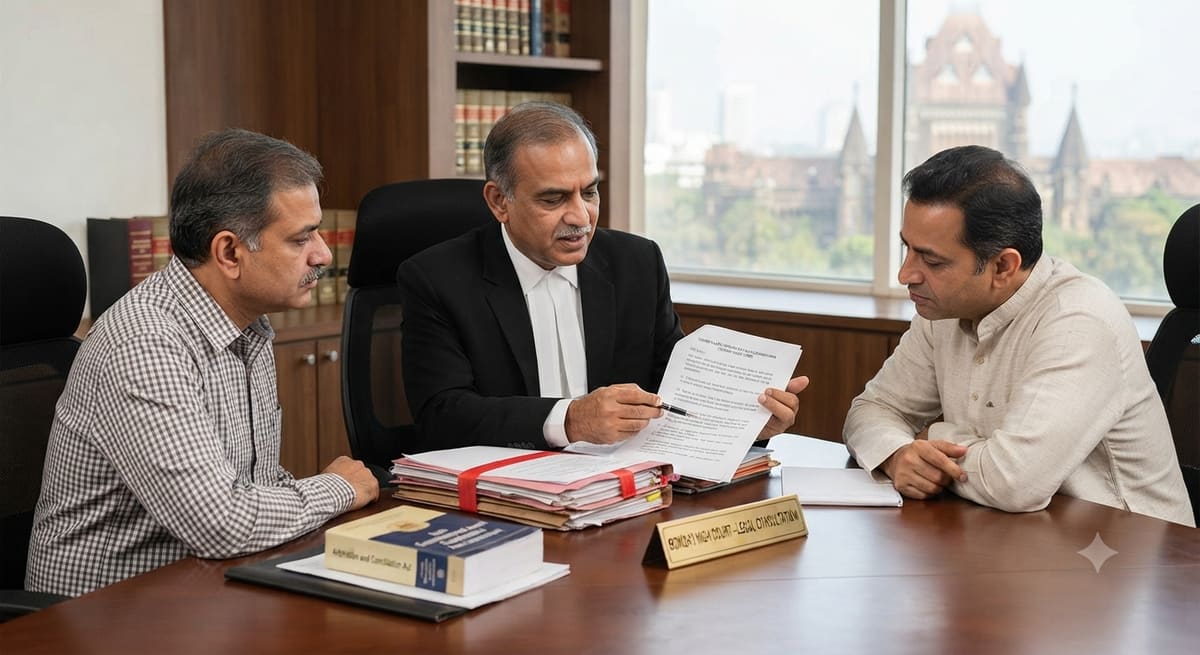
The Bombay High Court has delivered a definitive ruling that revenue authorities cannot unilaterally record a person as a tenant in land records without a prior adjudication of tenancy rights under the Bombay Tenancy and Agricultural Lands Act, 1948. This judgment reinforces the separation between fiscal record-keeping and substantive legal entitlements, setting a critical boundary for revenue officers across Maharashtra.
Background & Facts
The Dispute
The dispute centers on Mutation Entry No. 7391, which recorded respondent No.1 as a tenant on agricultural land in Maharashtra. The petitioners challenged this entry, arguing that tenancy rights cannot be created or recognized by mere revenue record entries. They contended that such rights must first be established through the statutory mechanism provided under the Bombay Tenancy and Agricultural Lands Act, 1948.
Procedural History
The matter progressed through multiple revenue forums:
- 2004: Petitioners filed Appeal No. 3 of 2004 before the appellate authority, which remanded the matter to the Tahsildar for reconsideration.
- After remand: The Tahsildar found respondent No.1 failed to prove tenancy under the Tenancy Act and declined to recognize him as a tenant.
- Sub Divisional Officer: Affirmed the Tahsildar’s finding, concluding no tenancy could be established.
- Commissioner (Revision): Reversed both findings, holding that long-term possession amounted to adverse possession, justifying the tenant entry.
Relief Sought
The petitioners sought quashing of Mutation Entry No. 7391 and a declaration that the revenue authorities lacked jurisdiction to record respondent No.1 as a tenant without a prior adjudication under the Tenancy Act.
The Legal Issue
The central question was whether revenue authorities under the Maharashtra Land Revenue Code, 1966 can record a person as a tenant in land records based solely on long possession, without a prior declaration of tenancy by the competent authority under the Bombay Tenancy and Agricultural Lands Act, 1948.
Arguments Presented
For the Petitioner
The petitioners relied on Section 70(b) and Section 85A of the Tenancy Act, arguing that only the designated tenancy authorities have exclusive jurisdiction to determine tenancy status. They emphasized that Section 85A mandates referral of any tenancy issue arising before any other forum - including revenue authorities - to the tenancy tribunal. They further contended that adverse possession, even if proven, does not equate to tenancy under the Act.
For the Respondent
The respondent, supported by the State, argued that long and uninterrupted possession over agricultural land justified recognition as a tenant in revenue records. The Commissioner’s view, adopted by the respondent, was that possession alone, especially when unchallenged for years, could be treated as sufficient basis for recording tenancy, irrespective of statutory procedures.
The Court's Analysis
The Court undertook a rigorous statutory interpretation of the Bombay Tenancy and Agricultural Lands Act, 1948, and the Maharashtra Land Revenue Code, 1966. It held that the Tenancy Act establishes a comprehensive, exclusive framework for determining tenancy rights. Section 70(b) vests exclusive power in tenancy authorities to declare tenancy, while Section 85A explicitly bars any other forum - including revenue officers - from deciding tenancy issues independently.
"The statute creates a clear and exclusive procedure for adjudication of tenancy claims. When the statute clearly entrusts this determination to a particular authority, the same issue cannot be decided by any other forum indirectly."
The Court rejected the Commissioner’s reasoning that adverse possession could substitute for statutory tenancy. It clarified that adverse possession confers ownership against the true owner, whereas tenancy is a contractual or statutory right to cultivate land under a landlord. The two are legally distinct. The Commissioner’s finding that respondent No.1 failed to prove tenancy rendered his subsequent reliance on adverse possession legally incoherent.
The Court further noted that revenue records serve fiscal purposes - collection of land revenue, assessment of dues - and are not instruments for creating or declaring substantive rights. Any entry inconsistent with statutory adjudication is ultra vires.
The Verdict
The petitioners won. The Court held that revenue authorities cannot record a person as a tenant without a prior declaration of tenancy by the competent authority under the Bombay Tenancy Act, 1948. The impugned mutation entry was quashed, and the Commissioner’s order was set aside.
What This Means For Similar Cases
Tenancy Declarations Are Exclusively Statutory
- Practitioners must ensure any claim of tenancy is first adjudicated under the Bombay Tenancy Act, 1948 before seeking mutation in revenue records.
- Revenue officers who record tenancy without such adjudication act beyond their jurisdiction and their orders are liable to be quashed.
Possession Alone Is Not Tenancy
- Long possession, even if unchallenged, cannot be treated as proof of tenancy under the Act.
- Claims based on adverse possession must be pursued separately under the Limitation Act and cannot be conflated with tenancy rights.
Section 85A Is a Jurisdictional Barrier
- Any civil court, tribunal, or revenue authority encountering a tenancy dispute must refer the matter to the tenancy tribunal.
- Failure to refer renders the proceeding void ab initio.
Documentary Evidence Prevails Over Oral Claims
- Oral assertions of tenancy without supporting documents or tribunal orders are insufficient for mutation.
- Revenue authorities must insist on certified orders from tenancy tribunals before effecting any change in tenant status.
Procedural Compliance Is Non-Negotiable
- Mutation entries under Section 149 of the Maharashtra Land Revenue Code are administrative, not adjudicatory.
- Any attempt to use mutation as a backdoor to establish substantive rights violates the principle of separation of powers under statutory law.