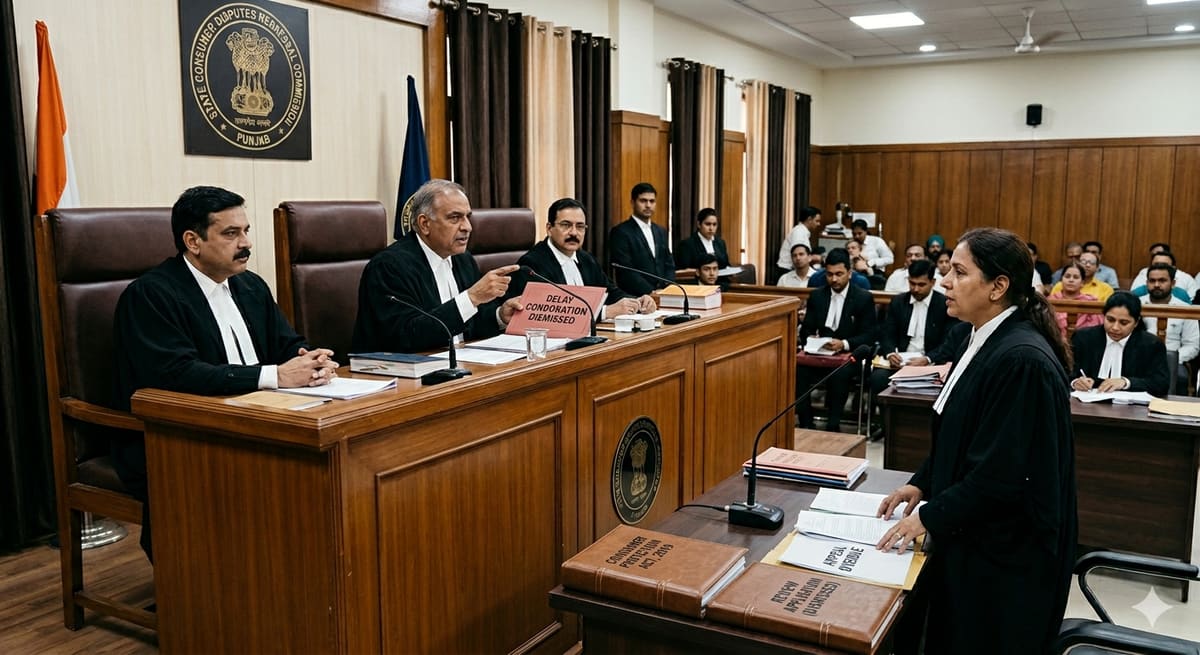
The Uttarakhand State Consumer Disputes Redressal Commission has reaffirmed that the two-year limitation period under the Consumer Protection Act, 2019 is strictly enforced, and mere delayed requests for revalidation of an expired financial instrument do not constitute a continuing cause of action. This ruling clarifies the boundaries of when a consumer’s inaction defeats their right to seek redressal.
Background & Facts
The Dispute
Smt. Kanti Dobhal filed a consumer complaint against the State Bank of India, alleging failure to revalidate a banker’s cheque issued on 11.03.2019 and transfer its proceeds to her savings account. She sent the cheque to the bank on 01.03.2023 - nearly four years after its issuance - for revalidation, claiming the bank’s inaction constituted a deficiency in service. She also submitted a delay condonation application citing the Covid-19 pandemic as the reason for not approaching the bank earlier.
Procedural History
- 11.03.2019: Banker’s cheque issued by State Bank of India
- 11.06.2019: Validity period of the cheque expired (three months from date of issue)
- 01.03.2023: Complainant sent cheque to bank for revalidation
- 02.06.2024: Complainant sent follow-up letter to bank, receiving no response
- 2024: Complaint filed before District Commission, Dehradun
- 02.04.2025: District Commission dismissed complaint as barred by limitation
- 10.03.2026: Revision petition heard ex-parte before State Commission
Relief Sought
The complainant sought direction to the bank to revalidate the cheque, credit the amount to her account, and pay compensation for mental agony and harassment.
The Legal Issue
The central question was whether the cause of action for a consumer complaint under Section 69 of the Consumer Protection Act, 2019 arises only upon the bank’s refusal to revalidate a cheque after its statutory validity period has expired, or whether the mere passage of time without action by the complainant extinguishes the right to seek redressal.
Arguments Presented
For the Petitioner
The petitioner’s counsel argued that the cause of action arose on 01.03.2023, when the bank refused to act on the revalidation request. He relied on Pushpa Jagannath Shetty & Ors. v. M/s Sahaj Ankur Realtors & Ors. to contend that limitation should not defeat substantive rights, and that efforts to secure remedy - even delayed - should be considered. He further asserted that the delay was due to the Covid-19 pandemic, which prevented physical visits to the bank.
For the Respondent
The bank did not appear, and no counter-arguments were formally presented. However, the Commission noted that the bank’s silence did not waive its right to rely on limitation, and that the complainant’s own conduct demonstrated negligence.
The Court's Analysis
The Commission examined the nature of a banker’s cheque under banking law and the statutory limitation regime under Section 69 of the Consumer Protection Act, 2019. It held that the validity of a banker’s cheque is strictly three months from the date of issue, as per Reserve Bank of India guidelines. The cheque expired on 11.06.2019, and any obligation to honor it ceased thereafter.
"It is settled proposition of law that merely by issuing legal notice, the limitation period cannot get extended."
The Commission cited State Bank of India v. M/s B.S. Agricultural Industries and Kandimalla Raghavaiah and Company v. National Insurance Company to affirm that limitation begins to run from the date the cause of action accrues - not from the date of a subsequent demand. The complainant’s failure to act between March 2019 and March 2023 was deemed inexcusable. The Covid-19 argument was rejected because the pandemic began in March 2020, nearly a year after the cheque expired, and the complainant offered no explanation for her inaction during the intervening period.
The Commission also relied on Punjab Small Industries and Export Corporation Ltd. v. Satinder Pal Singh, emphasizing that prolonged inaction followed by a legal notice cannot revive a time-barred claim. The complainant’s silence for four years constituted laches, and the doctrine of equitable relief could not override statutory limitation.
The Verdict
The revision petition was dismissed. The State Commission held that the two-year limitation period under Section 69 of the Consumer Protection Act, 2019 is mandatory, and that a consumer’s failure to act promptly after the expiry of a banker’s cheque extinguishes the cause of action. No condonation of delay was warranted.
What This Means For Similar Cases
Limitation Begins at Instrument Expiry, Not at Demand
- Practitioners must identify the precise date when the cause of action accrues - not when the consumer makes a demand
- In cases involving cheques, drafts, or demand instruments, the limitation clock starts at the instrument’s expiry date, not the date of a revalidation request
- Delayed complaints filed more than two years after instrument expiry will be dismissed unless a compelling, contemporaneous reason for delay is shown
Pandemic as a Justification Requires Precise Timeline
- Covid-19 cannot be invoked as a blanket excuse for delays occurring before or after the pandemic’s peak
- Affidavits must specify exact dates of inability to act and link them directly to lockdowns or health emergencies
- Generalized claims of "pandemic disruption" without temporal correlation will be rejected
Inaction Equals Laches in Consumer Forums
- Consumer forums will not reward negligence or passive behavior
- Complainants must demonstrate active, timely efforts to resolve disputes
- Silence for years followed by a legal notice does not constitute a continuing cause of action