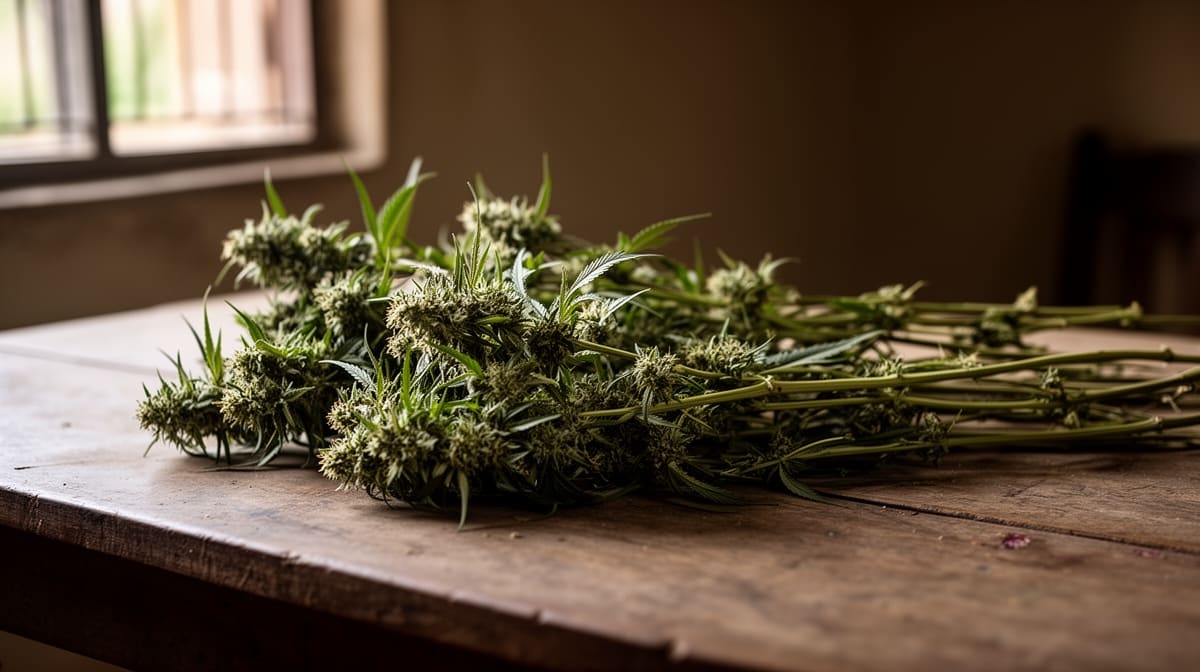
The Delhi High Court has granted regular bail to two accused in a case involving over 51 kilograms of ganja, holding that procedural irregularities in sampling under the NDPS Act and ambiguity in the statutory definition of ganja raise sufficient doubt to warrant release pending trial, even where commercial quantity is alleged.
Background & Facts
The Dispute
The petitioners, Manjay Kumar and Vikas Kumar, are accused in FIR No. 133/2025 registered at Police Station Civil Lines, District North, New Delhi, for offences under Sections 20 and 29 of the Narcotic Drugs and Psychotropic Substances Act, 1985. The prosecution alleges they were part of a large-scale ganja trafficking network involving multiple recoveries across Delhi and Odisha.
Key Facts
- The petitioners and co-accused Kushindra Kumar were apprehended on 04.03.2025 at 06:40 PM.
- Notices under Section 50 of the NDPS Act were served, but the petitioners refused personal search before a Gazetted Officer or Magistrate.
- Spot recovery on 04.03.2025: 677.9 grams of ganja from Manjay Kumar and 1,277.1 grams from Vikas Kumar.
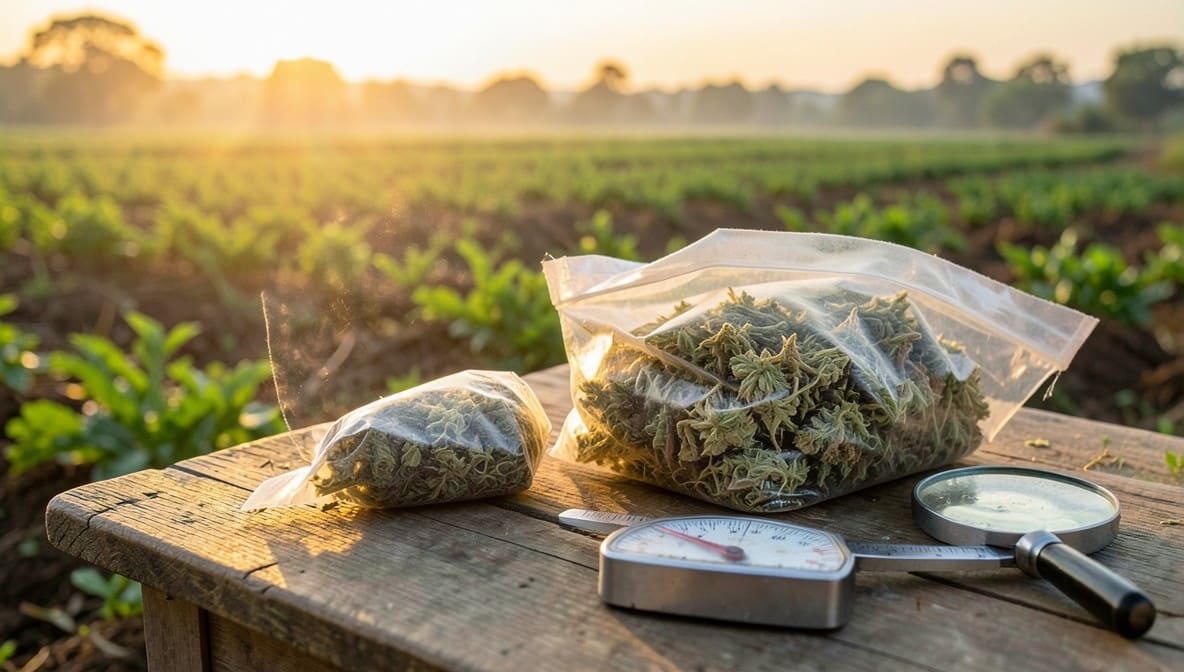
- A search of their rented house at House No. 62, Ground Floor, J-Block, Katra Khema No. 4, Andha Mughal, Kishanganj, Delhi, on 04.03.2025 yielded 12,882.8 grams of ganja in six packets.
- A raid at Mark Express Courier Company, Jhandewalan, Delhi, on 05.03.2025 recovered two parcels containing 18.700 kg and 18.450 kg of ganja respectively, labeled as "Khaki Gatta Petis".
- Total recovered contraband: 51.937 kilograms of ganja.
- The petitioners’ bank statements showed transfers of Rs. 1,00,000 each on 24.11.2024 and Rs. 1,00,000 from Vikas Kumar on 03.12.2024 to the account of Manoj Pradhan, a suspect in Odisha.
- Mobile Call Detail Records linked the petitioners’ phones to the recovery locations.
- Five Aadhaar cards were recovered, two in the name of Ankit Kumar Singh but bearing the photograph of Vikas Kumar.
- The owner of the rented house testified that the petitioners introduced themselves as "Ankit Kumar Singh" and "Deepak Kumar".
- The FSL report dated 13.02.2026 confirmed the presence of ganja in all samples.
- The chargesheet was filed on 18.08.2025; investigation into the source (Manoj Pradhan) remains ongoing.
- Manoj Pradhan is absconding; non-bailable warrants issued against him.
Procedural History
- 04.03.2025: Arrest of petitioners and co-accused; seizure of contraband.
- 05.03.2025: FIR No. 133/2025 registered.
- 18.03.2025: Sampling proceedings conducted before the Magistrate.
- 18.08.2025: Chargesheet filed before the Special Court.
- 05.03.2025: Petitioners arrested and remanded to judicial custody.
- 23.02.2026: Bail applications heard before the Delhi High Court.
- 19.03.2026: Judgment pronounced granting bail.
Relief Sought
The petitioners sought regular bail, arguing that the sampling procedure violated Section 52A of the NDPS Act and the Sampling Rules, 2022, and that the recovered substance did not meet the statutory definition of "ganja" under Section 2(iii)(b). They contended that these defects cast doubt on the applicability of Section 37 of the NDPS Act, which imposes stringent conditions for bail in commercial quantity cases.
The Legal Issue
The central question was whether procedural non-compliance with Section 52A of the NDPS Act and ambiguity regarding the statutory definition of "ganja" - particularly the exclusion of non-flowering plant parts from the weight calculation - raise sufficient doubt at the bail stage to warrant release despite the alleged commercial quantity of contraband.
Arguments Presented
For the Petitioner
Mr. Aditya Aggarwal argued that the sampling procedure violated Rule 10 of the Narcotic Drugs and Psychotropic Substances (Seizure, Storage, Sampling and Disposal) Rules, 2022, which requires one sample to be drawn from each individual packet. Instead, the prosecution drew collective samples of approximately 200 grams each from bundles of multiple packets (Marks D, P1, P2), without ensuring representative sampling from each. This, he submitted, rendered the FSL report unreliable and vitiated the chain of custody. He further contended that the FIR and seizure memos described the recovered substance as "dried branches, leaves, and grass-like materials" - not "flowering or fruiting tops" as required by Section 2(iii)(b) of the NDPS Act. Relying on Ravina Kumari v. State (NCT of Delhi), he argued that only the weight of flowering/fruiting tops counts toward commercial quantity, and since the entire seized material was weighed together, the actual quantity of ganja may fall below 20 kg, thereby excluding Section 37’s stringent bail conditions.
For the Respondent
Mr. Tarang Srivastava, Additional Public Prosecutor, submitted that the sampling procedure amounted to substantial compliance under Narcotics Control Bureau v. Kashif and Bharat Aambale v. State of Chhattisgarh, and that deviations do not automatically entitle an accused to bail. He emphasized that the FSL report confirmed the presence of ganja and that the description in the FIR was merely preliminary. He argued that the court should not interfere at the bail stage with evidentiary disputes that are matters for trial, and that the gravity of the offence and the scale of trafficking justified continued custody.
The Court's Analysis
The Court undertook a detailed analysis of both the sampling procedure and the statutory definition of ganja, applying recent Supreme Court precedents.
Regarding sampling, the Court noted that Rule 10(1) of the Sampling Rules mandates that one sample in duplicate be drawn from each package or container. The only exception under Rule 10(2) permits bundling of up to ten packets if they are identical in size, weight, marking, and yield identical results on a drug identification kit. The Court found that none of these conditions were met in the present case. The packets recovered from the flat and courier parcels varied in weight and were marked differently. Samples of 200 grams were drawn collectively from each bundle, while individual packet weights ranged from 512.2 grams to 5932.3 grams, and the samples drawn from individual packets were inconsistent (e.g., 4.9 grams from one, 49 grams from another). The Court held that this method defeated the purpose of ensuring each packet’s integrity could be verified, and that mixing samples - even without mixing contents - created an unverifiable composite that could mask non-narcotic material.
"The requirement that samples be drawn from each packet is intended to ensure that the packets containing the narcotics or contraband can be specifically identified. By mixing the samples drawn from each packet separately and testing them collectively, this objective is defeated. Such a procedure also results in the prosecution’s inability to quantify the contraband substance with precision."
The Court further relied on Bharat Aambale, which clarified that while procedural lapses do not automatically vitiate a trial, they may lead to an adverse inference if they go to the root of the matter. The Court found that the sampling irregularities here were not minor but substantial, affecting the reliability of the FSL report and the quantification of contraband.
On the definition of ganja, the Court acknowledged that the FIR and seizure memos described the substance as "dried branches, leaves, and grass-like materials," without explicit reference to "flowering or fruiting tops." While the FSL report described the material as "dried brownish green colour vegetative material having flowering and fruiting tops," the Court noted that the weight of the entire seized material - including stems, leaves, and stalks - was used to calculate the 51.937 kg total. Citing Ravina Kumari, the Court held that only the weight of the flowering/fruiting tops qualifies as ganja under Section 2(iii)(b), and that the exclusion of non-prohibited parts is mandatory for determining commercial quantity. Given the absence of any segregation or quantification of the flowering tops, the Court found it impossible to conclude at the bail stage that the contraband exceeded the 20 kg threshold.
"It is not possible, without any material on record, to speculate as to whether the weight of the flowering and fruiting tops alone would cross the threshold of commercial quantity."
The Court emphasized that at the bail stage, the inquiry is not whether the accused is guilty beyond reasonable doubt, but whether there is a prima facie case justifying continued detention. Applying Md. Muslim v. State (NCT of Delhi), the Court held that where procedural defects and definitional ambiguities create reasonable doubt about the applicability of Section 37, the benefit of doubt must go to the accused.
The Verdict
The petitioners succeeded. The Delhi High Court granted regular bail to Manjay Kumar and Vikas Kumar, subject to furnishing a bail bond of Rs. 50,000 each with one surety of like amount, to be approved by the Trial Court or Duty Magistrate. The petitioners must appear before the Special Court on all hearing dates, surrender passports, reside at their registered address, maintain operational mobile phones, avoid contact with witnesses, and not tamper with evidence. The Court clarified that its observations were confined to the bail stage and did not prejudge the merits.
What This Means For Similar Cases
Sampling Irregularities Can Trigger Benefit of Doubt at Bail Stage
- Practitioners must now challenge the sampling procedure under the NDPS Act at the earliest opportunity, even if the contraband quantity exceeds commercial limits.
- Collective sampling from multiple packets without meeting Rule 10(2) conditions constitutes a substantial violation, not a mere technicality.
- The burden shifts to the prosecution to prove substantial compliance; failure to do so may justify bail under Section 37.
Definition of Ganja Requires Precise Weight Calculation
- In all NDPS cases involving ganja, the defense must insist on segregation of flowering/fruiting tops from leaves, stems, and seeds before quantification.
- If the prosecution fails to provide a breakdown, the court must consider whether the actual quantity of qualifying material meets the commercial threshold.
- FSL reports stating "ganja" without specifying the proportion of flowering tops are insufficient to establish commercial quantity at the bail stage.
Bail Is Not Automatic, But Doubt Is Sufficient
- The Delhi HC reaffirmed that bail under Section 37 is not denied merely because of the quantity involved; the court must assess whether the prosecution’s case inspires confidence.
- Delay in trial (31 witnesses cited) and absence of criminal antecedents further support bail.
- Courts must avoid hypertechnicality but must not ignore material discrepancies that affect the foundation of the prosecution’s case.