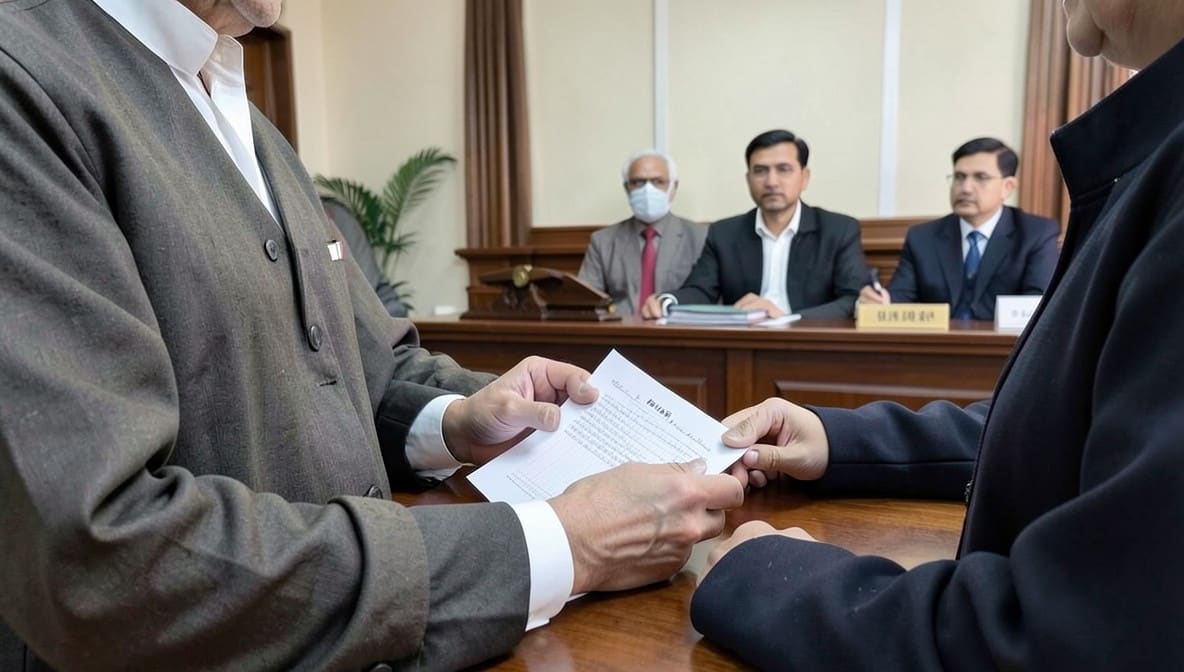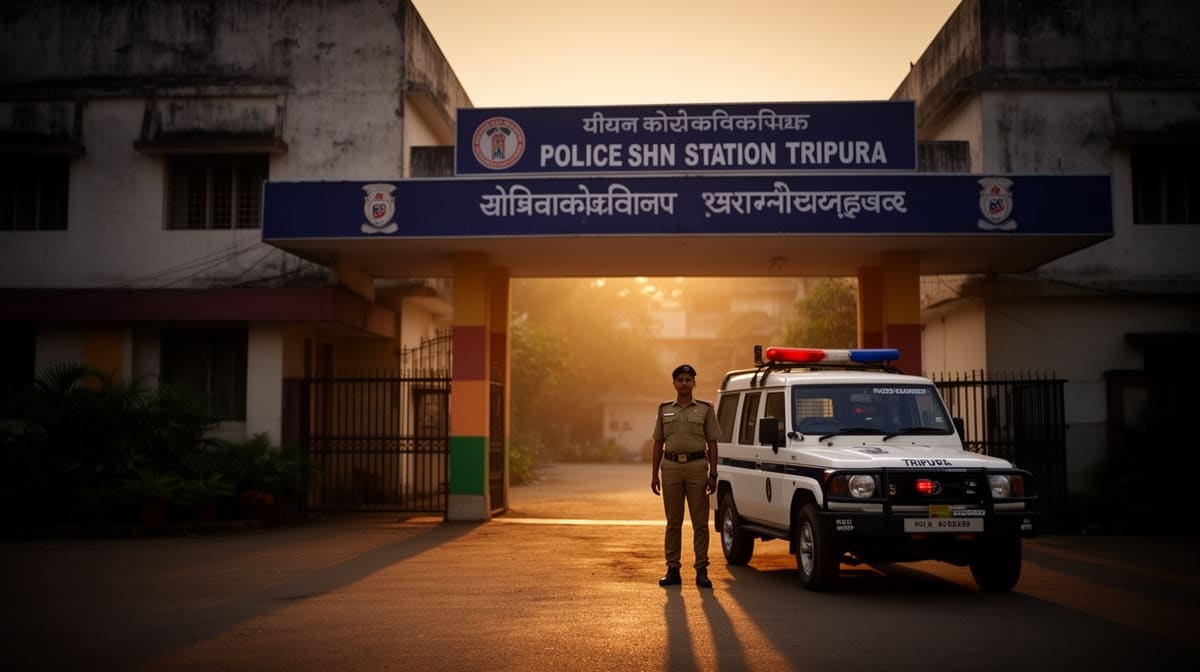
The Tripura High Court has clarified that while the arrest of a woman between sunset and sunrise without prior magisterial permission violates Section 46(4) of the CrPC, such a violation does not automatically render the arrest illegal or entitle the accused to bail as a matter of right. The Court granted bail in this NDPS Act case not on the ground of illegal arrest alone, but due to the completion of investigation, prolonged custody, and absence of any prayer for custody trial.
Background & Facts
The Dispute
The petitioner, Papi Akter, wife of Suman Miah, was arrested in connection with Sonamura Police Station Case No. 97 of 2025, registered under Sections 20(b)(ii)(B)/25/29 of the Narcotic Drugs and Psychotropic Substances (NDPS) Act. The case involved the recovery of 5.985 kg of ganja from her residence. Her husband fled during the raid and remains absconding. The central legal dispute concerns the legality of her arrest, which occurred after sunset but was formally recorded the next morning.
Key Facts
- On 24.11.2025 at 1900 hours (7:00 PM), SI Shubhankar Debbarma received credible intelligence that Papi Akter and her husband were storing ganja in their house, using a Maruti Eeco vehicle (TR-07-0413).
- At 2000 hours (8:00 PM), a police team including Inspector Tapas Das arrived at the residence and recovered 5.985 kg of ganja.
- Suman Miah fled upon police arrival; Papi Akter was detained at the scene.
- Papi Akter was not formally arrested on 24.11.2025. Her arrest was recorded on 25.11.2025 at 10:05 AM.
- The vehicle used for transportation of ganja was seized.
- The charge sheet was filed against both accused, with Suman Miah declared absconder.
- Papi Akter has two minor children, aged four and eight years, who were left unattended during her detention.
Procedural History
- 24.11.2025: Raid conducted at 2000 hours; Papi Akter detained.
- 25.11.2025: Formal arrest recorded at 10:05 AM.
- Date unspecified: Charge sheet filed under Sections 20(b)(ii)(B)/25/29 of the NDPS Act.
- Date unspecified: Bail application filed before the Tripura High Court.
- 02.02.2026: Hearing conducted.
- 16.03.2026: Judgment delivered.
The Parties' Positions
For the Petitioner
Mr. Kundan Pandey, Advocate, argued that the arrest was illegal under Section 46(4) of the CrPC (now Section 43(5) of the BNSS), which prohibits the arrest of women between sunset and sunrise unless exceptional circumstances exist and prior written permission of a First Class Magistrate is obtained. He contended that the actual arrest occurred at 2000 hours on 24.11.2025, when she was physically detained, and that the 10:05 AM record was a fabrication to circumvent the law. He relied on Directorate of Enforcement v. Subhash Sharma, Dr. Sangeeta Dutt v. State of Assam, and Bharati S. Khandhar v. Maruti Govind Jadhav to assert that such violations violate Articles 21 and 22 of the Constitution and warrant bail.
For the Respondent
Mr. Rajib Saha, Additional Public Prosecutor, argued that Section 46(4) is directory, not mandatory, citing Deepa v. S. Vijayalakshmi (Madras HC), Rakesh Chand v. NCT of Delhi, and Smt. Sadhna Upmanyu v. Station House Officer (Rajasthan HC). He contended that the exigencies of the case - ongoing drug trafficking, imminent disposal of contraband, and risk of flight - constituted exceptional circumstances justifying nighttime detention. He emphasized that the law must not impede effective investigation.
Relief Sought
The petitioner sought regular bail on the grounds of illegal arrest, humanitarian concerns for her minor children, and the completion of investigation. No prayer was made for custody trial.
The Legal Issue
Whether the arrest of a woman between sunset and sunrise, without prior magisterial permission under Section 46(4) of the CrPC, automatically renders the arrest illegal and entitles the accused to bail as a matter of right, even where investigation is complete and no custody trial is sought.
Arguments Presented
For the Petitioner
The petitioner’s counsel relied on multiple High Court judgments - including Dr. Sangeeta Dutt v. State of Assam and Bharati S. Khandhar v. Maruti Govind Jadhav - to argue that the time of arrest is determined by actual physical detention, not the formal record. He emphasized that the 14-hour detention without arrest violated Article 22(2) and Section 46(4). He contended that the failure to obtain magisterial permission, even in the face of alleged urgency, was a deliberate circumvention of statutory safeguards for women’s dignity and safety. He invoked Arnesh Kumar v. State of Bihar to argue that procedural violations of this nature undermine fundamental rights and justify bail.
For the Respondent
The State contended that Section 46(4) is directory, not mandatory, citing the Madras High Court’s detailed analysis in Deepa v. S. Vijayalakshmi. It argued that the legislative intent was to caution police, not to create an automatic right to bail. The State relied on State of Maharashtra v. Christian Community Welfare Council to assert that rigid adherence to the provision could frustrate investigations, especially in cases involving narcotics, where delay risks destruction of evidence. It maintained that the facts of this case - recovery of nearly six kilograms of ganja, flight of the co-accused, and the risk of evidence tampering - constituted exceptional circumstances justifying nighttime detention.
The Court's Analysis
The Court acknowledged the divergent views across High Courts but emphasized that the purpose of Section 46(4) is to protect women from harassment and uphold their dignity. However, it rejected the petitioner’s argument that any violation of the provision automatically entitles the accused to bail.
"The contention of Mr. Pandey, learned counsel that for non-compliance of Section 46(4) of Cr.P.C. [corresponding to Section 43 (5) of BNSS], the accused person will accrue an indefeasible right to be released on bail on that ground in every case, cannot be accepted."
The Court noted that while the Madras, Delhi, and Rajasthan High Courts have held Section 46(4) to be directory, the Supreme Court in State of Maharashtra v. Christian Community Welfare Council had cautioned against rigid enforcement where it impedes investigation. The Court observed that the police team had acted on credible intelligence, the contraband was about to be moved, and the husband had fled - factors that may constitute exceptional circumstances.
However, the Court found a critical procedural failure: the accused was detained from 2000 hours on 24.11.2025 until 10:05 AM on 25.11.2025 without any formal arrest or explanation. The record contained no evidence of attempts to contact a Magistrate, no record of reasons for delay, and no justification for the 14-hour detention without arrest.
"No explanation is found in the record as to why her arrest was shown on the following day in the morning when in the previous night she was detained by the police."
The Court declined to presume deliberate violation, as the arresting officer was not a party, but emphasized that the circumstances demanded inquiry. It noted that the investigation was complete, the charge sheet filed, and no custody trial was sought. The accused had been in custody for a considerable period.
The Verdict
The bail application was allowed. Papi Akter is granted regular bail on execution of a personal bond of Rs. 1,00,000 with one surety of like amount, subject to conditions: (i) the surety must be a permanent resident of Tripura; (ii) she shall not leave the State without prior permission of the Special Judge; (iii) she shall not influence or intimidate witnesses; (iv) she shall appear regularly before the Court; and (v) she shall attend court once a week until trial concludes. The Director General of Police is directed to conduct a departmental inquiry through an officer not below the rank of Superintendent of Police into the alleged violation of Section 43(5) of BNSS, and to initiate disciplinary action if deliberate violation is found.
What This Means For Similar Cases
Violation of Section 46(4) CrPC Does Not Automatically Entitle to Bail
- Practitioners must now argue that while violation of Section 46(4) is serious, bail cannot be claimed as an automatic right.
- Courts will examine the totality of circumstances: duration of detention, completion of investigation, and whether the violation was deliberate or due to exigency.
- Bail may be granted on other grounds (e.g., prolonged custody, no trial custody sought) even if the arrest is procedurally flawed.
Departmental Inquiry Is Now a Mandatory Consequence
- The Tripura HC has established that any unexplained violation of Section 46(4) must trigger a departmental inquiry.
- Police officers must now anticipate that failure to obtain magisterial permission - even if justified as "exceptional" - will be subject to scrutiny.
- Absence of written reports or failure to record reasons for delay will be treated as prima facie evidence of procedural negligence.
Nighttime Arrests in NDPS Cases Require Extraordinary Justification
- In narcotics cases, courts will scrutinize claims of "exceptional circumstances" more rigorously.
- Merely alleging that contraband was about to be moved is insufficient; police must demonstrate concrete, time-sensitive threats.
- The recovery of large quantities (e.g., >5 kg of ganja) does not, by itself, justify bypassing statutory safeguards.
Documentary Evidence of Arrest Timing Is Critical
- Arrest memos must reflect actual time of detention, not convenient recording times.
- Any discrepancy between detention and formal arrest will invite judicial skepticism and potential inquiry.
- Legal teams should now routinely request custody records and CCTV logs to establish actual time of deprivation of liberty.