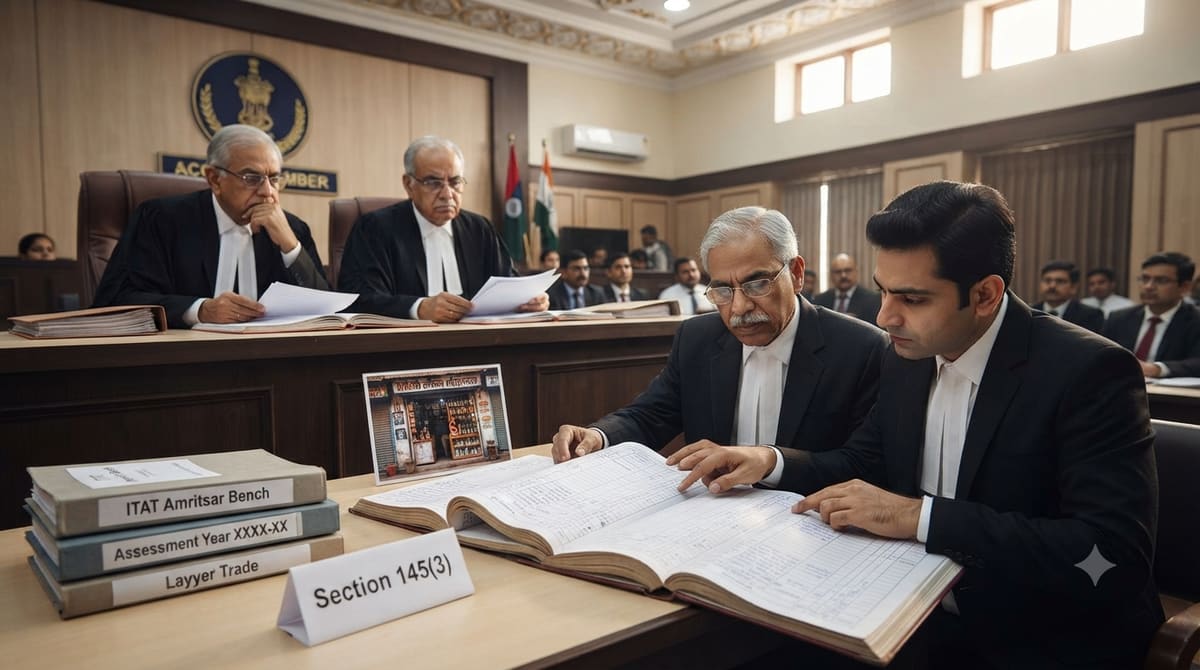
The Income Tax Appellate Tribunal, Ranchi, has clarified that profit estimation under Section 44AD for undisclosed business must be grounded in reasonableness and cannot be arbitrarily inflated. This decision reinforces the principle that while the absence of books of account permits estimation, it does not license speculative or excessive additions by tax authorities.
Background & Facts
The Dispute
The assessee, Sunil Kumar Sawa, operates an agency business in electronic goods under the name M/s. Universal Hi-Tech. He filed his return for Assessment Year 2009-10 declaring income of Rs. 2,37,660. The case was selected for scrutiny, and the Assessing Officer (AO) completed assessment under Section 143(3) on 30.12.2011, determining taxable income at Rs. 90,19,220. Subsequent appellate proceedings led to multiple revisions, culminating in the addition of undisclosed cash deposits totaling Rs. 6,14,28,008 in two bank accounts - one with SBI, Jugsalai, and another with Indusind Bank, Jamshedpur.
Key Facts
- The assessee maintained audited books for disclosed business but admitted no books were maintained for the unaccounted portion.
- Cash deposits of Rs. 6,14,28,008 were made into the two undisclosed bank accounts between 2005 and 2009.
- The assessee claimed these deposits were customer advances used to procure solar energy products on order, with payments made via cheque.
- The assessee submitted multiple versions of Profit & Loss accounts, proposing profit margins of 2% to 2.41% for the entire business, including undisclosed transactions.
- The AO and CIT(A) rejected these submissions as self-serving estimates lacking documentary support.
- The CIT(A) applied an 8% profit rate on the total undisclosed deposits, resulting in an estimated profit of Rs. 49,14,241.
- An additional Rs. 45,09,399 was added as capital deployed, and Rs. 29,893 as interest income from the undisclosed accounts.
Procedural History
- 30.12.2011: Assessment completed by AO under Section 143(3).
- 31.12.2013: CIT(A) partly allowed appeal, but upheld additions.
- 08.09.2017: ITAT set aside the order and remanded to AO.
- 2018 - 2020: AO made additions of Rs. 35,97,695 (profit), Rs. 45,09,399 (capital), and Rs. 29,893 (interest).
- 07.05.2025: CIT(A) upheld additions, applying 8% profit rate on Rs. 6,14,28,008.
- 29.01.2026: Hearing before ITAT Ranchi.
- 23.04.2026: Judgment pronounced.
The Parties' Positions
For the Appellant
- Argued that the 8% profit rate was arbitrary and unsupported by industry benchmarks.
- Cited audited financials showing consistent profit margins of 2% - 2.4% in disclosed business.
- Contended that the peak credit method was misapplied since withdrawals were by cheque, not cash.
- Asserted that no books were rejected under Section 145(3), making estimation unjustified.
- Requested application of 2.41% profit rate and deletion of capital addition and interest addition.
For the Revenue
- Maintained that absence of books made verification impossible.
- Argued that the 8% rate was a pragmatic estimate based on the scale of deposits and nature of business.
- Stated that interest income was independently taxable under "Other Sources" and could not be netted against bank charges due to lack of accounting.
- Rejected the assessee’s proposed profit margins as self-contradictory and unverified.
Relief Sought
The assessee sought:
- Reduction of profit addition from Rs. 49,14,241 to Rs. 14,80,000 (at 2.41%)
- Deletion of capital addition of Rs. 45,09,399
- Deletion or set-off of Rs. 29,893 interest income by bank charges
- Cancellation of interest under Sections 234A and 234B
The Legal Issue
Can the tax authorities apply an arbitrary profit percentage under Section 44AD to undisclosed business when books of account are not maintained, and if so, what standard of reasonableness must govern such estimation?
Arguments Presented
For the Appellant
The appellant relied on CIT v. M/s. S. S. Enterprises and CIT v. M. K. Agarwal to argue that estimation must be based on rational, verifiable data, not speculation. He emphasized that Section 44AD permits presumptive taxation only for eligible businesses, and its application to undisclosed income requires proportionality. He further cited CIT v. S. R. K. S. Industries to assert that where no books are rejected, estimation must align with the assessee’s demonstrated business model.
For the Respondent
The Revenue contended that the absence of books rendered any precise computation impossible. It relied on CIT v. S. K. Gupta to argue that in such cases, the authorities are entitled to adopt a reasonable estimate based on the scale of transactions. It maintained that 8% was a conservative rate given the volume of deposits and the nature of electronic goods agency business.
The Court's Analysis
The Tribunal acknowledged the validity of the Revenue’s position that unaccounted transactions without books of account necessitate estimation. However, it critically examined the 8% rate applied by the CIT(A). The Tribunal noted that the assessee’s disclosed business consistently yielded profit margins of 2% - 2.4%, and there was no evidence suggesting the undisclosed portion operated at significantly higher margins.
"The profit may vary from case to case and adopting a rate of 8% may not be accurate. However, there is no other way to arrive at a perfect figure of profit in the facts of the case."
The Tribunal observed that while the CIT(A) correctly identified the need for estimation, the rate chosen was disproportionately high. It held that Section 44AD, though not directly applicable to undisclosed income, provides a useful benchmark for reasonableness. The Tribunal further noted that the capital addition of Rs. 45,09,399 was redundant since the profit estimation already accounted for the return on capital. The interest income of Rs. 29,893 was upheld as taxable under "Other Sources," as bank charges could not be offset without accounting records.
The Tribunal concluded that a 3% profit rate - still above the assessee’s claimed 2.41% - was a fair, balanced, and reasonable compromise, reflecting the nature of the business and the scale of deposits without being speculative.
The Verdict
The appeal is partly allowed. The profit addition of Rs. 49,14,241 at 8% is reduced to Rs. 18,42,840 at 3% on the undisclosed deposit of Rs. 6,14,28,008. The capital addition of Rs. 45,09,399 is deleted. The interest income of Rs. 29,893 is confirmed. The interest under Sections 234A and 234B shall be recalculated based on the revised total income. The order of the CIT(A) dated 07.05.2025 is modified accordingly.
What This Means For Similar Cases
Estimation Must Reflect Business Reality, Not Revenue Convenience
- Practitioners must challenge arbitrary profit rates under Section 44AD when applied to undisclosed income, especially where audited books show consistent low margins.
- A rate exceeding the assessee’s documented profitability without corroborative evidence is vulnerable to reduction.
Capital Addition Is Redundant When Profit Is Estimated
- Where a profit percentage is applied to total deposits, the separate addition of "capital deployed" constitutes double taxation and must be objected to.
- Tribunals are increasingly recognizing this as a procedural error.
Interest Income Cannot Be Netted Without Books
- Bank charges cannot be offset against interest income unless supported by ledger entries or bank statements.
- Practitioners should advise clients to maintain minimal records even for unaccounted transactions to preserve the right to claim deductions.
Reasonableness Trumps Rigidity in Estimation
- The ITAT has affirmed that estimation is not a tool for revenue maximization but a last-resort mechanism.
- A 3% rate, even if higher than the assessee’s claim, was accepted because it was grounded in the business context - not because it favored the taxpayer.
Documentation Remains Critical
- Even if a business operates partly in cash, maintaining basic records of customer advances and supplier payments can prevent arbitrary additions.
- The Tribunal’s reliance on the assessee’s disclosed margins underscores the evidentiary value of consistent financial reporting.