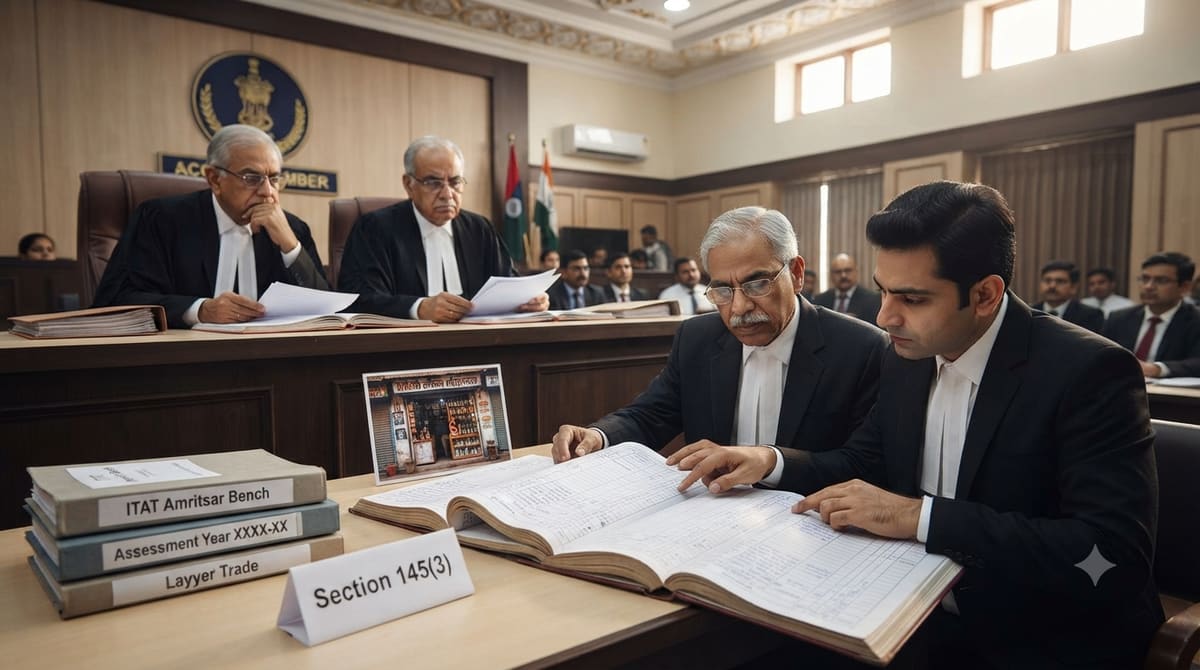
The Income Tax Appellate Tribunal (ITAT), Amritsar Bench, recently delivered a significant ruling in Jaswinder Singh v. DCIT (ITA Nos.585 & 586/ASR/2025), addressing the rejection of audited books of accounts in a high-volume liquor retail business. The Tribunal upheld the lower authorities' rejection of books under Section 145(3) of the Income-tax Act, 1961 but modified the profit estimation methodology, directing a net profit rate of 0.55% on net sales instead of the arbitrary 1% applied earlier. The ruling underscores the need for robust justification before rejecting audited books, particularly in regulated sectors like liquor retail, where structural realities often conflict with conventional accounting practices.
Background & Facts
The Dispute
The assessee, Jaswinder Singh, operates as a retail wine contractor (L-14 and L-2 licenses) in Bathinda, Punjab, under the proprietary concern M/s Jaswinder Singh & Co. The assessee is also a partner in multiple firms engaged in liquor retail. For the Assessment Years (AY) 2016-17 and 2017-18, the assessee filed audited returns declaring net incomes of Rs.94,13,460 and Rs.0 respectively, with net profit (NP) rates of 0.46% and -1.53%. The case was selected for scrutiny, and the Assessing Officer (AO) completed the assessment under Section 143(3) on 28.12.2018, rejecting the audited books and estimating NP at 1.50% on gross turnover, resulting in additions of Rs.1,45,06,784 and Rs.75,47,823 for AY 2016-17 and AY 2017-18 respectively.
Key Facts
The assessee's business involves over 60 retail outlets across Punjab, dealing exclusively in government-controlled liquor.
The liquor trade in Punjab is rigorously regulated by the state excise department, with all stock flows monitored via official license memos and transport passes.
The assessee's audited books were rejected by the AO under Section 145(3) for non-maintenance of branch-wise sale bills, itemized stock registers, and complete addresses for cash salary payments.
The AO noted that the assessee claimed an "Ahata" license fee of Rs.23,60,000 but declared zero ancillary revenue from bottle sales or venue operations.
The AO estimated NP at 1.50% on gross turnover (Rs.139,17,92,236) based on non-confronted third-party cases, resulting in an NP of Rs.2,08,76,883 and a lump-sum addition of Rs.1,45,06,784.
The CIT(A) upheld the rejection of books but restricted the NP rate to 1.0% for AY 2017-18, confirming Rs.1,39,17,922 and deleting the remaining addition of Rs.69,58,961, while allowing statutory depreciation of Rs.8,95,589.
The assessee's audited trading account declared a gross turnover of Rs.139,17,92,236 and a net profit of Rs.63,70,099 (NP rate of 0.46%) for AY 2016-17.
The assessee's past financial history shows NP rates ranging from 0.17% to 0.47% over the years, with AY 2017-18 declaring a net loss of -1.53%.
The assessee's core trading expenses (purchases and government license fees) constituted 98.12% of total expenditures, with purchases of Rs.63,28,25,184.70 and license fees of Rs.73,27,51,987.00.
The assessee advanced interest-free loans of Rs.7.57 crore against total interest-free funds of Rs.21.14 crore, including own capital of Rs.3.67 crore.
Procedural History
17.10.2016: Assessee filed ROI for AY 2016-17 declaring income of Rs.94,13,460.
28.12.2018: AO completed assessment under Section 143(3), rejecting audited books and estimating NP at 1.50% on gross turnover.
03.06.2025: CIT(A) upheld rejection of books but restricted NP rate to 1.0% for AY 2017-18, confirming Rs.1,39,17,922 and deleting the remaining addition of Rs.69,58,961.
21.07.2026: ITAT Amritsar heard the assessee's appeals (ITA Nos.585 & 586/ASR/2025).
23.07.2026: ITAT delivered the order, partly allowing the appeals and directing NP estimation at 0.55% on net sales.
Relief Sought
The assessee sought acceptance of audited books of accounts and deletion of additions made by the AO and CIT(A), arguing that the rejection of books was unjustified given the structural realities of the liquor trade in Punjab and the assessee's clean audit report.
The Legal Issue
The central question was whether the Assessing Officer and the Commissioner of Income Tax (Appeals) were justified in rejecting the assessee's audited books of accounts under Section 145(3) of the Income-tax Act, 1961, and whether the estimation of net profit at 1% on gross turnover was justified in the absence of strong evidence of understatement of income.
Arguments Presented
For the Appellant/Petitioner
The assessee's counsel, Shri Sudhir Sehgal, argued that:
The assessee's books of accounts were fully audited under Section 44AB and did not reveal any operational fraud or material discrepancies.
The retail liquor trade in Punjab is stringently regulated by the state excise department, with all stock flows monitored via official license memos and transport passes, eliminating the possibility of unrecorded sales.
The assessee's business involves high-volume cash sales across 60 outlets, making it impractical to maintain branch-wise sale bills or itemized stock registers.
The "Nil" entry in Column 35(a) of Form 3CD reflected the structural reality of having no physical inventory left at year-end, as liquor licenses are issued annually and stock is fully liquidated by the end of the financial year.
The assessee's core trading expenses (purchases and license fees) constituted 98.12% of total expenditures, with purchases of Rs.63.28 crore and license fees of Rs.73.27 crore, both fully verified by statutory documents.
The AO explicitly accepted the gross sales figure of Rs.139.17 crore but arbitrarily estimated NP at 1.50% without confronting the assessee with comparable cases.
Minor unvouched cash expenses across 60 outlets do not justify discarding a Rs.139.17 crore audited turnover.
The assessee's past financial history shows NP rates ranging from 0.17% to 0.47%, with AY 2017-18 declaring a net loss of -1.53%, indicating volatility in the business.
The assessee relied on judicial precedents such as Hem Raj v. ACIT (159 ITD 589), ITO v. Laxmi Narain Ramswaroop Shivhare (119 ITD 15), and CIT v. Kamlesh Kumar Jaiswal & Co. (42 Taxmann.com 197), which support the acceptance of audited books in liquor trade cases.
For the Respondent/State
The Revenue's counsel, Shri Manek Shah Kapoor, relied on the orders of the lower authorities, arguing that:
The assessee had not submitted sales registers in support of cash sales, which justified the rejection of books under Section 145(3).
The CIT(A) had reasonably given substantial relief by restricting the NP rate to 1.0% for AY 2017-18.
The assessee's claim of interest-free advances and lack of ancillary revenue from "Ahata" operations raised doubts about the completeness of the books.
The Court's Analysis
The ITAT, Amritsar Bench, examined the rival submissions and material on record, noting that the assessee's business is highly volume-driven and stringently regulated by the state excise department. The Tribunal observed that the AO had rejected the books for non-maintenance of branch-wise sale bills, itemized stock registers, and complete addresses for cash salary payments. However, the Tribunal recognized the structural realities of the liquor trade in Punjab, where:
Liquor licenses are issued annually, and physical stock is fully liquidated by the end of the financial year, making year-end inventory entries "Nil" a business reality rather than a bookkeeping defect.
All purchases and stock flows are monitored via official excise department license memos and transport passes, eliminating the possibility of unrecorded sales.
The assessee's audited books were clean, with no operational fraud or material discrepancies pointed out by the statutory auditor.
The Tribunal distinguished the assessee's case from conventional businesses, emphasizing that the liquor trade's regulatory framework and high-volume cash sales make conventional accounting practices impractical. The Tribunal noted that the AO had not confronted the assessee with comparable cases or benchmarks before estimating NP at 1.50% on gross turnover, which was arbitrary and unjustified.
The Tribunal also addressed the assessee's past financial history, which showed NP rates ranging from 0.17% to 0.47%, with AY 2017-18 declaring a net loss of -1.53%. The Tribunal observed that the assessee's NP rate of 0.46% for AY 2016-17 was significantly higher than in earlier years, indicating improved profitability.
"Considering the factual matrix and peculiar case in hand, in our view, for the sake of equity, the profit of 0.55% on net sales will justify in this case."
The Tribunal directed the AO to sustain 0.55% of net sales as the net profit, balancing the assessee's clean audit report and the structural realities of the liquor trade with the need for a reasonable estimation of income.
The Verdict
The ITAT, Amritsar Bench, partly allowed the assessee's appeals for both Assessment Years 2016-17 and 2017-18. The Tribunal:
Upheld the rejection of audited books of accounts under Section 145(3) but modified the profit estimation methodology.
Directed the AO to estimate net profit at 0.55% on net sales instead of the arbitrary 1% applied earlier.
Set aside the additions made by the AO and CIT(A), directing the AO to recompute the assessee's income accordingly.
Allowed statutory depreciation of Rs.8,95,589 against the net profit estimated at 0.55%.
What This Means For Similar Cases
Rejection of Books Requires Stronger Grounds in Regulated Sectors
Section 145(3) rejections must be grounded in concrete evidence of fraud, material discrepancies, or systemic failures, not structural realities of the business.
In regulated sectors like liquor retail, where stock flows are monitored by government authorities, conventional accounting practices may be impractical, and courts are increasingly reluctant to reject audited books without stronger justification.
Profit Estimation Must Be Benchmarked and Justified
Arbitrary profit estimations based on non-confronted third-party cases are unsustainable.
Courts now expect profit estimations to be benchmarked against comparable cases or industry standards, with clear reasoning for deviations.
The rule of consistency applies, but courts are willing to deviate where facts justify a different approach.
Structural Realities Trump Conventional Accounting in Liquor Trade
High-volume cash sales, annual liquor licenses, and government monitoring of stock flows are structural realities that courts now recognize.
Minor unvouched cash expenses or lack of year-end inventory do not justify discarding audited books in liquor trade cases.
Past financial history and industry benchmarks are critical in assessing the reasonableness of profit declarations.