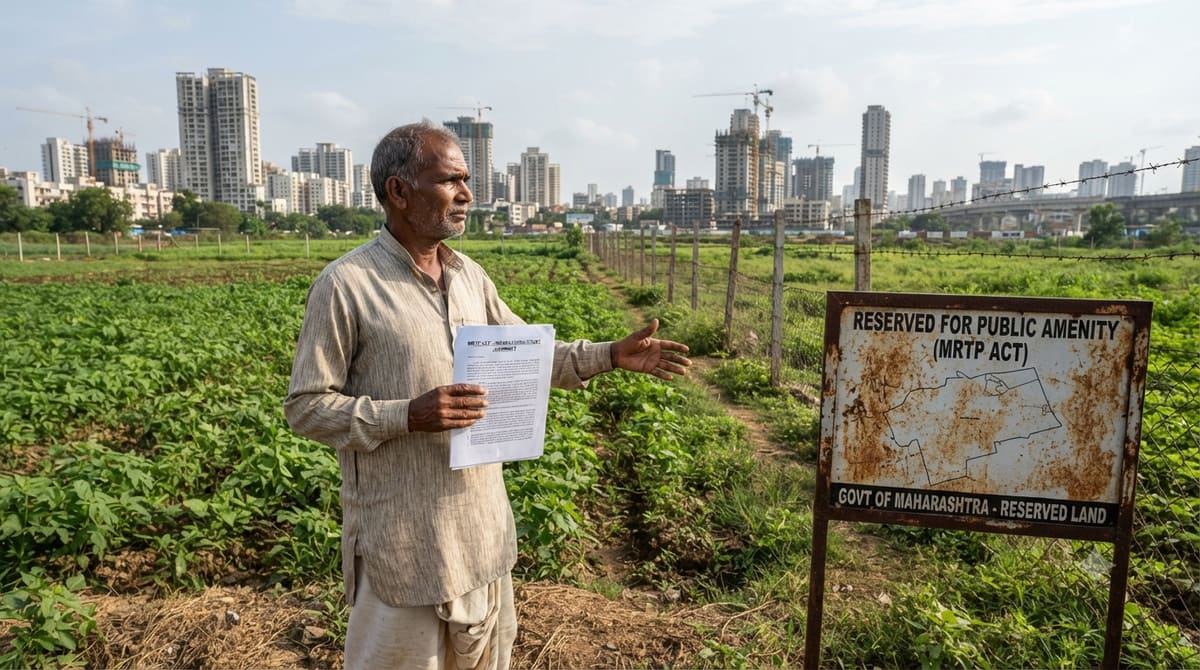
The Bombay High Court has reaffirmed the absolute power of the State Government to dispose of Government land under Section 40 of the Maharashtra Land Revenue Code, 1966 (MLRC), overriding statutory restrictions under Section 22-A and the consent of Gram Panchayats. In dismissing a writ petition challenging the allotment of 7.28 hectares of Gairan land for the Prime Minister Awas Yojana (PMAY-2.0), the Court held that the State’s authority under Section 40 MLRC is unfettered, even where the land is reserved for public housing and allotted to statutory authorities like MHADA. The judgment underscores the primacy of Section 40 MLRC over executive instructions and Gram Panchayat resolutions, setting a precedent for similar disputes involving Government land disposal.
Background & Facts
The Dispute
The petitioner, Gram Panchayat Nere (Village Nere, Taluka Mulshi, District Pune), challenged two orders dated 13.06.2025 passed by the District Collector, Pune, allotting 4 hectares 24 ares and 3 hectares 4 ares of Gairan land to the Maharashtra Housing and Area Development Authority (MHADA) for construction of houses under the Pradhan Mantri Awas Yojana (PMAY-2.0). The Gram Panchayat argued that the allotment violated the Government Resolution dated 12.07.2011 and Section 22-A of the MLRC, which mandate Gram Panchayat consent for diversion of Gairan land. The petitioners further alleged that the allotment was arbitrary, ignoring a Minutes of Meeting dated 15.02.2022 wherein the then Revenue Minister directed the authorities to ascertain the Gram Panchayat’s bona fide area requirement for projects like rural hospitals, schools, and public parks.
Key Facts
- The disputed land is classified as Gairan land (land reserved for grazing of village cattle).
- The Government Resolution dated 12.07.2011 was issued in compliance with the Supreme Court’s judgment in Jagpal Singh v. State of Punjab, mandating Gram Panchayat consent for diversion of such lands.
- The Minutes of Meeting dated 15.02.2022 recorded a direction to assess the Gram Panchayat’s requirement for welfare projects.
- The Gram Panchayat passed a resolution opposing the allotment to MHADA.
- The Revenue Record showed the Gram Panchayat’s name in the ‘Other Rights’ column, though ownership vested with the State.
- The regional plan reserved the subject lands for ‘public housing’.
Procedural History
- 15.02.2022: Meeting held in the Revenue Minister’s chamber; direction issued to assess Gram Panchayat’s land requirement.
- 13.06.2025: District Collector passes impugned orders allotting 7.28 hectares to MHADA for PMAY-2.0.
- 28.01.2026: Writ Petition (WP No. 972 of 2026) filed before Bombay High Court; notice issued.
- 04.03.2026: Interim order passed directing status-quo on the subject lands.
- 10.07.2026: Final judgment dismissing the writ petition and vacating the interim order.
Relief Sought
The petitioners sought:
- Quashing of the impugned orders dated 13.06.2025.
- Direction to cancel the allotment to MHADA.
- Recognition of the Gram Panchayat’s right to utilize the land for welfare projects as per the Minutes of Meeting dated 15.02.2022.
The Legal Issue
The central question was whether the State Government’s power under Section 40 of the MLRC to dispose of Government land overrides:
- The consent requirement under Section 22-A of the MLRC and the Government Resolution dated 12.07.2011,
- The Gram Panchayat’s resolution opposing the allotment, and
- The direction issued in the Minutes of Meeting dated 15.02.2022 for assessing the Gram Panchayat’s bona fide requirement.
Arguments Presented
For the Petitioner (Gram Panchayat)
- Violation of Section 22-A MLRC: The allotment was illegal as Section 22-A mandates Gram Panchayat consent for diversion of Gairan land, unless no other suitable Government land is available.
- Arbitrary Exercise of Power: The allotment ignored the Minutes of Meeting dated 15.02.2022, which directed assessment of the Gram Panchayat’s requirement for welfare projects.
- Supreme Court Precedent: Reliance was placed on Jagpal Singh v. State of Punjab, wherein the Supreme Court directed eviction of illegal encroachers and restoration of Gram Panchayat lands for common use.
- Government Resolution Compliance: The Government Resolution dated 12.07.2011 requires Gram Panchayat consent, which was not obtained.
- Revenue Record Entry: The ‘Other Rights’ column in the Revenue Record showed the Gram Panchayat’s name, indicating its interest in the land.
For the Respondents (State and MHADA)
- Section 40 MLRC is Absolute: Section 40 MLRC vests the State with unfettered power to dispose of Government land, overriding Section 22-A and any executive instructions.
- Binding Precedents: The Bombay High Court’s judgments in Santosh Madhukar Bhondve v. State of Maharashtra (WP No. 3098 of 2021), Group Gram Panchayat Shirdhon v. State of Maharashtra (PIL No. 3 of 2005), and Prashant Sunil Kachole v. State of Maharashtra (WP No. 17617 of 2025) held that Section 40 MLRC prevails over Section 22-A.
- Executive Instructions Superseded: The Government Resolution dated 12.07.2011 is an executive instruction and was superseded by the statutory amendment introducing Section 22-A in 2017.
- Public Purpose: The allotment was for PMAY-2.0, a Central Government scheme for housing the economically weaker sections, fulfilling the public purpose requirement under Section 22-A(2).
- Regional Plan Compliance: The subject lands were reserved for ‘public housing’ in the regional plan, and the allotment to MHADA aligned with this reservation.
- No Crystallized Right: The Minutes of Meeting dated 15.02.2022 did not create a vested right in favor of the Gram Panchayat; it merely directed an assessment of requirements.
- Distinguishable Precedent: Jagpal Singh dealt with private encroachers, whereas the present case involves Government allotment for public purpose, rendering the precedent inapplicable.
The Court's Analysis
The Court conducted a statutory interpretation of Sections 22-A and 40 of the MLRC, examining their interplay and the binding precedents of the Bombay High Court.
Statutory Framework
-
Section 22-A MLRC:
- Prohibits diversion of Gairan land except for public purpose projects of the Central/State Government or statutory authorities, if no other suitable Government land is available.
- Requires compensatory land transfer for non-public authority projects.
- Section 22-A(6) vests the power of diversion in the State Government.
-
Section 40 MLRC:
- Provides: “Nothing contained in any provision of this Code shall derogate from the right of the State Government to dispose of any land, the property of Government, on such terms and conditions as it deems fit.”
- The Court emphasized the absolute and unfettered nature of this provision, holding that it overrides all other provisions of the MLRC, including Section 22-A.
Binding Precedents
The Court relied on three judgments of the Bombay High Court:
-
Santosh Madhukar Bhondve v. State of Maharashtra (WP No. 3098 of 2021, dated 12.09.2024):
- Held that Section 40 MLRC grants the State absolute power to dispose of Government land, irrespective of Section 22-A.
- Observed that the opening phrase of Section 40 (“nothing contained in any provision of this Code”) leaves no doubt about its overriding effect.
-
Group Gram Panchayat Shirdhon v. State of Maharashtra (PIL No. 3 of 2005, dated 22.07.2025):
- Followed Santosh Bhondve in holding that Section 40 prevails over Section 22-A.
-
Prashant Sunil Kachole v. State of Maharashtra (WP No. 17617 of 2025, dated 10.03.2026):
- Specifically concerned allotment of land for PMAY, rejecting arguments similar to those raised by the petitioner.
“Section 40 of the MLRC, 1966 as extracted above, vests almost absolute right in the State Government to dispose of any land or property of the Government on such terms and conditions as it deems fit. The language in which Section 40 is couched leaves no room of doubt that the right of the State Government to dispose of any of its land or property is irrespective of any provision of MLRC, 1966 for the reason of opening phrase occurring in Section 40 is ‘nothing contained in any provision of this Code’. Thus, we are of the opinion that by operation of Section 40 of the MLRC, 1966, the State Government is vested with right to dispose of any land of the Government on such terms and conditions which are to be determined by it irrespective of any other provision available in MRLC, 1966 including Section 22A.”
Distinguishing Jagpal Singh
The Court distinguished the Supreme Court’s judgment in Jagpal Singh v. State of Punjab ((2011) 11 SCC 396) on the following grounds:
- Jagpal Singh dealt with private encroachers who illegally occupied Gram Panchayat lands for personal benefit.
- The present case involves Government allotment for public purpose (PMAY-2.0), which aligns with the public purpose exception under Section 22-A(2).
- The Government Resolution dated 12.07.2011 was issued in compliance with Jagpal Singh but was superseded by the statutory amendment introducing Section 22-A in 2017.
Arbitrariness and Public Purpose
The Court rejected the petitioner’s allegation of arbitrariness, holding:
- The Minutes of Meeting dated 15.02.2022 did not create a crystallized right in favor of the Gram Panchayat; it merely directed an assessment of requirements.
- The regional plan reserved the lands for ‘public housing’, and the allotment to MHADA fulfilled this purpose.
- The Revenue Record entry showing the Gram Panchayat’s name in the ‘Other Rights’ column did not confer any proprietary right, as ownership vested with the State.
- The allotment satisfied the public purpose requirement under Section 22-A(2), as PMAY-2.0 is a Central Government scheme for housing the economically weaker sections.
The Verdict
The writ petition was dismissed. The Court held:
- The State Government’s power under Section 40 MLRC is absolute and overrides Section 22-A, the Government Resolution dated 12.07.2011, and the Gram Panchayat’s resolution.
- The impugned orders dated 13.06.2025 allotting 7.28 hectares of Gairan land to MHADA for PMAY-2.0 were legal and valid.
- The interim order dated 04.03.2026 directing status-quo was vacated.
- The petitioner Gram Panchayat was granted liberty to make a fresh representation for its proposed projects, which the State authorities shall consider in accordance with law.
What This Means For Similar Cases
Section 40 MLRC Trumps All Other Provisions
- Practitioners must note that Section 40 MLRC grants the State Government unfettered power to dispose of Government land, irrespective of any other provision in the MLRC, including Section 22-A.
- Gram Panchayat consent is not mandatory for allotment of Government land to statutory authorities for public purpose projects, even if the land is classified as Gairan land.
- Executive instructions (e.g., Government Resolutions) are subordinate to statutory provisions and can be superseded by amendments.
Public Purpose Justifies Allotment
- Public housing schemes like PMAY-2.0 satisfy the public purpose requirement under Section 22-A(2) MLRC.
- The regional plan reservation for ‘public housing’ strengthens the State’s case for allotment to authorities like MHADA.
- Private encroachment cases (e.g., Jagpal Singh) are distinguishable from Government allotments for public purpose.
Procedural Safeguards Remain Critical
- While Section 40 MLRC grants absolute power, procedural compliance (e.g., invoking Section 40 in the impugned order) is essential to avoid challenges.
- Fresh representations for Gram Panchayat projects may be considered on merits, but no vested right accrues from Minutes of Meetings or resolutions unless crystallized into an order.
- Revenue Record entries showing Gram Panchayat’s name in ‘Other Rights’ column do not confer proprietary rights if ownership vests with the State.