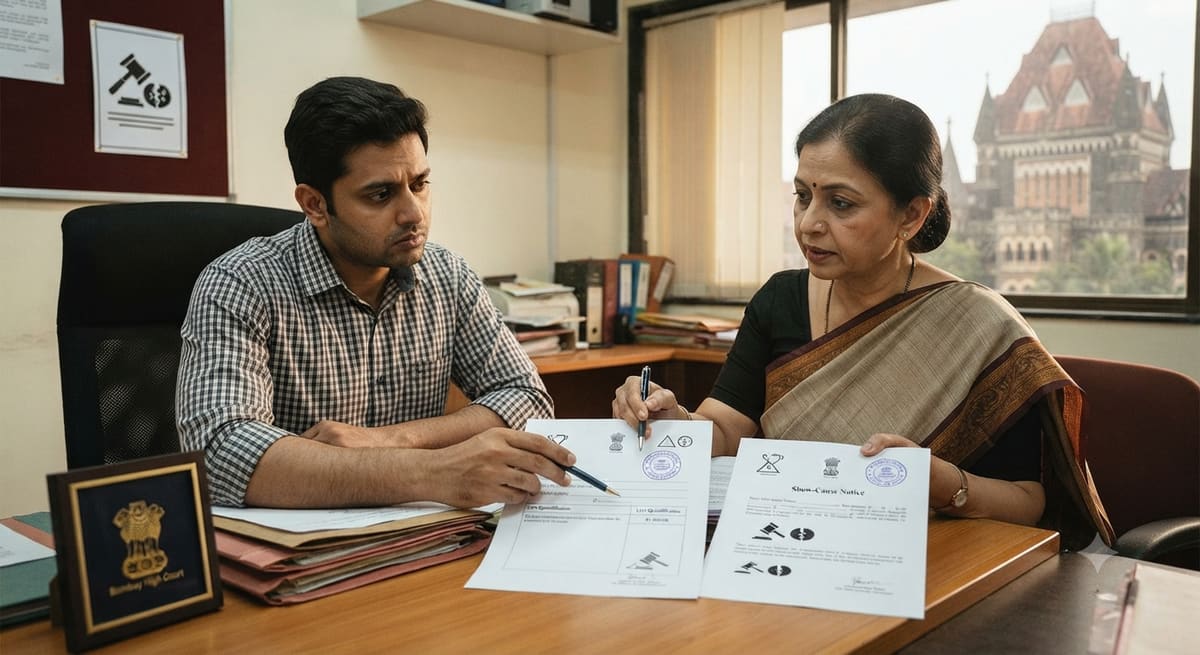
The Calcutta High Court has clarified that the Payment of Gratuity Act, 1972 does not permit imposition of gratuity liability on a principal employer in the absence of a direct employment relationship with the worker. This ruling reinforces the statutory boundaries of employer liability under the Act and rejects judicial expansion through analogies to the Contract Labour (Regulation and Abolition) Act, 1970.
Background & Facts
The Dispute
The dispute arose from a claim for gratuity by a contract worker employed through a contractor for housekeeping and maintenance services at a facility operated by the State Bank of India (SBI), the petitioner herein. The worker, respondent No. 4, was engaged by M/s MSE Management Services Pvt. Limited (the contractor) in May 2012 and worked at SBI’s premises under the contractor’s supervision. He was never directly appointed, paid, or supervised by SBI.
Key Facts
- The contract worker was hired by the contractor on 01.05.2012
- He worked continuously until his termination in 2024, serving over 12 years
- He was paid wages and managed entirely by the contractor
- SBI had no role in recruitment, payroll, discipline, or termination
- The worker filed an application in Form ‘N’ under the Payment of Gratuity Act, 1972 against both the contractor and SBI as principal employer
- The application claimed gratuity for 12 years of service, alleging non-payment by both parties
Procedural History
- 15.06.2023: Application filed in Form ‘N’ before the Controlling Authority (Respondent No. 3)
- 10.11.2023: Controlling Authority held that the contractor was liable for gratuity under Section 4 of the Act, as the worker completed five years of continuous service
- 10.11.2023: Controlling Authority directed the contractor to pay gratuity of Rs. 4,20,000 with simple interest at 10% per annum from the date it became payable under Section 7(3A)
- 12.12.2023: Contractor filed appeal under Section 7(7) of the Act, depositing the entire gratuity amount with the Controlling Authority as required by law
- 17.03.2025: Appellate Authority reversed the Controlling Authority’s order, holding SBI as principal employer liable under Section 21(4) of the Contract Labour Act, 1970, and enhanced gratuity to Rs. 4,80,000
- 22.05.2025: Writ Petition (WPA 2570 of 2025) filed before the Calcutta High Court challenging the Appellate Authority’s order
- 16.04.2026: Hearing concluded; judgment delivered on the same day
Relief Sought
The petitioner (SBI) sought quashing of the Appellate Authority’s order dated 17.03.2025, setting aside the imposition of gratuity liability on it, and restoration of the Controlling Authority’s order holding the contractor liable. The worker did not challenge the Controlling Authority’s order.
The Legal Issue
The central question was whether a principal employer, who has no direct employment relationship with a contract worker, can be held liable for payment of gratuity under the Payment of Gratuity Act, 1972 by importing provisions of Section 21(4) of the Contract Labour (Regulation and Abolition) Act, 1970.
Arguments Presented
For the Petitioner
The petitioner’s counsel argued that the Payment of Gratuity Act, 1972 is a self-contained statute with clearly defined definitions of ‘employer’ and ‘employee’ under Sections 2(e) and 2(f). He contended that liability for gratuity arises only where a direct employer-employee relationship exists. He relied on Hindustan Steel Works Construction Ltd. v. Commissioner of Labour (1996) 10 SCC 599, Sailen Seth v. Deputy Labour Commissioner (2010) 3 CHN 899, and FIS Payment Solutions v. Assistant Labour Commissioner (2023 SCC Online Cal 1500) to show that courts have consistently refused to extend gratuity liability to principal employers absent direct employment. He emphasized that Section 21(4) of the Contract Labour Act deals only with wages, not gratuity, and cannot be read into the Gratuity Act.
For the Respondent
The respondent’s counsel contended that gratuity forms part of wages and therefore falls within the ambit of Section 21(4) of the Contract Labour Act, which makes the principal employer liable for all payments due to contract labour. He relied on Shibaprasad Sutradhar v. State of West Bengal (2025), Sail Growth Works v. Shirajul Khan (2023), and Hindustan Petroleum Corp. v. Appellate Authority (2025), all decided by coordinate benches of the Calcutta High Court, which had held principal employers liable. He also cited the Madras High Court’s decision in Superintending Engineer v. Appellate Authority (2011) to support the proposition that gratuity is a wage component.
The Court's Analysis
The Court undertook a detailed statutory interpretation of both the Payment of Gratuity Act, 1972 and the Contract Labour (Regulation and Abolition) Act, 1970. It observed that the two statutes serve entirely different purposes: the former ensures post-service benefits to employees who have rendered long service, while the latter regulates the conditions of contract labour employment.
"The definition of wages under the 1970 Act are contractual wages, and would cover within its scope, inter alia, wages, which are subject matter of Section 21 are specified sums, which are payable in praesenti by the contractor under the terms of the contract of employment with each other as well as under any existing award, settlement or order of the Court. Section 21 of the Act of 1970 does not deal with nor does it cover other obligations which are imposed upon the contractor under the provisions such as Andhra Pradesh Contract Labour (Regulation and Abolition) Rules 1971."
The Court emphasized that gratuity is not a wage payable in praesenti but a deferred benefit accruing after five years of continuous service. It further noted that the Supreme Court in Hindustan Steel Works Construction Ltd. had explicitly rejected the notion that obligations under the Contract Labour Act could be imported into other labour statutes.
The Court distinguished the judgments relied upon by the respondent, noting that the coordinate benches which held principal employers liable had erred by conflating wages with gratuity. It held that those decisions were in conflict with earlier, well-reasoned judgments of the same court in Sailen Seth and FIS Payment Solutions, and therefore could not prevail.
The Court also observed that the contractor, who had directly employed the worker, admitted liability and had deposited the gratuity amount with the Controlling Authority. The worker himself was not aggrieved by the original order holding the contractor liable. The Appellate Authority’s decision to shift liability to SBI, a party with no employment relationship, was therefore arbitrary and legally unsustainable.
The Verdict
The writ petition succeeded. The Calcutta High Court set aside the Appellate Authority’s order dated 17.03.2025, which had imposed gratuity liability on the principal employer. The Court restored the Controlling Authority’s order dated 10.11.2023, directing the contractor to pay gratuity of Rs. 4,20,000 with simple interest at 10% per annum from the date it became payable. Since the entire amount had already been deposited with the Controlling Authority, the Court directed the authority to disburse the amount to the contract worker within three weeks of communication of this order.
What This Means For Similar Cases
Principal Employer Liability Requires Direct Employment
- Practitioners must now argue that gratuity liability under the Payment of Gratuity Act, 1972 is strictly limited to direct employers
- Any attempt to impose liability on principal employers via Section 21(4) of the Contract Labour Act is legally untenable
- Employers engaging contract labour must ensure contractors comply with gratuity obligations, but cannot be held vicariously liable
Statutory Separation of Wages and Gratuity Is Absolute
- Gratuity is not a component of wages under the Payment of Gratuity Act
- Courts must not conflate wage-related obligations under the Contract Labour Act with statutory gratuity entitlements
- Claims for gratuity must be adjudicated under the specific provisions of the Payment of Gratuity Act, not by analogy to other statutes
Precedent Hierarchy in Coordinate Benches Matters
- When coordinate benches deliver conflicting judgments, the earlier, well-reasoned precedent prevails
- Later judgments that ignore binding Supreme Court rulings on statutory interpretation are liable to be set aside
- Practitioners should cite Hindustan Steel Works Construction Ltd. as the authoritative precedent on statutory separation