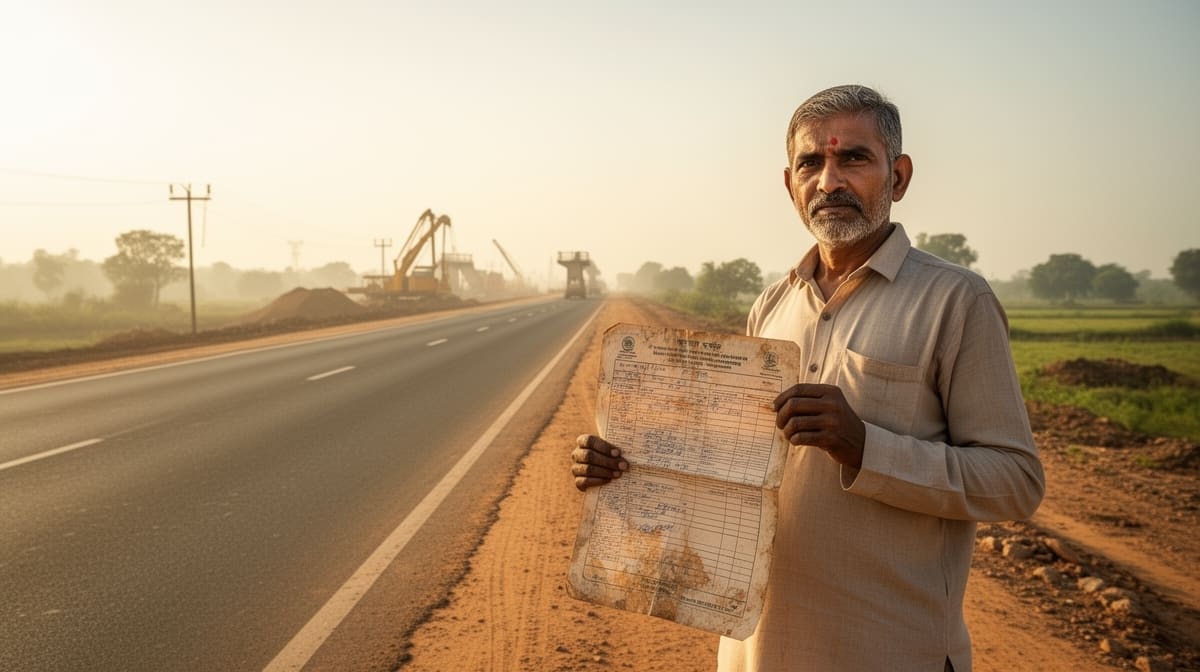
The Gauhati High Court has clarified that the mere disbursement of compensation does not extinguish a landowner’s statutory right to seek arbitration under the National Highways Act, 1956 when the compensation is challenged as inadequate. This ruling reinforces procedural safeguards for property owners and mandates timely referral of disputes to arbitrators upon formal request.
Background & Facts
The Dispute
The petitioner, Nijam Uddin Laskar, owns a plot of land measuring 7 kathas 8 gondas in Silchar, Cachar, on which he constructed an Assam-type house with three commercial shops. The Union of India, through NHIDCL, notified the acquisition of this land for the four-laning of NH-37 under Section 3A(1) of the National Highways Act, 1956. Despite the property being used commercially, the Competent Authority classified it as agricultural land, resulting in a significantly lower compensation amount.
Procedural History
- March 2024: Petitioner submitted first representation challenging land classification and compensation
- May 2025: Second representation filed, explicitly invoking Section 3G(5) for referral to Arbitrator
- June 2025: Third representation reiterated demand for arbitration
- August 2025: Writ petition filed after no action was taken by authorities
- March 2026: Hearing before Gauhati High Court
Relief Sought
The petitioner sought a direction to the Competent Authority to refer the dispute regarding inadequacy of compensation to the Arbitrator appointed by the Central Government under Section 3G(5) of the National Highways Act, 1956, and to determine compensation in accordance with Sections 26 to 30 of the Right to Fair Compensation and Transparency in Land Acquisition, Rehabilitation and Resettlement Act, 2013.
The Legal Issue
The central question was whether the Competent Authority under Section 3G(5) of the National Highways Act, 1956 is obligated to refer a dispute on inadequacy of compensation to an Arbitrator when a landowner submits a formal representation, even after compensation has been disbursed.
Arguments Presented
For the Petitioner
Mr. F. U. Barbhuiya argued that Section 3G(5) creates a mandatory duty to refer disputes upon request, irrespective of payment. He cited State of Haryana v. Sardar Singh to emphasize that disbursement of compensation does not waive the right to challenge its adequacy. The petitioner’s two written representations constituted clear invocation of statutory rights under Section 3G(5), and the Authority’s inaction violated natural justice and statutory mandate.
For the Respondent
The Union and NHIDCL contended that since the compensation amount had already been paid, the matter was rendered infructuous. The State of Assam and the Settlement Officer argued that the classification of land as agricultural was based on revenue records and that no statutory obligation arose post-payment. They relied on Union of India v. Rameshwar Prasad to suggest that payment extinguishes the right to challenge.
The Court's Analysis
The Court rejected the argument that payment of compensation negates the right to arbitration. It held that Section 3G(5) is a substantive right designed to ensure fair valuation, and its invocation is not contingent on whether payment has been made. The Court emphasized that the statutory framework under the National Highways Act, 1956 is intended to protect landowners from arbitrary valuation, and the reference to Arbitrator is a procedural safeguard that cannot be bypassed.
"The disbursement of compensation does not operate as a waiver of the right to seek arbitration under Section 3G(5). The legislature intended that disputes on inadequacy be resolved by an independent forum, not by administrative fiat."
The Court distinguished Union of India v. Rameshwar Prasad, noting that case dealt with procedural delay, not the mandatory nature of referral. It further held that the petitioner’s two representations were sufficient to trigger the obligation under Section 3G(5), and the Authority’s silence amounted to a failure to perform a statutory duty.
The Court also noted that while the Land Acquisition Act, 2013 provides enhanced compensation norms, its provisions are not directly applicable to acquisitions under the National Highways Act, 1956. However, the principles of fairness and transparency underpinning the 2013 Act may inform the Arbitrator’s assessment.
The Verdict
The petitioner succeeded. The Court held that Section 3G(5) imposes a mandatory obligation on the Competent Authority to refer disputes on compensation inadequacy to the Arbitrator upon written request, regardless of whether compensation has been disbursed. The Court directed the Authority to refer the matter within 30 days of service of the certified copy of the judgment.
What This Means For Similar Cases
Arbitration Referral Is Mandatory, Not Discretionary
- Practitioners must file written representations invoking Section 3G(5) immediately upon receiving inadequate compensation offers
- Authorities cannot delay or ignore such requests on grounds of payment being made
- Failure to refer constitutes a violation of statutory duty and is grounds for writ relief
Classification of Land Must Be Scrutinized Before Compensation Determination
- Land classified as agricultural in revenue records but used commercially must be challenged at the earliest stage
- Petitioners should submit proof of commercial use (shop licenses, electricity bills, income tax returns) alongside representation
- Arbitrators must consider actual use, not merely revenue classification
Payment Does Not Preclude Challenge
- Disbursement of compensation is not a bar to arbitration under Section 3G(5)
- Landowners retain the right to seek enhanced compensation even after receipt
- Authorities must preserve funds or secure undertakings pending arbitration if the amount is contested