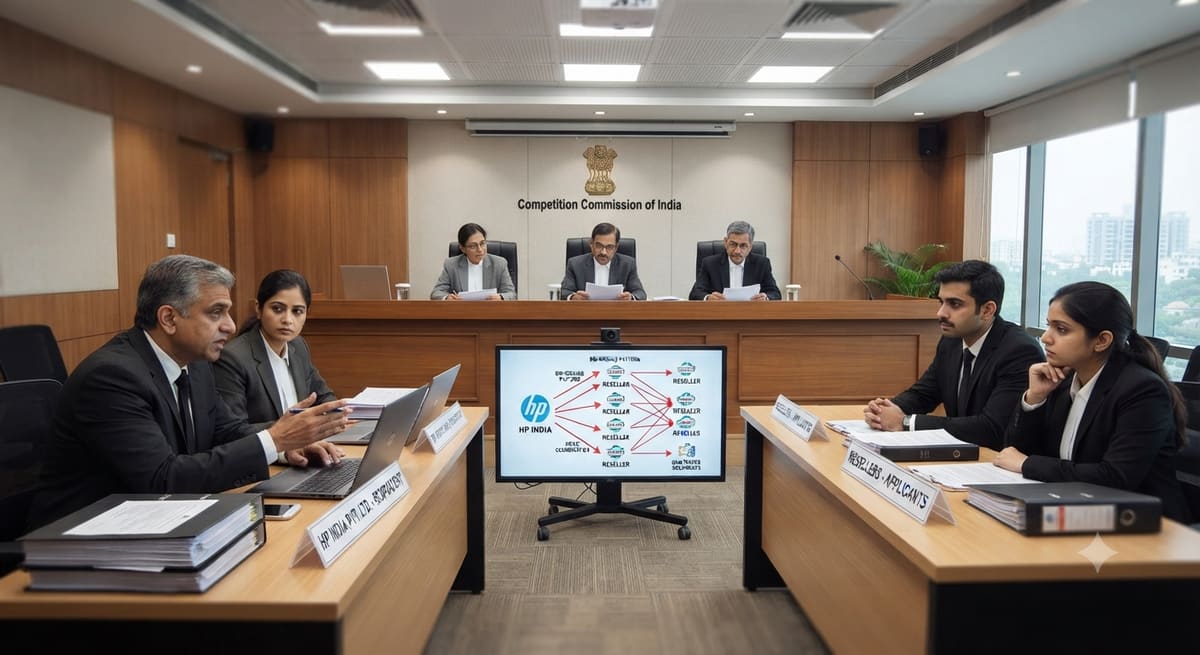
The Competition Commission of India has found a prima facie case of anti-competitive vertical restraints in the Indian poultry industry, directing a detailed investigation into the breeder agreements of the Venkateshwara Hatcheries Group. The order underscores that exclusive supply clauses and restrictions on breeders from dealing with competing parent stock may violate Section 3(4) of the Competition Act, 2002, even in highly integrated business models.
Background & Facts
The Dispute
The People for Animals (PFA), a registered animal welfare trust, filed an Information before the Competition Commission of India (CCI) alleging abuse of dominance and vertical restraints by the Venkateshwara Hatcheries Group (VH Group) and its eight group companies (OP-1 to OP-8), along with its Chairperson, Ms. Anuradha Desai (OP-9). The Informant alleged that the VH Group, through standardized Breeder Agreements, imposes restrictive conditions on contract farmers that foreclose competition in the markets for commercial layer hen and broiler chicken parent stock.
Key Facts
- The VH Group is described as the largest fully integrated poultry group in Asia, operating across breeding, feed production, hatchery management, and downstream distribution.
- OP-1 (Venkateshwara Hatcheries Pvt. Ltd.) is the holding company; OP-3 (Venco) supplies Vencobb broiler parent stock; OP-4 (VRB) supplies BV 300 layer parent stock.
- The VH Group holds over 80% market share in the commercial layer hen segment and over 75% in the broiler chicken segment in India, according to the Informant.
- The group controls key industry bodies: the National Egg Coordination Committee (NECC) with 35,000 members, and the Bharat Egg Producers Association (BEPA), where three of five directors are linked to the VH Group.
- The VH Group also controls All-India Poultry Development and Services Pvt. Ltd. (AIPDS) through Ms. Anuradha Desai and Mr. B. Venkatesh Rao.
- The Informant submitted a 2024 study from Punjab showing negative net returns for contract broiler farmers due to low growing charges, delayed payments (up to 60 days), and high feed costs.
Procedural History
- 28.06.2017: PFA filed Prior Information (Case Nos. 09 and 36 of 2017) against NECC and Agrocorpex India Ltd. alleging price-fixing under Section 3(3).
- 14.01.2022: CCI dismissed the Prior Information, clarifying that the VH Group was not a party and its conduct was not under adjudication.
- 2025: PFA filed the present Information (Case No. 15 of 2025) on 15.03.2025, alleging abuse of dominance and vertical restraints under Sections 3(4) and 4 of the Act.
- 30.07.2025: CCI issued notice to OP-1 seeking comments and documents, including copies of BBA and LBA.
- 03.09.2025: PFA submitted its supplementary response.
- 10.11.2025: OPs submitted their detailed reply, challenging jurisdiction, res judicata, and lack of AAEC.
- 07.01.2026: CCI heard oral submissions.
- 01.04.2026: CCI passed the present order.
The Parties' Positions
For the Informant (PFA)
- The VH Group’s Breeder Agreements (BBA and LBA) contain clauses that prohibit contract breeders from selling commercial chicks or hatching eggs to unauthorized persons, including competitors, overseas buyers, or users of non-VH breeds.
- Clause 7.1.10 of BBA and Clause 7.1.11 of LBA define "unauthorized persons" broadly to exclude all non-VH entities.
- Clause 7.1.13 (BBA) and 7.1.14 (LBA) prohibit breeders from dealing with any other breed of parent stock, effectively locking them into VH’s ecosystem.
- These restrictions constitute exclusive supply and territorial allocation under Section 3(4), causing appreciable adverse effect on competition (AAEC).
- The VH Group’s control over NECC and BEPA enables it to influence egg prices and suppress competition.
- Contract farmers suffer from exploitative terms: delayed payments, low compensation, and forced contributions to industry funds.
For the Respondents (OPs)
- The Informant is barred by res judicata and limitation from re-litigating issues already adjudicated in Case Nos. 09 and 36 of 2017.
- Vertical integration is a global industry norm, essential for biosecurity, quality control, and efficiency.
- Competitors such as Suguna Foods, Sneha, and Skylark Hatcheries operate similarly.
- No demonstrable harm to competition, consumer choice, or innovation has been shown.
- The Informant failed to prove dominance or AAEC under Section 3(4).
- The allegations of abuse under Section 4 are speculative and lack economic evidence.
Relief Sought
The Informant sought:
- Immediate cessation of mandatory contributions to NECC and similar bodies.
- Cessation of forced exclusivity in Vencobb and Babcock breeds.
- Institution of an inquiry under Section 26(1) directing the Director General (DG) to investigate violations of Sections 3(4) and 4.
- Removal of anti-competitive clauses from BBA and LBA.
- Penalties under Section 27.
- Any other appropriate directions.
The Legal Issue
The central question was whether the standardised Breeder Agreements imposed by the VH Group, which prohibit contract breeders from selling commercial chicks or hatching eggs to unauthorized persons and from dealing with competing parent stock, constitute vertical restraints under Section 3(4) of the Competition Act, 2002, that cause or are likely to cause an appreciable adverse effect on competition.
Arguments Presented
For the Appellant/Petitioner
The Informant relied on Coca-Cola India Pvt. Ltd. v. Competition Commission of India to argue that exclusive distribution agreements that foreclose market access to competitors constitute vertical restraints. It cited FICCI v. CCI to show that even if vertical integration is efficient, it cannot justify exclusionary conduct. The Informant submitted that the broad definition of "unauthorized persons" in the agreements effectively creates a closed loop, preventing breeders from entering alternative markets or sourcing from competitors. The Punjab study demonstrated economic harm to farmers, indicating market distortion. The Informant also emphasized that the VH Group’s control over NECC and BEPA amplifies its market power, creating a de facto cartel-like structure.
For the Respondent/State
The OPs contended that vertical integration is a legitimate and efficient business model widely adopted in the global poultry industry. They cited Suguna Foods v. CCI to argue that operational efficiencies and biosecurity justify integrated structures. They asserted that the Informant failed to quantify market foreclosure or consumer harm. The OPs argued that the prior case was distinct in subject matter and parties, and res judicata did not apply. They maintained that the agreements are standard industry terms and do not amount to anti-competitive agreements under Section 3(4), as no AAEC was established.
The Court's Analysis
The Commission began by distinguishing the present case from the prior Information (Case Nos. 09 and 36 of 2017), noting that the earlier matter concerned price-fixing under Section 3(3) against NECC, while the current case concerns vertical restraints under Section 3(4) against the VH Group’s contractual terms. The Commission held that the two matters involve different parties, different legal provisions, and different conduct, thereby rejecting the OPs’ plea of res judicata.
The Commission accepted the Informant’s delineation of two relevant product markets: (a) the market for production and supply of parent stock of commercially viable layer hen breeds in India; and (b) the market for production and supply of grandparent/parent stock of commercially viable broiler chicken breeds in India. The geographic market was accepted as pan-India, given the homogeneous regulatory and logistical environment.
The Commission noted that while the VH Group faces competition from Suguna, Sneha, and international lines like Hubbard and Ross, its market share, as alleged, is substantial. However, the Commission explicitly declined to determine dominance at this stage, stating that the focus was on the nature of the agreements.
"The restriction or limitation on the market of commercial broiler chicks and hatching eggs without adequate reason amounts to an imposition of vertical restraints in the form of exclusive supply and distribution agreement as provided under Section 3(4) of the Act."
The Commission examined Clauses 7.1.10 and 7.1.11 of the BBA and LBA, which prohibit breeders from selling to unauthorized persons, and Clauses 7.1.13 and 7.1.14, which prohibit breeders from dealing with any other breed. These clauses, the Commission held, prima facie restrict the breeders’ freedom to source from or sell to competitors, thereby reducing intra-brand and inter-brand competition.
The Commission acknowledged the OPs’ arguments regarding efficiency and biosecurity but held that such justifications cannot override the prima facie anti-competitive effect of the restrictions. The Commission noted that the agreements are standard form contracts, leaving breeders with no bargaining power, and that the restrictions are not tied to any demonstrable quality or health rationale.
The Commission further noted that the VH Group’s influence over NECC and BEPA, while not directly part of the Section 3(4) analysis, contextualizes the market power of the group and supports the inference of potential market foreclosure.
The Verdict
The Commission found a prima facie case of violation of Section 3(4) of the Competition Act, 2002, and directed the Director General to investigate the matter. The DG is ordered to complete the investigation and submit a report within 90 days of receiving this order. The DG is also directed to examine the role of officers responsible for the alleged conduct under Section 48 of the Act. The investigation shall include whether similar vertical restraints exist among other major poultry integrators. No penalties or interim relief were granted at this stage.
What This Means For Similar Cases
Vertical Restraints in Standard Form Contracts Are High-Risk
- Practitioners must scrutinize exclusive supply clauses in franchise, licensing, and breeder agreements for broad definitions of "unauthorized persons".
- Even if vertical integration is efficient, restrictions that prevent downstream actors from sourcing alternatives may trigger CCI scrutiny.
- Agreements that prohibit dealing with competing brands, even without explicit territorial limits, can be deemed anti-competitive.
Industry Associations Must Be Separated from Commercial Operations
- Control over trade bodies like NECC or BEPA by dominant firms raises red flags for collusion or market manipulation.
- Firms must ensure that industry associations operate independently and do not serve as conduits for anti-competitive coordination.
- Evidence of overlapping directorships between commercial entities and industry bodies should be disclosed and justified.
Burden of Justification Shifts to the Dominant Player
- Once a prima facie vertical restraint is shown, the burden shifts to the enterprise to prove pro-competitive benefits that outweigh the anti-competitive effect.
- Generic claims of "efficiency" or "biosecurity" are insufficient without data, benchmarks, or comparative analysis.
- The CCI will not accept industry norms as justification if they result in market foreclosure.