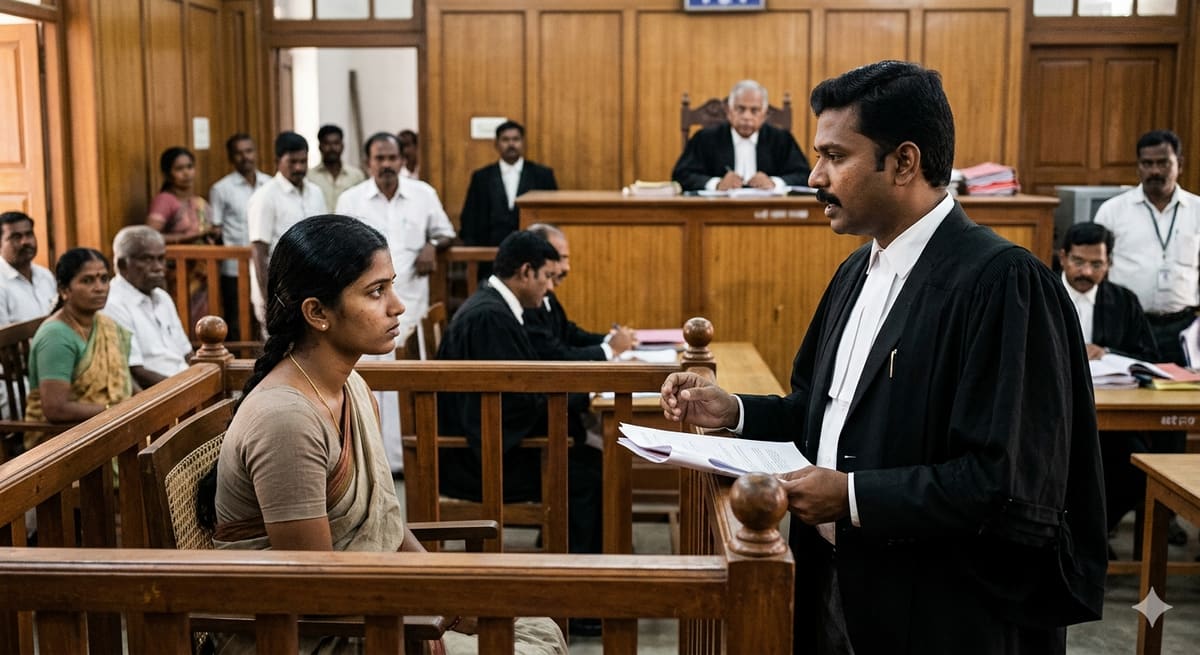
The Madras High Court has clarified that Section 33(5) of the POCSO Act, 2012, which restricts cross-examination of child victims in certain circumstances, ceases to apply once the victim attains majority before testimony. This ruling reinforces the constitutional right to a fair trial even in sensitive sexual offence cases.
Background & Facts
The Dispute
The petitioner, B. Thatchinamoorthi, is accused of offences under Section 366 of the IPC and Section 6 of the POCSO Act, 2012, relating to the abduction and sexual assault of a minor girl. The alleged incident occurred on 20.03.2017. The victim, born on 13.05.2000, attained the age of majority on 13.05.2017 - over two months before the charge sheet was filed on 30.08.2017. The trial commenced on 13.08.2019, and the victim, P.W.11, was chief-examined on 14.11.2019. At that time, she was already 19 years old. The petitioner was not represented by counsel during the chief-examination, and cross-examination was deferred. He was later assigned legal aid counsel.
Key Facts
- Victim’s date of birth: 13.05.2000
- Date of alleged offence: 20.03.2017
- Victim attained majority: 13.05.2017
- Charge sheet filed: 30.08.2017
- Trial commenced: 13.08.2019
- P.W.11 chief-examined: 14.11.2019 (age: 19 years)
- Petitioner represented by legal aid counsel from 2020 onwards
- Petition under Section 311 Cr.P.C. filed on 01.04.2024 seeking recall of P.W.11 for cross-examination
- Trial Court dismissed petition on 10.05.2024, invoking Section 33(5) of the POCSO Act
- As of 01.04.2026, victim is 27 years old
Procedural History
- 20.03.2017: Alleged offence committed
- 13.05.2017: Victim attains majority
- 30.08.2017: Charge sheet filed in Crime No. 55/2017
- 13.08.2019: Trial commences before Fast Track Mahila Court, Ramanathapuram
- 14.11.2019: P.W.11 chief-examined; no cross-examination due to absence of counsel
- 01.04.2024: Petitioner files Crl.M.P. No. 705/2024 under Section 311 Cr.P.C. to recall P.W.11
- 10.05.2024: Sessions Judge dismisses petition, relying on Section 33(5) of the POCSO Act
- 28.03.2026: Criminal Original Petition filed under Section 528 of BNSS, 2023, before Madras High Court
- 01.04.2026: Judgment delivered by Madras High Court
Relief Sought
The petitioner sought setting aside of the order dated 10.05.2024 dismissing the recall petition, and permission to cross-examine P.W.11, arguing that Section 33(5) was inapplicable as the victim was no longer a child at the time of examination.
The Legal Issue
The central question was whether Section 33(5) of the POCSO Act, 2012 prohibits the recall and cross-examination of a witness who was a child at the time of the alleged offence but had attained majority before her chief-examination in court.
Arguments Presented
For the Petitioner
The learned counsel argued that Section 33(5) applies only when the victim is a child at the time of testimony, not at the time of the offence. He relied on the precedent in S. Ganeshan v. State, where the Madras High Court held that once the victim attains majority, the restrictions under Section 33(5) cease to operate. He emphasized that the petitioner’s failure to cross-examine was due to inadvertence and lack of representation, not deliberate delay, and that denying cross-examination would violate the right to a fair trial under Article 21 of the Constitution.
For the Respondent
The Additional Public Prosecutor contended that Section 33(5) was designed to protect child victims from trauma during trial, and its application should not be narrowly interpreted. He argued that the provision’s protective intent extends to the entire trial process, regardless of the victim’s age at the time of testimony, and that allowing cross-examination after years of delay would prejudice the prosecution.
The Court's Analysis
The Court examined the language of Section 33(5), which states: "The court shall not permit the cross-examination of the child victim by the accused or any person acting on his behalf." The Court noted that the provision explicitly refers to the "child victim," a term defined under Section 2(d) of the POCSO Act as a person below eighteen years of age. Since the victim was 19 years old at the time of chief-examination and is now 27, she no longer qualifies as a "child" under the Act.
The Court relied on its own earlier decision in S. Ganeshan v. State, where it held:
"...the victim is now aged about 21 years and she will not fall within the definition of 'child' so as to Section 33(5) of the POCSO Act, 2012."
The Court further observed that the denial of cross-examination in this case would result in grave prejudice to the accused, particularly as the evidence of P.W.11 was central to the prosecution’s case. The Court emphasized that the right to cross-examine is a fundamental component of natural justice and cannot be curtailed by a provision that no longer applies. The trial court’s reliance on Section 33(5) was therefore legally untenable.
The Verdict
The petition was allowed. The order dated 10.05.2024 dismissing the recall petition was set aside. The petitioner is directed to file the process memo within three days of receiving a copy of this order. The cross-examination of P.W.11 shall be completed on the same day she appears in court. No further opportunity for cross-examination shall be granted. The trial court is directed to ensure the proceedings are concluded expeditiously.
What This Means For Similar Cases
Section 33(5) Is Age-Specific at Time of Testimony
- Practitioners must assess the victim’s age at the time of chief-examination, not the date of offence, to determine applicability of Section 33(5)
- If the victim is 18 or older during testimony, Section 33(5) cannot be invoked to deny cross-examination
Fair Trial Overrides Procedural Delays
- Inadvertent non-cross-examination due to lack of counsel does not forfeit the right to recall a witness under Section 311 Cr.P.C.
- Courts must balance victim protection with the accused’s right to confront witnesses
Judicial Discretion Must Be Grounded in Statutory Language
- Courts cannot extend statutory protections beyond their textual scope
- Relying on protective intent without reference to statutory definitions risks violating procedural fairness