The Himachal Pradesh High Court has reaffirmed that negligent driving resulting in death attracts stringent punishment under Section 304-A IPC, with courts obligated to impose deterrent sentences to curb the rising toll of road accidents. The judgment also clarifies the evidentiary weight of an accused’s statement under Section 313 CrPC when it aligns with prosecution evidence.
Background & Facts
The Dispute
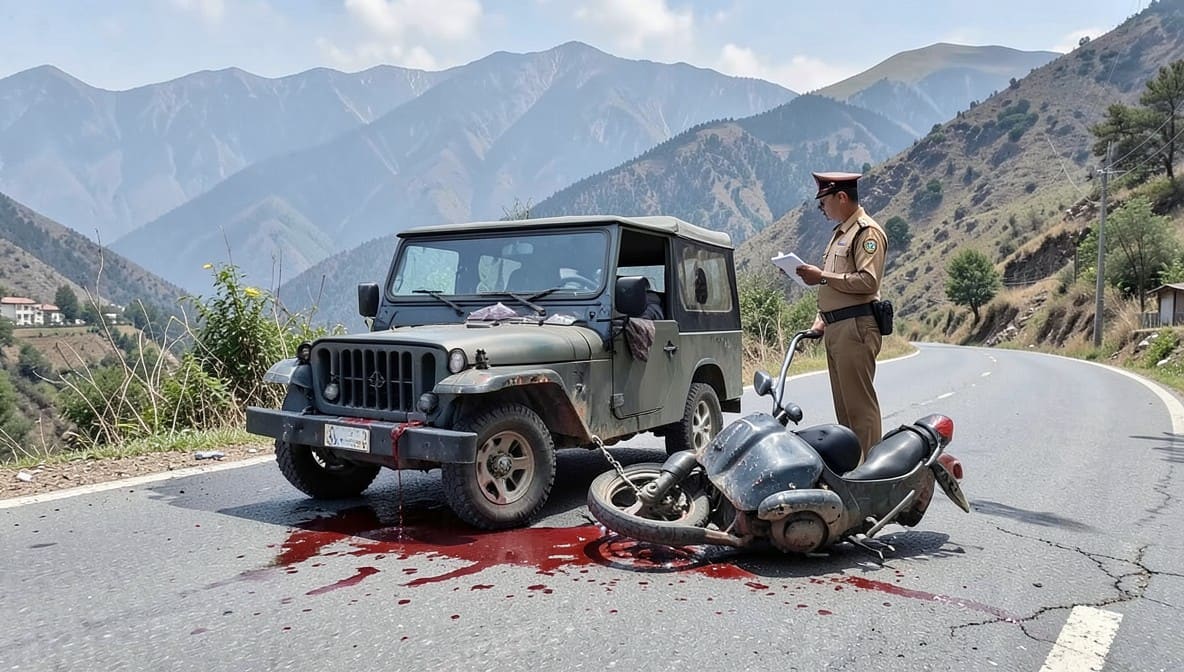
The petitioner, Rajeev Kumar, was charged with causing the death of Ashwani Kumar through rash and negligent driving on 30.01.2006. The incident occurred near Barthin, District Bilaspur, Himachal Pradesh, when a jeep bearing registration No. HP-22-2752, driven by the petitioner, collided with a scooter bearing registration No. HP-23A-1229. The scooter was dragged for 30-35 feet, resulting in fatal head injuries to Ashwani Kumar, who later succumbed at PGI, Chandigarh.
Key Facts
- The accident occurred on 30.01.2006 at approximately 10:30 a.m.
- The scooter was being driven from Barthin towards Balhseena; the jeep was coming from Balhseena towards Barthin.
- The jeep struck the scooter on the wrong side of the road, leaving only 2.5 feet of space on the scooter’s left side, while the jeep occupied the right side with 10 feet of clearance.
- The driver of the jeep fled the scene without rendering aid.
- The jeep was located and seized at Chakmoh Bazaar at approximately 1:30 p.m.
- The driver identified himself as Rajeev Kumar (the petitioner).
- The vehicle’s left bumper and indicator were visibly damaged.
- The scooter’s registration number was HP-23A-1229; the jeep’s was HP-22-2752.
- The victim, Ashwani Kumar, was 28 years old and sustained craniocerebral trauma due to blunt head injury.
- The police recorded an entry (Ext.PW-10/A) at 10:30 a.m. noting the accident and the direction of the jeep’s escape.
- An application (Ext.PW-5/A) for MLC was filed by HC Thakur Dass (PW-11) at 10:45 a.m., explicitly mentioning the jeep’s registration number.
- The mechanical examination report (Ext.PW-9/A) by HHC Dev Raj (PW-9) confirmed no mechanical defects in either vehicle.
- The post-mortem report (Ext.PX) concluded death was due to blunt head trauma consistent with a motor vehicle accident.
- The petitioner admitted in his Section 313 CrPC statement that he was driving the jeep on the date of the accident.
Procedural History
- 30.01.2006: Accident occurred at approximately 10:30 a.m.
- 10:30 a.m.: Police entry recorded (Ext.PW-10/A) at Talai Police Station.
- 10:45 a.m.: MLC application filed mentioning jeep’s registration number.
- 11:00 a.m.: ASI Ram Dass (PW-10) left police station to investigate.
- 11:15 a.m.: Subhash Chand (PW-7) intercepted jeep at Chakmoh Bazaar.
- 1:30 p.m.: Jeep seized at Chakmoh Bazaar; F.I.R. (Ext.PW-12/A) registered.
- 05.08.2014: Trial Court convicted petitioner under Sections 279, 304-A IPC and Section 187 MV Act.
- 29.05.2015: Additional Sessions Judge, Bilaspur, upheld conviction and sentence.
- 24.03.2026: Himachal Pradesh High Court dismissed revision petition.
The Parties' Positions
For the Petitioner (Rajeev Kumar): Argued that the prosecution failed to prove identity of the driver, that the registration number of the jeep was not known until after seizure, and that there were contradictions between Subhash Chand (PW-7) and ASI Ram Dass (PW-10) regarding the sequence of events. Claimed no eyewitness identified him in court.
For the Respondent (State of Himachal Pradesh): Contended that the petitioner admitted driving the jeep under Section 313 CrPC, that the prosecution’s version was corroborated by multiple witnesses and physical evidence, and that the concurrent findings of two courts should not be disturbed absent perversity.
Relief Sought
The petitioner sought quashing of the conviction and sentence under Sections 279, 304-A IPC and Section 187 MV Act, arguing that the evidence was insufficient and the findings were perverse.
The Legal Issue
Whether the concurrent findings of conviction under Section 304-A IPC, based on circumstantial evidence and the accused’s admission under Section 313 CrPC, can be set aside by a revisional court in the absence of perversity or jurisdictional error, and whether the sentence imposed was legally justified under the principle of deterrence.
Arguments Presented
For the Appellant/Petitioner
The petitioner’s counsel, Mr. N.S. Chandel, argued that the prosecution failed to establish the identity of the driver beyond doubt. He emphasized that the registration number of the jeep was not mentioned in the initial daily diary entry and was only recorded after the vehicle was seized. He contended that the testimony of Subhash Chand (PW-7) and ASI Ram Dass (PW-10) were irreconcilable on the timing and sequence of events. He further argued that no eyewitness identified the petitioner in court, rendering the identification process defective. He relied on Kishan Rao v. Shankargouda and Bir Singh v. Mukesh Kumar to assert that revisional courts cannot reappreciate evidence absent perversity.
For the Respondent/State
The Additional Advocate General, Mr. Lokender Kutlehria, submitted that the petitioner had admitted driving the jeep under Section 313 CrPC, which, under State of Maharashtra v. Sukhdev Singh and Mohan Singh v. Prem Singh, can be used to corroborate prosecution evidence. He highlighted that the site plan, photographs, mechanical reports, and post-mortem findings all aligned with the prosecution’s version. He emphasized that the petitioner’s failure to render aid and his flight from the scene satisfied the ingredients of Section 187 MV Act and Section 304-A IPC. He cited Dalbir Singh v. State of Haryana to argue that the sentence was not excessive but necessary for deterrence.
The Court's Analysis
The Court began by reiterating the narrow scope of revisional jurisdiction under Section 397 CrPC, citing Malkeet Singh Gill v. State of Chhattisgarh and State of Gujarat v. Dilipsinh Kishorsinh Rao. It held that revisional courts are not appellate forums and cannot reappreciate evidence unless the findings are perverse, based on no evidence, or involve a jurisdictional error.
The Court found no perversity in the concurrent findings of the Trial Court and the Appellate Court. It emphasized that the petitioner had admitted under Section 313 CrPC that he was driving the jeep on the date of the accident. Citing State of Maharashtra v. Sukhdev Singh and Mohan Singh v. Prem Singh, the Court held that while such a statement is not evidence stricto sensu, it may be taken into consideration and used to corroborate prosecution evidence. The Court noted that the petitioner’s admission was not challenged and was consistent with the recovery of the vehicle and the damage to its bumper.
The Court further held that the suggestions made during cross-examination of prosecution witnesses - such as the jeep being driven on the Kachha portion or the driver attempting to save the victim - were incriminating and binding on the accused under Balu Sudam Khalde v. State of Maharashtra. These suggestions, the Court reasoned, could only have been made if the accused was present at the scene.
Regarding the alleged contradiction between Subhash Chand (PW-7) and ASI Ram Dass (PW-10), the Court found the discrepancy minor and explained by the timeline: Subhash Chand informed the police at 11:15 a.m., and ASI Ram Dass left the station at 11:00 a.m. - a timing that supports the former’s version. The Court rejected the argument that the registration number was introduced post-seizure, noting that the MLC application filed at 10:45 a.m. already referenced HP-22-2752.
The Court examined the road layout through the site plan (Ext.PW-11/A) and photographs, concluding that the jeep was driven on the wrong side of the road, violating Rule 2 of the Rules of the Road Regulations, 1989. It relied on Fagu Moharana v. State, State of H.P. v. Dinesh Kumar, and State of H.P. v. Niti Raj to hold that such conduct amounted to negligence per se.
The Court accepted the post-mortem report and mechanical examination as conclusive. It held that the failure to render aid and the act of fleeing the scene satisfied the requirements of Section 187 MV Act.
On sentencing, the Court invoked Dalbir Singh v. State of Haryana, State of Punjab v. Balwinder Singh, and State of Punjab v. Saurabh Bakshi to emphasize that Section 304-A IPC demands deterrent sentencing due to the alarming frequency of road accidents in India. It held that the two-year sentence was not excessive and was justified to instill fear in negligent drivers.
"The accused admitted in his statement recorded under Section 313 of Cr.P.C. that he was driving the jeep bearing registration No. HP-22-2752, therefore, the accused never disputed that he was the driver of the jeep."
"Courts must bear in mind that... road accidents have proliferated to an alarming extent, and the toll is galloping up day by day in India... Criminal Courts cannot treat the nature of the offence under S. 304-A, I.P.C. as attracting the benevolent provisions of S. 4 of the PO Act."
The Verdict
The revision petition was dismissed. The conviction under Sections 279, 304-A IPC and Section 187 MV Act was upheld. The sentence of two years’ simple imprisonment for Section 304-A IPC, six months for Section 279 IPC, and one month for Section 187 MV Act - all to run concurrently - was confirmed. The fine of ₹2,000 for Section 304-A IPC, ₹1,000 for Section 279 IPC, and ₹500 for Section 187 MV Act was upheld, with default sentences of three months, one month, and seven days respectively. The Court directed that the records be sent back forthwith.
What This Means For Similar Cases
Section 313 CrPC Statements Are Powerful Corroborative Tools
- Practitioners must treat an accused’s admission under Section 313 CrPC as a critical piece of corroborative evidence, even if not evidence stricto sensu.
- Where the accused admits to driving the vehicle, and the prosecution establishes negligence and causation, conviction under Section 304-A IPC becomes highly probable.
- Defense arguments based solely on lack of eyewitness identification will fail if the accused’s own statement and circumstantial evidence align.
Deterrent Sentencing Is Mandatory in Fatal Road Accidents
- Courts are now bound to impose sentences that act as deterrents, not lenient penalties, under Section 304-A IPC.
- Probation under Section 4 of the Probation of Offenders Act, 1958, is inapplicable in cases involving death due to rash or negligent driving.
- A two-year sentence is now the norm for such offenses; fines alone are insufficient and will be enhanced.
Minor Inconsistencies in Witness Testimony Do Not Invalidate Convictions
- Minor contradictions in timelines or sequence of events, if explained by the overall evidence, do not create reasonable doubt.
- The Court will accept the version supported by physical evidence (site plan, photographs, mechanical reports) over oral inconsistencies.
- Police entries and official documents (e.g., MLC applications) dated prior to arrest carry greater weight than post-arrest claims.