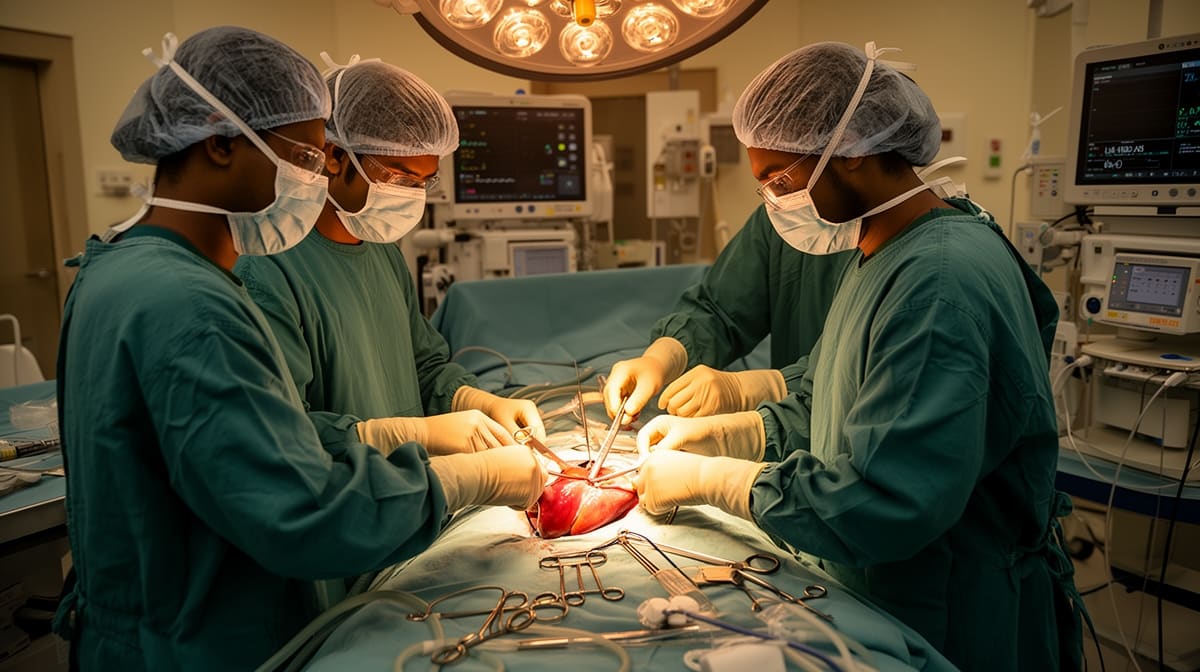
In a landmark ruling that redefines familial relationships in the context of life-saving medical procedures, the Punjab and Haryana High Court has held that a mother-in-law qualifies as a 'near relative' under the Transplantation of Human Organs and Tissues Act, 1994 for the purpose of kidney swap donations. The judgment prioritizes humanitarian necessity over rigid statutory interpretation, setting a new precedent for organ transplantation jurisprudence in India.
Background & Facts
The Dispute
Two petitioners, Anil Kumar and Harjit Singh, both suffering from end-stage renal disease, sought permission to undergo a kidney swap transplant at PGIMER, Chandigarh. Each petitioner’s intended donor - Anil Kumar’s mother-in-law, Meena Devi, and Harjit Singh’s wife - were medically incompatible with their respective recipients due to blood group and tissue mismatches. The families proposed a reciprocal donation: Meena Devi would donate her kidney to Harjit Singh, and Harjit Singh’s wife would donate hers to Anil Kumar. This arrangement, known as a paired kidney exchange, is a recognized medical protocol to overcome biological incompatibility.
Key Facts
- Anil Kumar and Harjit Singh were both on regular dialysis as of 2025, with no viable living donor within the statutory definition of 'near relative'.
- Meena Devi (mother-in-law of Anil Kumar) and the wife of Harjit Singh voluntarily offered to donate their kidneys.
- Medical evaluation at PGIMER confirmed biological incompatibility between each donor-recipient pair.
- The Authorization Committee under the Transplantation of Human Organs and Tissues Act, 1994 (THOTA) rejected the swap request on the sole ground that a mother-in-law is not listed as a 'near relative' under Section 2(i).
- The petitioners had no alternative donor and faced prolonged dependence on dialysis, with associated physical, emotional, and financial burdens.
- Both families were unrelated to each other prior to the proposed swap, with no commercial or intermediary involvement.
Procedural History
- 2024: Petitioners approached PGIMER for transplant evaluation and proposed kidney swap.
- Late 2024: Authorization Committee convened under Section 9(3-A) of THOTA and rejected the request.
- 2025: Two writ petitions filed before the Punjab and Haryana High Court:
- CWP-33455-2025 (Anil Kumar and others)
- CWP-38231-2025 (Md. Shamim Akhtar Didar and others)
- 19.03.2026: Hearing concluded; judgment delivered by Justice Jagmohan Bansal.
The Parties' Positions
For the Petitioners
The petitioners argued that the definition of 'near relative' under Section 2(i) of THOTA must be interpreted purposively, not literally. They contended that:
- The Act’s primary objective is to facilitate life-saving transplants while preventing commercial exploitation.
- Modern Indian families, especially in urban settings, are nuclear and lack extended kinship networks.
- Excluding mother-in-law from 'near relative' defeats the humanitarian purpose of the Act.
- The Court’s own precedent in Ajay Mittal v. Union of India (2022 SCC OnLine P&H 3696) supported a liberal interpretation.
- The Supreme Court in Executive Engineer v. Sri Seetaram Rice Mill (2012) and K.V. Muthu v. Angamuthu Ammal (1997) held that 'means' does not always imply exclusivity when context demands a broader reading.
For the Respondent (Union of India and PGIMER)
The respondents maintained that:
- Section 2(i) of THOTA explicitly defines 'near relative' as spouse, son, daughter, father, mother, brother, sister, grandfather, grandmother, grandson, or granddaughter.
- The term 'means' in the definition renders it exhaustive.
- Section 9(3-A) permits swapping only if donors are 'near relatives' as defined.
- The Authorization Committee acted strictly within statutory bounds and had no authority to expand the definition.
- Any expansion of the term must come from legislative amendment, not judicial interpretation.
Relief Sought
The petitioners sought:
- A direction to the Authorization Committee to approve the kidney swap between the two families.
- A declaration that mother-in-law qualifies as a 'near relative' under Section 9(3-A) of THOTA for the purpose of organ swapping.
- An order directing PGIMER to proceed with the transplant upon fulfillment of all medical and procedural formalities.
The Legal Issue
The central question was whether the term 'near relative' as defined in Section 2(i) of the Transplantation of Human Organs and Tissues Act, 1994, is exhaustive and excludes mother-in-law, or whether a purposive interpretation permits its inclusion in the context of paired kidney donation under Section 9(3-A).
Arguments Presented
For the Petitioner
The petitioners relied on the Supreme Court’s rulings in Executive Engineer v. Sri Seetaram Rice Mill and K.V. Muthu v. Angamuthu Ammal to argue that the word 'means' in a statutory definition does not automatically render it exhaustive. They emphasized that the object of THOTA is to save lives and prevent commercial exploitation, not to create artificial barriers to donation. They pointed out that the Act already permits organ donation to non-relatives under Section 9(3), subject to Authorization Committee scrutiny under Rule 7(3). If the Committee can approve donations to strangers based on emotional bonds and absence of commercial intent, then denying a swap between two families with deep familial ties - where the mother-in-law is functionally equivalent to a parent - is arbitrary and irrational. The petitioners also highlighted the societal shift toward nuclear families, where grandparents are often deceased or medically unfit to donate, leaving mother-in-law as the only viable donor.
For the Respondent
The respondents argued that the statutory definition is clear and unambiguous. They contended that the legislature deliberately chose to list specific relatives and omitted mother-in-law, suggesting intentional exclusion. They warned that judicial expansion of the term could open the floodgates to claims by other in-laws, creating uncertainty in transplant protocols. They maintained that the Authorization Committee’s role is administrative and bound by the text of the law, and that any change must come from Parliament. They also noted that Section 9(3) provides an alternative pathway for non-relatives, making the petitioners’ request unnecessary.
The Court's Analysis
The Court undertook a detailed analysis of statutory interpretation principles, distinguishing between the use of 'means' and 'means and includes'. It observed that while 'means and includes' creates an exhaustive list, 'means' alone permits a purposive reading, particularly when the context demands it. The Court cited Executive Engineer v. Sri Seetaram Rice Mill to affirm that 'means' does not always restrict the scope of a definition, especially when a literal interpretation would frustrate the Act’s purpose.
"An interpretation which upon application of the provisions at the ground reality, would frustrate the very law should not be accepted against the common sense view which will further such application."
The Court further relied on K.V. Muthu v. Angamuthu Ammal, where the Supreme Court held that even a 'conclusive' definition of 'family' could be read inclusively when the context and object of the statute required it. The Court noted that THOTA’s preamble and structure emphasize the preservation of life and the prevention of organ trafficking - not the exclusion of emotionally and socially significant relationships.
The Court observed that the Authorization Committee already evaluates non-relative donations under Rule 7(3) for commercial intent, emotional bond, and absence of coercion. In this case, all those safeguards were satisfied: the donors were close family members, no payment was involved, no middlemen existed, and the financial and medical records were transparent. The Court reasoned that if a stranger can be approved as a donor under Section 9(3), then a mother-in-law, who is often treated as a parent in Indian households, should not be excluded under Section 9(3-A) merely due to a technical omission in the definition.
The Court emphasized that the Act’s object is not to regulate family structures but to save lives. It held that excluding mother-in-law from 'near relative' in the context of organ swapping would be an absurd result inconsistent with the Act’s humanitarian purpose.
The Verdict
The petitions were allowed. The Court held that for the purpose of kidney swap under Section 9(3-A) of the Transplantation of Human Organs and Tissues Act, 1994, the term 'near relative' includes mother-in-law. The Authorization Committee at PGIMER is directed to approve the proposed kidney swap between the two families, subject to compliance with all medical protocols and procedural requirements under Rule 7. The transplant must be conducted within 60 days of this order, and PGIMER is directed to bear all administrative costs associated with expediting the process. The Court further directed that this interpretation shall apply to all pending and future cases involving organ swapping under Section 9(3-A).
What This Means For Similar Cases
Mother-in-Law Is Now a Recognized Donor in Organ Swaps
- Practitioners may now argue that mother-in-law qualifies as a 'near relative' for paired kidney donation under THOTA 1994.
- Authorization Committees must reassess previous rejections based solely on the exclusion of mother-in-law.
- Legal notices and applications for organ swaps must now include mother-in-law as a potential donor without requiring prior legislative amendment.
Purposive Interpretation Overrides Literal Definitions in Life-Saving Statutes
- Courts will apply purposive construction to definitions using 'means' when literal interpretation defeats the statute’s humanitarian purpose.
- This judgment reinforces that statutes governing health and life-saving interventions must be interpreted flexibly.
- Similar arguments may now be raised in other contexts where statutory definitions exclude socially significant relationships (e.g., step-parents, adoptive parents, or in-laws in adoption or guardianship laws).
Non-Relative Donation Pathway Does Not Render Swap Provision Redundant
- The existence of Section 9(3) for non-relative donations does not negate the need for Section 9(3-A) to accommodate familial swaps.
- The Court clarified that Section 9(3-A) is designed to streamline approvals for emotionally bonded, non-commercial exchanges - making it more efficient than the general non-relative route.
- Practitioners should prioritize Section 9(3-A) for family-based swaps, even if one donor falls outside the traditional list, provided the relationship is genuine and meets Rule 7(3) criteria.