
The Supreme Court has reaffirmed that compensation for acquired land must be determined strictly in accordance with the statutory framework under the Right to Fair Compensation and Transparency in Land Acquisition, Rehabilitation and Resettlement Act, 2013. In this case, the Court set aside an arbitral award that improperly valued industrial land using a residential sale deed, emphasizing that statutory methodology cannot be circumvented even in arbitration proceedings.
Background & Facts
The Dispute
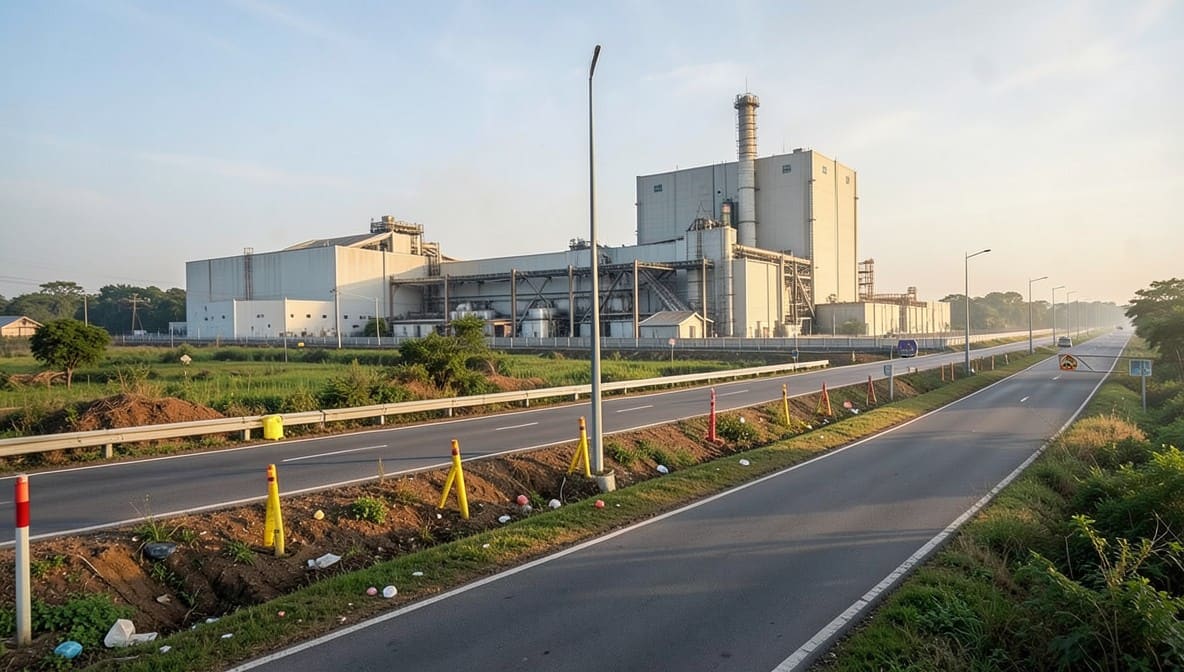
The National Highways Authority of India (NHAI) sought to acquire land for the four-laning of National Highway No. 547-E in Nagpur District. The acquired land, measuring 1,394 square meters in Survey No. 66 of Mouza Pardi (Rithi), Tahsil-Saoner, was owned by Alfa Remidis Ltd. The dispute centered on the classification and valuation of the land for compensation purposes.
Key Facts
- Notification under Section 3A(1) of the National Highways Act, 1956, was issued on 09.05.2017 for acquisition of the land
- The Deputy Collector, Land Acquisition (General), Nagpur, issued an order on 27.03.2018 classifying the land as fallow agricultural land and awarded compensation at ₹161.63 per square meter
- Alfa Remidis Ltd. contested this classification, asserting the land was being used for industrial purposes - specifically, for the production of paracetamol medicine
- The company submitted documents including: (i) a registered sale deed dated 29.03.2017 for a 195.09 sq. m. residential plot in Mouza Saoner at ₹3,588/sq. m.; (ii) the Ready Reckoner rate of ₹2,020/sq. m. for Zone 4 lands (which includes Mouza Pardi)
- The Arbitrator, in Award dated 22.11.2021, accepted the ₹3,588/sq. m. rate from the residential sale deed and enhanced compensation accordingly
- NHAI challenged the Award under Section 34 of the Arbitration and Conciliation Act, 1996, before the District Judge, Nagpur
- The District Judge, by judgment dated 11.09.2023, set aside the Award, holding it violated Section 26 of the 2013 LA Act
- Alfa Remidis Ltd. appealed to the Bombay High Court (Nagpur Bench), which, by judgment dated 05.06.2025, restored the Arbitrator’s Award
- The Supreme Court granted special leave to appeal on 14.11.2025, and directed NHAI to deposit ₹50,00,000, which Alfa Remidis Ltd. withdrew
Procedural History
- 09.05.2017: Notification issued under Section 3A(1) of the NH Act
- 27.03.2018: Deputy Collector’s compensation order at ₹161.63/sq. m.
- 2019-20: Arbitration Case No. 193/ARB/2019-20 filed under Section 3G(5) of the NH Act
- 22.11.2021: Arbitrator’s Award enhancing compensation to ₹3,588/sq. m.
- 2022: NHAI filed Section 34 application before District Judge-10, Nagpur
- 11.09.2023: District Judge set aside the Award
- 05.06.2025: Bombay High Court (Nagpur Bench) restored the Award via Arbitration Appeal No. 39 of 2023
- 14.11.2025: Supreme Court granted SLP and directed deposit of ₹50,00,000
- 12.05.2026: Supreme Court judgment delivered
Relief Sought
NHAI sought setting aside of the Arbitrator’s Award and restoration of the Deputy Collector’s original compensation rate. Alfa Remidis Ltd. sought confirmation of the enhanced rate of ₹3,588/sq. m. and full statutory benefits under the 2013 LA Act.
The Legal Issue
The central question was whether an Arbitrator may determine market value of industrial land under Section 26(1)(b) of the 2013 LA Act by relying on a single sale deed of residential land in a nearby village, despite the existence of a higher, applicable government stamp duty rate under Section 26(1)(a).
Arguments Presented
For the Appellant (NHAI)
NHAI contended that the Arbitrator and High Court erred in disregarding the mandatory hierarchy under Section 26(1) of the 2013 LA Act. It argued that the sale deed relied upon was for a residential plot, not industrial land, and thus not of a ‘similar type’ as required by Explanation 1. Further, Section 26(1)(b) requires an average of multiple sale deeds over three years, not a single transaction. NHAI emphasized that the Ready Reckoner rate of ₹2,020/sq. m. for Zone 4 - which includes Mouza Pardi - was the correct benchmark under clause (a), and that the Arbitrator’s methodology violated the statutory scheme.
For the Respondent (Alfa Remidis Ltd.)
Alfa Remidis Ltd. argued that the land was non-agricultural and used for industrial purposes, and that the ₹3,588/sq. m. rate from the nearby sale deed was the best available proxy for market value. It contended that the High Court correctly appreciated the evidence and that the Arbitrator’s award should not be disturbed under Section 34(2A) of the Arbitration Act, which bars interference for mere errors of law or reappreciation of evidence.
The Court's Analysis
The Supreme Court undertook a detailed statutory interpretation of Section 26(1) of the 2013 LA Act, which governs the determination of market value for land acquisition. The Court observed that the provision mandates a hierarchical approach: the Collector must adopt the higher of (a) the stamp duty rate, (b) the average sale price of similar land in the nearest village, or (c) the consented amount.
"The Arbitrator completely ignored the directives of Section 26(1)(b) of the 2013 LA Act and the Explanations thereunder, by adopting a sale exemplar of a totally dissimilar type of land and, at that, a single sale exemplar, which was contrary to the statutory mandate."
The Court held that the sale deed dated 29.03.2017 pertained to a residential plot of 195.09 sq. m. in Mouza Saoner, whereas the acquired land was industrial in nature and 1,394 sq. m. in extent. The two were not of a ‘similar type’ as required by Section 26(1)(b). The Court further emphasized that Explanation 1 and 2 require the average of multiple sale deeds over the preceding three years, and reliance on a single transaction is impermissible. This was reinforced by the precedent in Madhya Pradesh Road Development Corporation v. Vincent Daniel and others.
The Court noted that Alfa Remidis Ltd. itself had cited the Ready Reckoner rate of ₹2,020/sq. m. - a rate applicable to Zone 4, which includes Mouza Pardi - and that this rate was the statutory benchmark under clause (a). The Arbitrator’s failure to apply this rate, despite its availability and statutory primacy, constituted patent illegality under Section 34(2A) of the Arbitration Act.
The Court rejected the argument that the Arbitrator’s discretion in evidence appreciation insulated the award from challenge. It held that when an award contravenes a mandatory statutory provision, it is not merely an error of law but a patent illegality that renders the award void.
The Verdict
The appeal was allowed. The Supreme Court set aside the High Court’s judgment dated 05.06.2025 and the Arbitrator’s Award dated 22.11.2021. The compensation payable to Alfa Remidis Ltd. for 1,394 square meters of land is fixed at ₹2,020 per square meter, amounting to ₹28,15,880. The sum of ₹50,00,000 already withdrawn by the respondent shall be adjusted against this amount. The balance, if any, shall be paid within eight weeks. The respondent is entitled to all other statutory benefits under the 2013 LA Act. Parties shall bear their own costs.
What This Means For Similar Cases
Market Value Must Reflect Land Use and Type
- Practitioners must ensure that comparables used for valuation are of the same land use - industrial, residential, or agricultural - and not merely geographically proximate
- A sale deed for a residential plot cannot be used to value industrial land, even if located in a neighboring village
- The classification of land use at the time of notification is decisive, not the prior or intended use
Single Sale Deeds Are Statutorily Inadmissible
- Section 26(1)(b) requires an average derived from multiple registered sale deeds over three years
- Relying on one transaction, regardless of its price, violates the statutory mandate and constitutes patent illegality
- Arbitrators and courts must calculate averages as per Explanation 2: taking into account only half of the highest-priced deeds
Ready Reckoner Rates Are Statutory First Reference
- Where a government Ready Reckoner rate exists for the area and land type, it is the primary benchmark under Section 26(1)(a)
- This rate must be applied unless a higher value is established under clause (b) or (c)
- Ignoring the Ready Reckoner rate in favor of an unrelated sale deed is legally unsustainable





