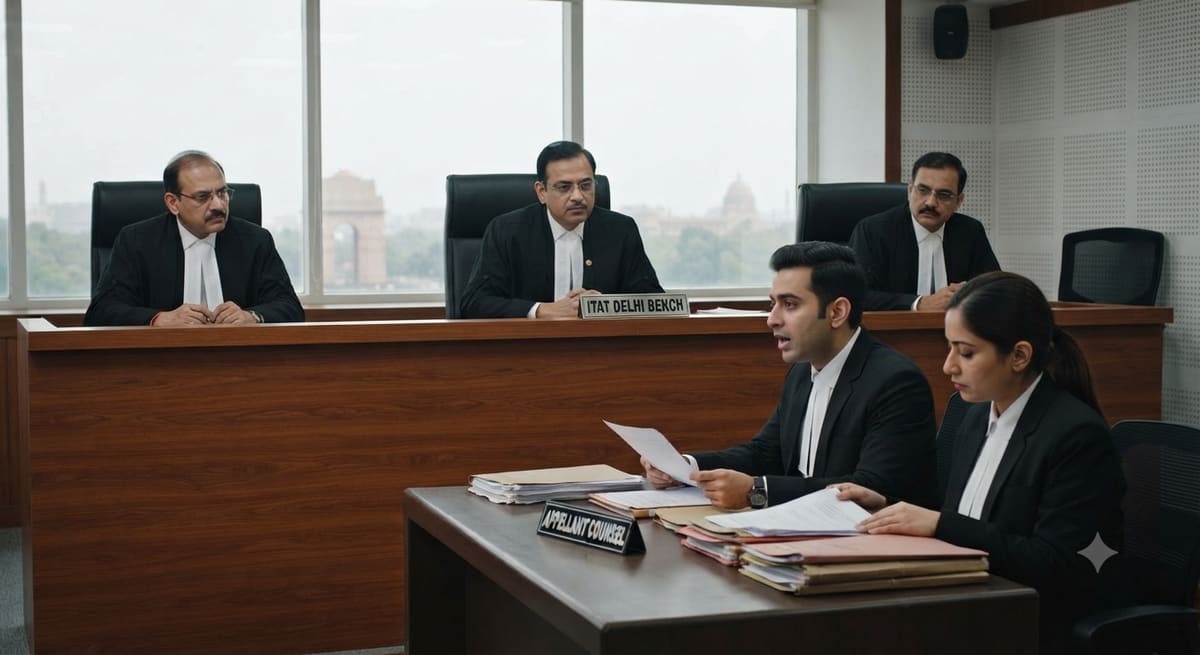
The Income Tax Appellate Tribunal, Agra, has reaffirmed that the requirement to issue a reasoned, speaking order under Section 250(6) of the Income Tax Act is non-negotiable - even when an appeal is decided ex parte. This judgment underscores that procedural fairness cannot be sacrificed for administrative convenience, and that the absence of reasoning vitiates any appellate order regardless of the appellant’s default.
Background & Facts
The Dispute
The appellant, Satish Chandra Huf, challenged the order dated 02.12.2024 passed by the Commissioner of Income Tax (Appeals) (CIT(A)) Delhi, which confirmed a penalty under Section 270A of the Income Tax Act, 1961 for the Assessment Year 2017-18. The CIT(A) disposed of the appeal ex parte, without examining the merits or recording reasons for the decision.
Key Facts
- The appellant filed his Income Tax Return for A.Y. 2017-18 on 30.09.2017
- The Assessing Officer issued a notice under Section 143(3) and later passed an order under Section 270A on 15.01.2023, imposing a penalty
- The appellant filed a first appeal before the CIT(A) on 10.03.2023
- The CIT(A) scheduled hearings on 25.07.2023, 05.08.2024, 14.10.2024, and 04.11.2024
- The appellant did not appear at any of these hearings
- The CIT(A) passed an ex parte order on 02.12.2024 confirming the penalty
- The appellant claims he never received the CIT(A)’s order by post
- He became aware of the order only upon receiving a demand notice dated 07.11.2025
- He downloaded the impugned order from the ITBA portal on 28.11.2025
- The instant appeal before ITAT was filed on 03.02.2026
- The appeal was filed 338 days beyond the statutory limitation period
- The appellant filed an application for condonation of delay on 17.03.2026, supported by an affidavit stating his total dependence on his chartered accountant for compliance
Procedural History
- 30.09.2017: Filing of ITR for A.Y. 2017-18
- 15.01.2023: AO passed penalty order under Section 270A
- 10.03.2023: First appeal filed before CIT(A)
- 25.07.2023: First hearing date fixed by CIT(A)
- 05.08.2024: Second hearing date
- 14.10.2024: Third hearing date
- 04.11.2024: Fourth hearing date
- 02.12.2024: CIT(A) passed ex parte order confirming penalty
- 07.11.2025: Demand notice received by appellant
- 28.11.2025: Impugned order downloaded from ITBA portal
- 03.02.2026: Appeal filed before ITAT
- 17.03.2026: Application for condonation of delay filed
- 23.04.2026: ITAT heard the appeal and pronounced order
- 29.04.2026: Order signed and dated
Relief Sought
The appellant sought setting aside of the CIT(A)’s ex parte order dated 02.12.2024, and a direction to the CIT(A) to decide the appeal on merits after affording a proper hearing.
The Legal Issue
The central question was whether the CIT(A) could lawfully dispose of an appeal under Section 250 of the Income Tax Act in an ex parte manner without recording reasons or addressing the appellant’s contentions, and whether such an order satisfies the statutory mandate of a speaking order under Section 250(6).
Arguments Presented
For the Appellant
The appellant, through his affidavit, contended that he was not deliberately absent but was unaware of the proceedings due to reliance on his chartered accountant. He argued that the CIT(A)’s order was legally defective for failing to record reasons, violating Section 250(6) and the principles of natural justice. He further submitted that even if the appeal was ex parte, the appellate authority was duty-bound to examine the merits and provide reasoned findings.
For the Respondent
The Department’s Senior DR argued that the appellant had been given multiple opportunities to appear and submit submissions, and that the CIT(A) was justified in proceeding ex parte. The Department contended that the penalty was correctly confirmed and that the appellant’s delay in filing the appeal was inexcusable.
The Court's Analysis
The Tribunal acknowledged the delay in filing the appeal but accepted the appellant’s explanation supported by an uncontroverted affidavit. It held that the delay was due to genuine dependence on a third party and lack of actual knowledge of the impugned order, and accordingly condoned the delay.
The Tribunal then turned to the core legal defect: the absence of reasoning in the CIT(A)’s order. It emphasized that Section 250(6) of the Income Tax Act mandates that the CIT(A) must record reasons for the decision. The Tribunal observed:
"It is well settled in law that the reason is the life of law. It is that filament that injects soul to the order. Absence of analysis not only evinces non-application of mind but also mummifies the core spirit of the order."
The Tribunal held that even in ex parte appeals, the appellate authority cannot abdicate its statutory duty to provide reasoned findings. The mere fact that the appellant did not appear does not absolve the CIT(A) of the obligation to examine the record, assess the merits, and articulate the basis for upholding or setting aside the order of the Assessing Officer.
The Tribunal further noted that the CIT(A) had not even addressed the appellant’s primary contention - that notices under Section 270A were not properly served. This omission rendered the order legally unsustainable.
The Tribunal clarified that it was not expressing any opinion on the merits of the penalty or the validity of the notices. Its sole concern was the procedural illegality in the absence of a speaking order.
The Verdict
The appeal was allowed for statistical purposes. The impugned order dated 02.12.2024 passed by the CIT(A) is set aside. The matter is remanded to the CIT(A) for fresh adjudication on merits in accordance with law. The CIT(A) is directed to pass a speaking order within eight weeks, ensuring compliance with Section 250(6) and the principles of natural justice. The appellant is directed to cooperate fully and appear before the CIT(A) for the hearing.
What This Means For Similar Cases
Speaking Orders Are Non-Negotiable
- Practitioners must challenge any appellate order under Section 250 that lacks reasoning, regardless of whether it is ex parte or on merits
- The absence of analysis is a jurisdictional defect, not a mere procedural irregularity
- Courts and tribunals will not uphold orders that are silent on the points raised by the appellant
Ex Parte Does Not Mean Exempt from Reasoning
- Even when the appellant is absent, the appellate authority must independently examine the record
- The burden to record reasons lies with the authority, not the appellant
- Failure to do so renders the order voidable, not merely defective
Procedural Compliance Trumps Administrative Convenience
- Multiple hearing dates do not cure the absence of a reasoned order
- The duty to speak is statutory and cannot be waived by the appellant’s default
- Practitioners should cite Section 250(6) and this judgment when opposing summary disposal of appeals without reasons