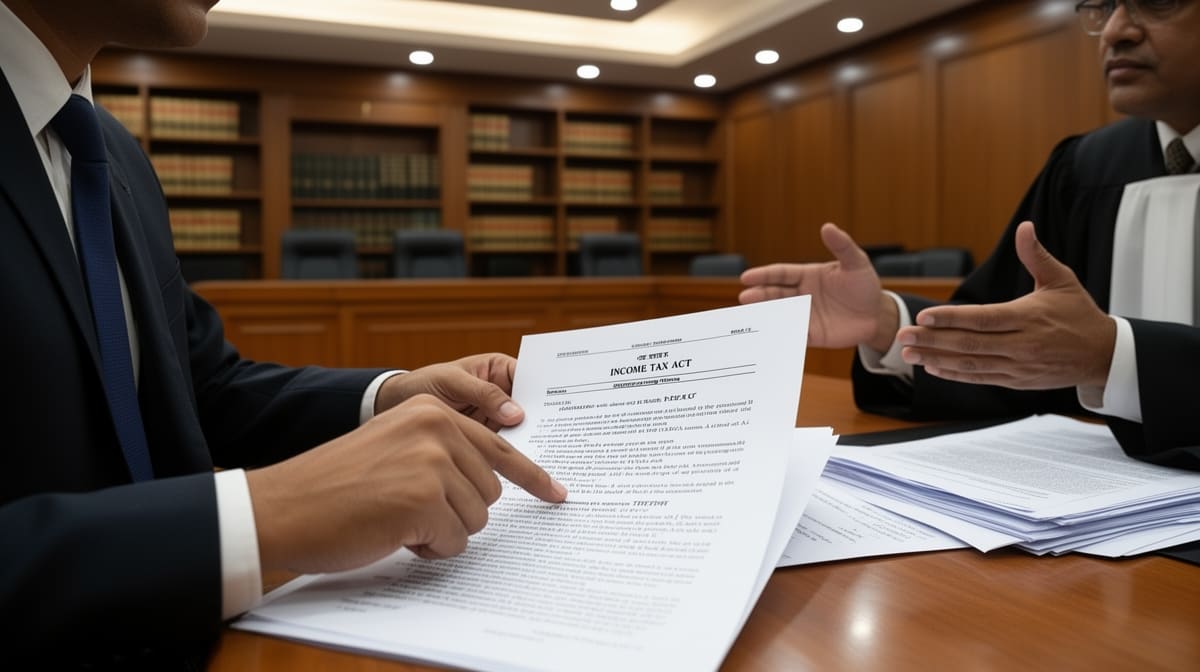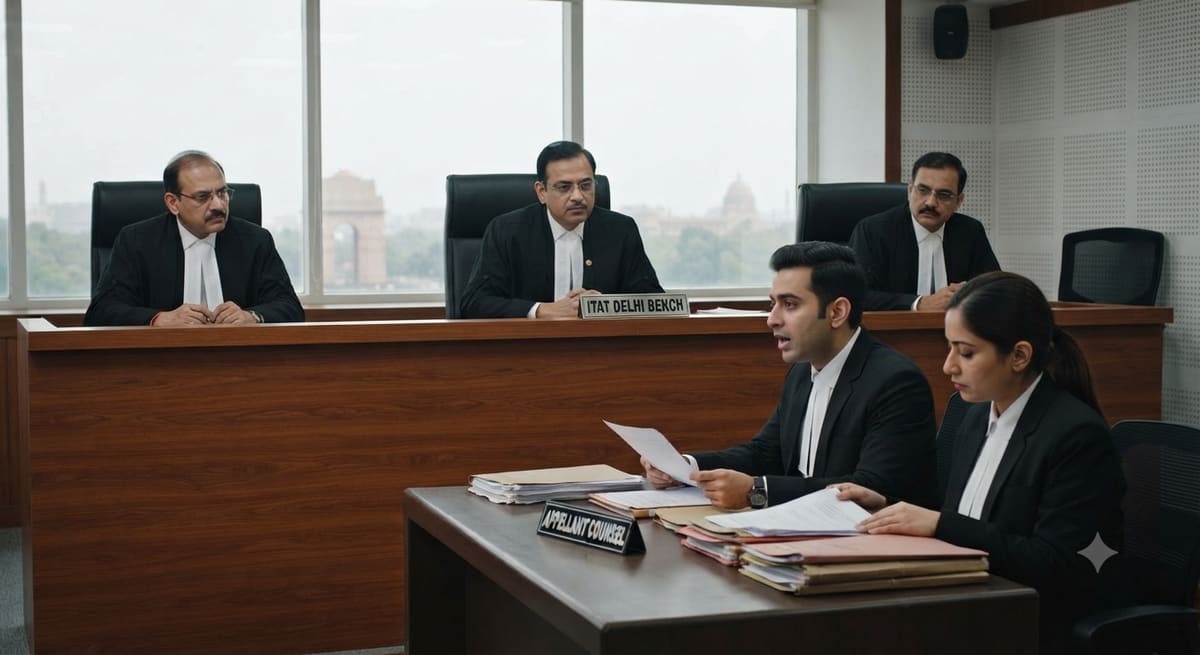
The Income Tax Appellate Tribunal, Delhi, has reaffirmed that appellate authorities under the Income Tax Act cannot dispose of appeals ex-parte without addressing merits, especially when statutory mandates for reasoned orders are ignored. This ruling reinforces procedural fairness and the duty of appellate bodies to provide transparent, legally sound reasoning.
Background & Facts
The Dispute
The dispute arose from a penalty order issued under Section 270A of the Income Tax Act, 1961, against the assessee, Mrs. Jaspali Chauhan, for Assessment Year 2020-21. The Assessing Officer (AO) imposed a penalty of Rs. 3,24,512/- alleging under-reporting of income. The assessee filed an appeal before the Commissioner of Income Tax (Appeals) [CIT(A)], who dismissed the appeal ex-parte without adjudicating the merits of the case.
Key Facts
Penalty order dated 24.07.2025 issued by AO under Section 270A
CIT(A) issued four notices to the assessee between 01.08.2025 and 10.11.2025
Assessee did not respond to any of the four notices
CIT(A) passed order dated 19.11.2025, dismissing the appeal ex-parte and upholding the AO’s penalty
Assessee claims notices were received in spam/junk email folder and were not visible
Husband of the assessee, Shri Virender Singh Ruhella, underwent cardiac bypass surgery at BLK Max Hospital and was discharged on 15.10.2025
Hospital discharge documents were filed before the Tribunal on 14.07.2026
Assessee retired on superannuation in 2019 and has no prior penalty history
No records or assessment files were called for by CIT(A) prior to dismissal
Procedural History
24.07.2025: AO issues penalty order under Section 270A
01.08.2025: First notice issued by CIT(A) for filing submissions
15.08.2025: Second notice issued
29.09.2025: Third notice issued
10.11.2025: Fourth and final notice issued
19.11.2025: CIT(A) dismisses appeal ex-parte without hearing or reasoning
22.12.2025: Assessee files appeal before ITAT (ITA No. 8206/Del/2025)
14.07.2026: Hearing before ITAT; assessee submits hospital records and explains non-compliance
15.07.2026: ITAT pronounces order
The Parties' Positions
For the Appellant (Assessee)
Notices were not received due to technical failure (spam/junk folder)
Personal hardship: husband’s critical cardiac surgery on 15.10.2025 prevented timely response
Hospital discharge papers were submitted before Tribunal as proof
No malafide intent; willing to file full submissions if given another opportunity
Penalty under Section 270A is not sustainable on merits
For the Respondent (Department)
Assessee received four notices and failed to respond
Non-compliance justifies ex-parte dismissal under procedural rules
AO’s penalty order is prima facie valid
No prejudice caused as CIT(A) acted within statutory powers
No need to remand; penalty should be upheld
Relief Sought
The assessee sought:
Setting aside of the CIT(A)’s ex-parte order dated 19.11.2025
Remand of the appeal for fresh adjudication with proper opportunity
Withdrawal of penalty under Section 270A on merits
Costs of litigation
The Legal Issue
The central question was whether Section 250(6) of the Income Tax Act, 1961 mandates that the CIT(A) must pass a reasoned, speaking order on the merits of the appeal, and whether dismissal of an appeal ex-parte without addressing substantive issues violates this statutory obligation.
Arguments Presented
For the Appellant
The assessee relied on the mandatory language of Section 250(6), which requires the CIT(A) to state the points for determination, the decision thereon, and the reasons for such decision. It was argued that an ex-parte dismissal without any analysis of the penalty’s legality, the nature of under-reporting, or the assessee’s explanations constitutes a failure to perform the statutory duty of appellate adjudication. The assessee cited CIT v. Suresh Kumar (2018) and DCIT v. Ramesh Chandra (2020) to establish that appellate authorities cannot act as mere rubber stamps of AO orders. The personal hardship due to the husband’s surgery was presented as a legitimate, documented excuse for non-compliance, not negligence.
For the Respondent
The Department contended that the assessee had ample opportunity to respond to four notices and chose not to. It argued that procedural compliance is non-negotiable and that the CIT(A) was entitled to dismiss the appeal under Rule 46A of the Income Tax Rules, 1962, for non-appearance. The Department maintained that the AO’s penalty was based on clear discrepancies in income disclosure and that the appellate authority was not obligated to delve into merits when the assessee remained silent. It further argued that remand would cause undue delay and prejudice to revenue interests.
The Court's Analysis
The Tribunal conducted a detailed review of Section 250(6), which states: "The Commissioner shall state the points for determination, his decision thereon and the reasons for such decision." The Court emphasized that this is not a discretionary provision but a statutory imperative. The CIT(A) did not call for the assessment file, did not examine the basis of the penalty, and did not record any reasoning whatsoever. The order merely stated: "Appeal dismissed ex-parte. Penalty confirmed." This, the Tribunal held, is not a decision under Section 250(6) - it is an abdication of duty.
"The appellate authority is not a mere administrative post; it is a judicial functionary bound by law to reason its decisions. To dismiss an appeal without addressing the merits is to deny the assessee the right to be heard and higher authorities the benefit of reasoned adjudication."
The Tribunal acknowledged the assessee’s failure to respond to notices but noted that procedural lapses cannot override substantive justice, especially when the failure is explained with credible documentation. The husband’s cardiac surgery on 15.10.2025, just days before the final notice, was deemed a compelling, non-negligent reason for non-compliance. The Tribunal further observed that the CIT(A)’s order, being subject to appeal before ITAT and ultimately the High Court under Section 260A, must contain sufficient reasoning to enable meaningful appellate review. An order devoid of reasoning renders the entire appellate structure dysfunctional.
The Tribunal also rejected the Department’s argument that the penalty was valid on its face. It clarified that even if the AO’s order appears prima facie correct, the CIT(A) must independently evaluate it. The power of enhancement under Section 250(1) underscores the seriousness of the appellate role - it cannot be exercised in a vacuum.
The Verdict
The appeal was allowed for statistical purposes. The Tribunal set aside the CIT(A)’s ex-parte order dated 19.11.2025 and remanded the matter to the CIT(A) for fresh adjudication. The CIT(A) is directed to afford the assessee a fresh opportunity to file submissions and must pass a speaking order under Section 250(6), addressing all points of contention. If the assessee fails to comply with the new notice, the CIT(A) may proceed ex-parte but only after recording detailed reasons. No penalty or interest is directed at this stage. The Tribunal explicitly stated it has not expressed any opinion on the merits of the penalty.
What This Means For Similar Cases
Reasoned Orders Are Non-Negotiable
Practitioners must challenge any CIT(A) order that merely confirms the AO’s decision without analysis
A one-line dismissal without reference to evidence, arguments, or statutory provisions is legally void
Appeals against such orders should be filed on grounds of violation of Section 250(6)
Personal Hardship Can Justify Procedural Delay
Medical emergencies, supported by documentation, constitute valid grounds for non-compliance
Tribunals are increasingly willing to overlook technical defaults when justice demands it
Always file medical records, hospital discharge summaries, or death certificates as evidence
Appellate Authorities Cannot Be Passive
CIT(A) must independently examine the AO’s order - it cannot act as a mere affirming body
Failure to call for assessment records or examine documents constitutes procedural illegality
The power to enhance penalties implies a duty to scrutinize - not to rubber-stamp
Procedural Fairness Trumps Technicality
The Tribunal prioritized substantive justice over procedural technicalities
This judgment reinforces the principle that justice must not only be done but must be seen to be done
Practitioners should argue that ex-parte dismissals without reasoning violate Article 14 and 21 of the Constitution