The Bombay High Court has clarified that ownership of agricultural land or receipt of crop insurance compensation does not automatically negate a spouse’s entitlement to interim maintenance under Section 24 of the Hindu Marriage Act. The judgment reinforces the principle that maintenance must be assessed based on actual income and living needs, not speculative or non-liquid assets.
Background & Facts
The Dispute
The petitioner, Dnyaneshwar Narayan Jadhav, filed a petition for divorce under Section 13(1) of the Hindu Marriage Act, 1955. In response, the respondent, Rupali Dyaneshwar Jadhav, filed an application under Section 24 of the same Act seeking interim maintenance during the pendency of the divorce proceedings. The Civil Judge (Senior Division), Karjat, allowed the application by order dated 24.02.2025 (Exhibit-13), directing the petitioner to pay Rs.6,000 per month as interim maintenance.
Key Facts
- The petitioner is the husband and the respondent is the wife; they are no longer residing together.
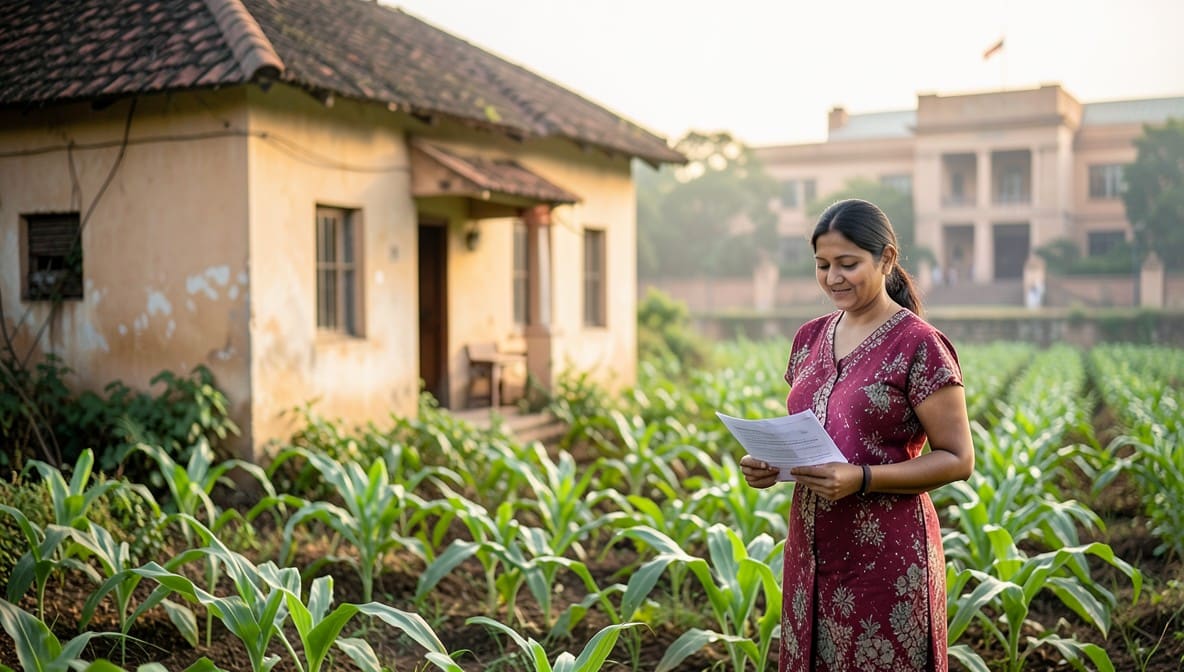
- The petitioner claims the respondent owns agricultural land measuring 2 H 48 R, which she cultivates.
- The respondent received compensation under the Pradhan Mantri Fasal Bima Yojna (PMFBY) for crop loss.
- Bank statements submitted by the petitioner show deposits of Rs.6,730, Rs.6,454, and Rs.3,000 in the respondent’s account between 26.08.2024 and 29.08.2024.
- The petitioner contends these amounts demonstrate sufficient income to meet the respondent’s needs.
- The petitioner did not file his own affidavit disclosing his income or assets before the Family Court.
- The respondent did not file any affidavit disclosing her income or assets.
Procedural History
- Date of filing of divorce petition: Not specified, but proceedings initiated prior to 24.02.2025.
- 24.02.2025: Family Court, Karjat, passed order granting interim maintenance of Rs.6,000 per month to the respondent.
- 2025: Petitioner filed Writ Petition No. 4483 of 2025 before the Bombay High Court, Aurangabad Bench, challenging the interim maintenance order.
- 23.03.2026: Hearing concluded and judgment delivered by Justice S.G. Chapalgaonkar.
The Parties' Positions
For the Petitioner
- Argued that the respondent has sufficient means through agricultural income and crop insurance payouts.
- Relied on bank statements showing deposits in the respondent’s account.
- Invoked Rajnesh v. Neha (2021) 2 SCC 324 to assert that both parties are obligated to file detailed affidavits of income and assets before maintenance is granted.
- Cited Aditi Alias Mithi v. Jitesh Sharma (Criminal Appeal No. 3446 of 2023, decided 06.11.2023), particularly paragraph 14, to argue that the Family Court erred in deciding the application without compliance with Rajnesh guidelines.
- Contended that the maintenance order is unjustified and should be set aside.
For the Respondent
- Supported the interim maintenance order as reasonable and proportionate.
- Did not dispute the petitioner’s claims about land ownership or insurance payouts.
- Did not file an affidavit disclosing income, but argued that the petitioner’s failure to disclose his own income precludes him from challenging her non-disclosure.
Relief Sought
The petitioner sought:
- Setting aside of the interim maintenance order dated 24.02.2025.
- Dismissal of the respondent’s application for interim maintenance.
- Direction to the Family Court to reconsider the matter only after both parties file affidavits as mandated by Rajnesh v. Neha.
The Legal Issue
Can a spouse be denied interim maintenance under Section 24 of the Hindu Marriage Act merely because the other spouse owns agricultural land or receives crop insurance compensation, especially when the claiming spouse has not filed an affidavit of income as required by Rajnesh v. Neha?
Arguments Presented
For the Appellant/Petitioner
The petitioner relied on Rajnesh v. Neha to argue that the Family Court violated mandatory procedural requirements by granting maintenance without both parties filing affidavits disclosing income, assets, and liabilities. He contended that the respondent’s ownership of agricultural land and receipt of PMFBY compensation constitute sufficient means to meet her needs, rendering maintenance unnecessary. He further cited Aditi Alias Mithi v. Jitesh Sharma to assert that non-compliance with Rajnesh renders the maintenance order legally unsustainable.
For the Respondent/State
The respondent did not contest the petitioner’s factual claims but argued that the Family Court’s order was based on the overall status of the parties and was neither excessive nor arbitrary. She emphasized that the petitioner himself failed to disclose his income, thereby forfeiting his right to object to her non-disclosure. She maintained that agricultural income is seasonal and uncertain, and cannot be equated with regular, liquid income.
The Court's Analysis
The Court examined the procedural and substantive dimensions of the maintenance order. It acknowledged the binding precedent in Rajnesh v. Neha, which mandates that both parties must file comprehensive affidavits of income and assets before any interim maintenance is determined. However, the Court emphasized that the petitioner’s own failure to file such an affidavit precluded him from raising a procedural objection against the respondent.
"Pertinently, petitioner has not filed his own affidavit before Trial Court disclosing his sources of income or assets in terms of law laid down in case of Rajnesh (supra). In that view of matter, petitioner cannot blame respondent for not filing her affidavit disclosing income."
The Court further held that ownership of agricultural land and receipt of crop insurance compensation do not equate to regular, assured income. Agricultural earnings are subject to monsoon, market prices, and crop cycles, and cannot be reliably used to assess maintenance capacity. The Court noted that the Family Court had assessed the maintenance amount of Rs.6,000 per month in light of the parties’ status and standard of living, and found no evidence of excess or arbitrariness.
The Court also observed that the petitioner’s reliance on three isolated bank deposits over a four-day period was insufficient to establish a pattern of regular income. The absence of any evidence of the respondent’s monthly earnings or net surplus rendered the petitioner’s argument speculative.
The Verdict
The writ petition was dismissed. The interim maintenance order of Rs.6,000 per month dated 24.02.2025 was upheld. The Court directed that any amount already deposited by the petitioner pursuant to the interim order be transmitted to the Family Court for disbursal to the respondent. The Court further directed the Family Court to conclude the divorce proceedings within six months from the date of judgment.
What This Means For Similar Cases
Agricultural Income Does Not Equal Regular Income
- Practitioners must avoid equating land ownership or crop insurance payouts with stable, liquid income for maintenance purposes.
- Courts will assess maintenance based on actual, recurring income, not speculative or seasonal earnings.
- Evidence of agricultural income must be accompanied by proof of net monthly surplus, not just gross receipts.
Non-Disclosure by One Party Cannot Be Used to Penalize the Other
- If one spouse fails to file an affidavit of income as required by Rajnesh v. Neha, they cannot later challenge the other spouse’s non-disclosure.
- The burden of compliance is mutual; failure by one party does not absolve the other.
- Courts will not allow procedural objections to be weaponized when the objecting party has not complied themselves.
Maintenance Orders Are Context-Specific
- Maintenance under Section 24 is not a rigid formula but a discretionary assessment of status, needs, and capacity.
- Amounts like Rs.6,000 per month, even if modest, may be justified where the spouse has no other means and the petitioner’s income is undisclosed.
- Courts will uphold maintenance orders unless they are demonstrably exorbitant or unsupported by any factual basis.