The Punjab and Haryana High Court has affirmed that the welfare of a disabled custodial parent and her minor child can justify the transfer of a matrimonial petition to a more convenient forum, especially when the opposing party fails to contest the application. This decision reinforces the principle that procedural rigidity must yield to substantive justice in family disputes involving vulnerability.
Background & Facts
The Dispute
The applicant, Shivani, filed an application seeking transfer of a divorce petition filed against her by her husband, Vinit, under Section 13 of the Hindu Marriage Act, 1955 (HMA/2424/2025). The petition was pending before the Family Court, Ludhiana. Shivani sought transfer to the Family Court at Ambala, where she and her minor daughter currently reside.
Key Facts
- The marriage between the parties took place on 05.12.2020.
- A daughter was born from the marriage and is currently approximately 3½ years old.
- The child is in the sole care and custody of the applicant, Shivani.
- The parties have been living separately since the onset of matrimonial discord.
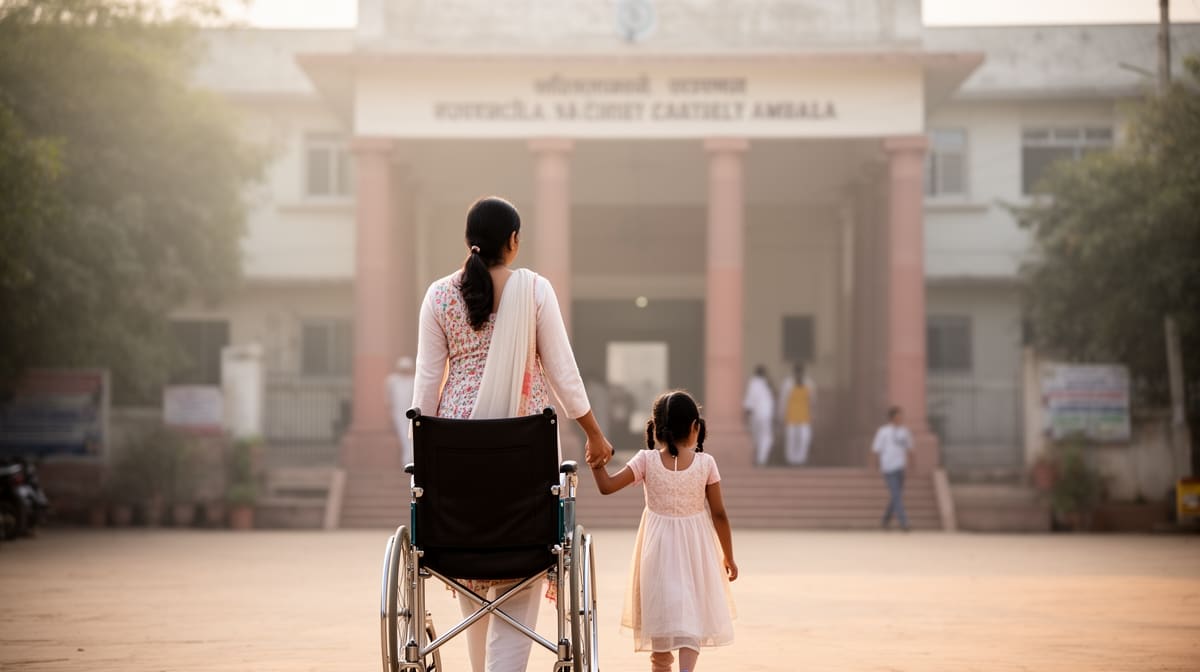
- Shivani resides with her daughter at her parental home in Ambala.
- Shivani is a person with a 30% locomotor disability, as certified under the Rights of Persons with Disabilities Act, 2016 (Annexure P-2).
- Shivani has no independent source of income.
- The distance between Ludhiana and Ambala is approximately 120 kilometres.
- The respondent, Vinit, did not appear in court despite service, and made no representation at any stage.
Procedural History
- HMA/2424/2025: Petition for divorce filed by respondent-husband in Family Court, Ludhiana.
- Date of Application: Applicant filed transfer application before the Punjab and Haryana High Court.
- 16.03.2026: Hearing held before Justice Archana Puri; respondent remained absent.
- 16.03.2026: Court proceeded ex parte against the respondent due to non-appearance.
Relief Sought
The applicant sought transfer of the divorce petition from the Family Court, Ludhiana, to the Family Court, Ambala, on grounds of her physical disability, lack of financial means, and the best interests of the minor child.
The Legal Issue
The central question was whether a matrimonial petition may be transferred under inherent powers to a forum more convenient for a disabled custodial parent and her young child, particularly when the opposing party does not oppose the transfer.
Arguments Presented
For the Applicant
Counsel for the applicant submitted that the applicant, being physically disabled with 30% locomotor impairment and without any income, faces severe hardship in traveling 120 kilometres to attend proceedings in Ludhiana. The presence of a minor child under her sole care further compounds the difficulty. The transfer would ensure access to justice and protect the child’s welfare. The respondent’s consistent non-appearance indicated acquiescence to the request.
For the Respondent
No representation was made by or on behalf of the respondent. The court proceeded ex parte due to the respondent’s failure to appear despite service.
The Court's Analysis
The Court emphasized that the welfare of the child and the vulnerability of the custodial parent are paramount considerations in matrimonial matters. It noted that the applicant’s disability, coupled with her lack of financial independence, renders travel to Ludhiana not merely inconvenient but potentially prohibitive. The Court observed that the respondent’s absence, despite multiple opportunities to appear, amounted to a waiver of any objection to transfer.
"Considering the fact of the applicant, taking care of the minor daughter, who is about 3½ years old and also, about the applicant herself to be physically handicapped as well as considering the distance between the two places and above it, the respondent not having come forward to resist the transfer application, the same is allowed."
The Court held that the inherent jurisdiction of the High Court under Article 227 of the Constitution permits such transfer to prevent abuse of process and ensure equitable access to justice. The principle of parens patriae was invoked to safeguard the interests of the minor child. The Court further noted that the Family Court at Ambala is the competent jurisdiction since the applicant and child reside there, and the petition’s transfer would not prejudice the substantive rights of either party.
The Verdict
The applicant succeeded. The High Court ordered the transfer of the divorce petition under Section 13 of the Hindu Marriage Act (HMA/2424/2025) from the Family Court, Ludhiana, to the Family Court, Ambala. The record was directed to be sent to the District and Sessions Judge, Ambala, who was directed to assign the matter to the Family Court, Ambala. Both parties were directed to appear before the Family Court, Ambala, within one month from 16.03.2026.
What This Means For Similar Cases
Custodial Disability Justifies Forum Transfer
- Practitioners may now invoke disability status and lack of financial means as compelling grounds for transfer under Section 25 of the HMA or inherent powers under Article 227.
- A certificate of disability under the RPWD Act, 2016, should be annexed as evidence to substantiate the claim.
Non-Appearance Waives Opposition
- When the respondent fails to appear despite service, courts may treat this as constructive consent to transfer applications, especially where welfare considerations are involved.
- Ex parte proceedings do not preclude substantive relief; courts may still grant equitable remedies based on undisputed facts.
Child’s Welfare Overrides Procedural Convenience
- The physical proximity of the child’s residence to the forum is now a decisive factor, even if the petition was originally filed elsewhere.
- Courts must prioritize the child’s stability and the custodial parent’s ability to participate meaningfully in proceedings.