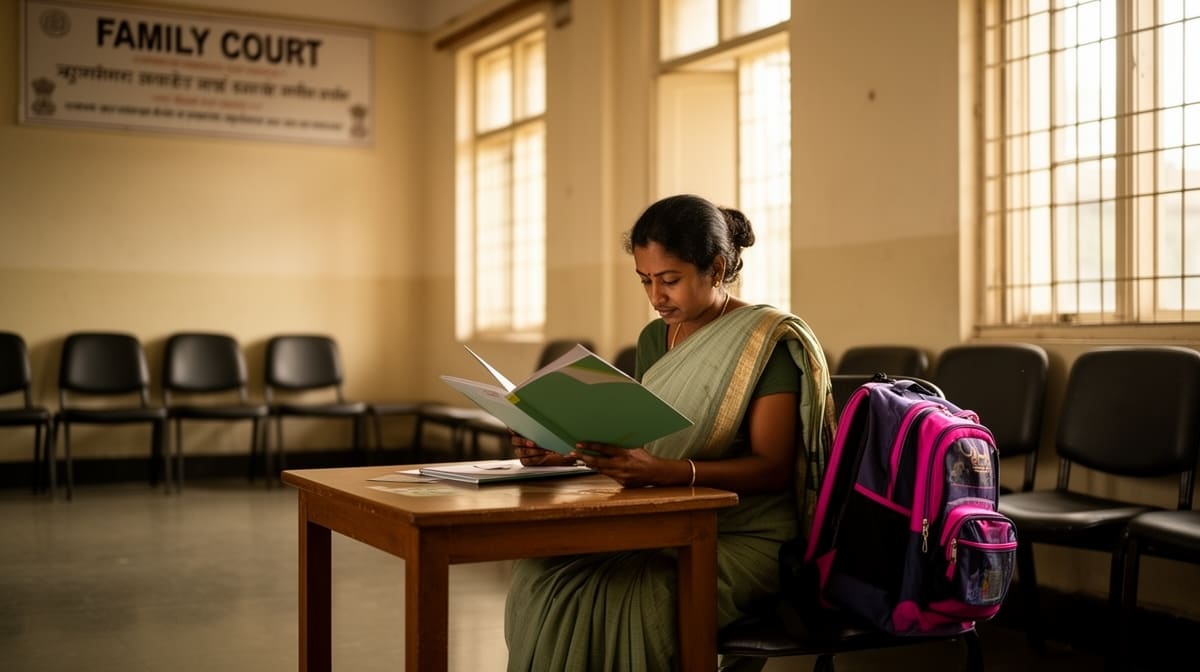
In a significant ruling reinforcing the principle of convenience in matrimonial disputes, the Kerala High Court transferred divorce proceedings from Palakkad to Thiruvananthapuram, emphasizing the need to avoid conflicting findings and prioritize the wife's logistical ease. The judgment reaffirms established precedents that women's convenience takes precedence in transfer petitions under Section 24 of the Code of Civil Procedure (CPC).
Background & Facts
The Dispute
The petitioner, Aiswarya B., filed a transfer petition seeking to move O.P.No.424 of 2025 (a divorce petition filed by her husband, Sachin S.) from the Family Court, Palakkad to the Family Court, Thiruvananthapuram. The petitioner had already instituted two related proceedings in Thiruvananthapuram: O.P.No.196 of 2025 (seeking return of gold) and M.C.No.06 of 2025 (a miscellaneous case).
Key Facts
- The parties are married, and the dispute arises from the same matrimonial relationship.
- The husband filed O.P.No.424 of 2025 for divorce before the Family Court, Palakkad.
- The wife filed O.P.No.196 of 2025 and M.C.No.06 of 2025 before the Family Court, Thiruvananthapuram, involving common questions of fact and evidence.
- The wife contended that traveling over 600 km to Palakkad for hearings would cause significant inconvenience.
Procedural History
- 2025: The husband filed O.P.No.424 of 2025 for divorce before the Family Court, Palakkad.
- 2025: The wife filed O.P.No.196 of 2025 and M.C.No.06 of 2025 before the Family Court, Thiruvananthapuram.
- 14.07.2026: The wife filed T.R.P(C) No.15 of 2026 before the Kerala High Court seeking transfer of O.P.No.424 of 2025 to Thiruvananthapuram.
Relief Sought
The petitioner sought the transfer of O.P.No.424 of 2025 from the Family Court, Palakkad to the Family Court, Thiruvananthapuram to avoid conflicting findings and to mitigate the inconvenience of traveling long distances.
The Legal Issue
The central question was whether Section 24 of the CPC permits the transfer of matrimonial proceedings from one Family Court to another, considering the convenience of the wife and the need to avoid multiplicity of proceedings.
Arguments Presented
For the Petitioner (Wife)
- Cited established precedents, including Sumitha Sing v. Kumar Sanjay and another, Mona Aresh Goel v. Aresh Satya Goel, Vaishali Shridhar Jagtap v. Shridhar Vishwanath Jagtap, Santhini v. Vijaya Venkatesh, and Aiswarya N.C.V. v. A.S. Saravana Karthik Sha, to argue that the convenience of women must be prioritized in transfer petitions.
- Contended that the proceedings in Palakkad and Thiruvananthapuram involve common questions of fact and evidence, and conducting trials in different courts could lead to conflicting findings.
- Highlighted the logistical difficulty of traveling over 600 km for hearings.
For the Respondent (Husband)
- The judgment does not record any specific arguments presented by the respondent opposing the transfer.
The Court's Analysis
The Court relied on a series of precedents to underscore the principle that the convenience of women and children must be prioritized in transfer petitions, particularly in matrimonial disputes. The Court observed:
"The Hon'ble Supreme Court has time and again held that it is the convenience of women and children that has to be looked into while ordering transfer of the case from one court to another, particularly in matrimonial disputes."
The Court further noted that since the proceedings in Palakkad and Thiruvananthapuram arise from the same matrimonial relationship and involve common questions of fact and evidence, it is expedient and in the interest of justice to transfer the case. This would prevent multiplicity of proceedings and avoid conflicting findings.
The Verdict
The Kerala High Court allowed the transfer petition and passed the following directions:
- O.P.No.424 of 2025 was transferred from the Family Court, Palakkad to the Family Court, Thiruvananthapuram.
- The Registry was directed to forward a copy of the order to the Family Court, Palakkad with instructions to transmit the records of O.P.No.424 of 2025 to the Family Court, Thiruvananthapuram.
- The Family Court, Thiruvananthapuram was directed to issue notice to the parties for their appearance immediately upon receipt of the records.
- The parties were granted liberty to move the Family Court, Thiruvananthapuram for consolidation and joint trial of all related cases.
What This Means For Similar Cases
Convenience of Women Takes Precedence
- Courts must prioritize the convenience of women in matrimonial disputes when considering transfer petitions under Section 24 CPC. This principle is well-established and consistently applied.
- Practitioners should emphasize the logistical challenges faced by women, such as long-distance travel, to strengthen transfer petitions.
Avoiding Multiplicity of Proceedings
- When multiple proceedings arise from the same matrimonial relationship and involve common questions of fact, courts are inclined to transfer cases to a single forum to avoid conflicting findings.
- Consolidation of proceedings is encouraged to streamline litigation and ensure judicial efficiency.
Consolidation and Joint Trial
- Parties can seek consolidation of related proceedings in the same court to ensure uniformity in findings and reduce the burden of litigating in multiple forums.
- The judgment underscores the importance of judicial economy and the need to prevent inconsistent rulings in matrimonial disputes.