The Andhra Pradesh High Court has dismissed a transfer petition filed under Section 24 of the Code of Civil Procedure, 1908, reinforcing that mere apprehension of bias is insufficient to transfer a case from one court to another. The judgment underscores the necessity of prima facie evidence to substantiate claims of judicial prejudice, particularly in matrimonial disputes where procedural fairness is paramount.
Background & Facts
The Dispute
The petitioner, Varun Jeeri, filed a transfer petition under Section 24 CPC seeking to withdraw F.C.O.P.No.209 of 2025 (a divorce petition) from the Family Court-cum-V Additional District Judge, Tirupati, and transfer it to another competent Family Court in Chittoor District. The petitioner, a software engineer residing in the USA, alleged severe mental cruelty by the respondent/wife, Pujitha Jeeri, including quarrelsome behavior, filthy language, and isolation from friends. The divorce petition was filed under Section 13(1)(ia) of the Hindu Marriage Act, 1955 on grounds of cruelty.
Key Facts
- The petitioner and respondent were married on 10.05.2023.
- The petitioner has been residing in the USA since 2014.
- The respondent allegedly subjected the petitioner to mental cruelty, including suspicion, verbal abuse, and hostility toward his parents.
- The petitioner filed F.C.O.P.No.62 of 2025 (later renumbered as F.C.O.P.No.209 of 2025) for divorce before the Family Court, Visakhapatnam.
- The respondent filed Tr.C.M.P.No.124 of 2025 seeking transfer of the divorce case to the Family Court at Tirupati, which was allowed by the High Court.
- The High Court dispensed with the petitioner’s personal appearance in F.C.O.P.No.209 of 2025 but not in the respondent’s other pending cases (maintenance and restitution of conjugal rights).
Procedural History
- 10.05.2023: Marriage solemnized.
- 2024: Petitioner moved to the USA; respondent allegedly subjected him to cruelty.
- 2025: Petitioner filed F.C.O.P.No.62 of 2025 (divorce petition) before the Family Court, Visakhapatnam.
- 2025: Respondent filed Tr.C.M.P.No.124 of 2025 for transfer of the divorce case to Tirupati.
- 2025: High Court allowed the transfer petition, renumbering the case as F.C.O.P.No.209 of 2025 before the Family Court, Tirupati.
- 08.10.2025, 24.10.2025, 09.11.2025: Family Court proceedings in F.C.O.P.No.209 of 2025 did not insist on the petitioner’s personal appearance.
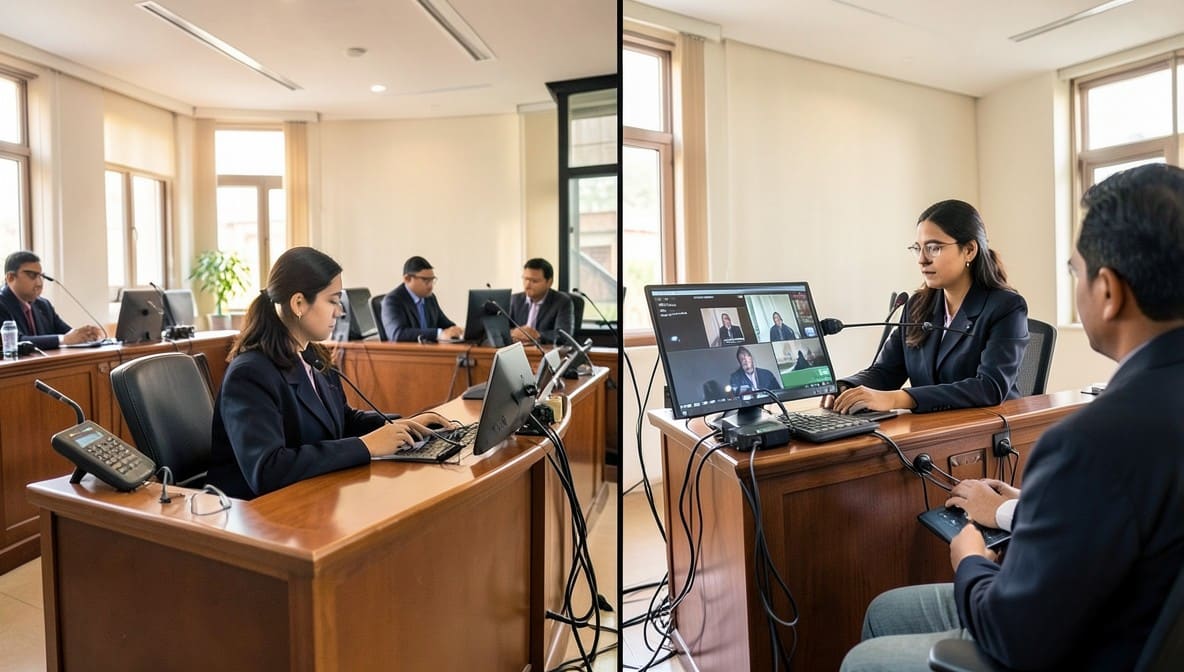
- 11.12.2025: Family Court, Tirupati, reported installation of Video Conferencing facility.
- 21.04.2026: Present transfer petition (Tr.C.M.P.No.388 of 2025) reserved.
- 15.06.2026: Present transfer petition dismissed.
The Parties' Positions
For the Petitioner
- The petitioner contended that the Family Court, Tirupati, exhibited bias by directing him to arrange virtual hearings himself, despite the High Court’s order dispensing with his personal appearance.
- He argued that the trial Judge’s insistence on virtual arrangements was an act of willful non-compliance and demonstrated prejudice.
- Reliance was placed on precedents such as Amardeep Singh v. Harveen Kaur and Anuradha Bhashin v. Union of India to support the claim of procedural unfairness.
For the Respondent
- The respondent denied the allegations of cruelty and asserted that the petitioner deserted her under the pretext of visiting his ill mother.
- She contended that the petitioner failed to appear in court proceedings, leading to protracted litigation.
- The respondent argued that the transfer petition was filed to evade proceedings in her maintenance and restitution of conjugal rights cases.
- She urged the Court to dismiss the transfer petition, emphasizing that the petitioner’s apprehension of bias was baseless.
Relief Sought
The petitioner sought withdrawal of F.C.O.P.No.209 of 2025 from the Family Court, Tirupati, and its transfer to another competent Family Court in Chittoor District.
The Legal Issue
The central question was whether mere apprehension of bias, without prima facie evidence of judicial prejudice, is sufficient to transfer a case under Section 24 CPC from one court to another.
Arguments Presented
For the Petitioner
- The petitioner argued that the trial Judge’s direction to arrange virtual hearings demonstrated bias and willful non-compliance with the High Court’s order.
- Reliance was placed on G.Shrilakshmi v. Anirudh Ramkumar and Reena Chadha v. Government of NCT of Delhi to emphasize the need for procedural fairness.
- The petitioner contended that the trial Judge’s conduct created a reasonable apprehension of unfairness.
For the Respondent
- The respondent countered that the petitioner’s allegations were baseless and lacked prima facie evidence.
- She argued that the petitioner sought transfer to evade proceedings in her pending cases.
- The respondent emphasized that the trial Judge had not insisted on the petitioner’s personal appearance in F.C.O.P.No.209 of 2025.
The Court's Analysis
The Court conducted a thorough examination of the petitioner’s apprehension of bias and the procedural history of the case. Key observations included:
-
Prima Facie Evidence Requirement: The Court held that mere apprehension of bias is insufficient to transfer a case under Section 24 CPC. The petitioner failed to provide prima facie evidence that the trial Judge acted unfairly or was influenced by extraneous considerations.
"Mere apprehension is not a ground for seeking transfer of a case from one Court to another Court."
-
Procedural Compliance: The Court noted that the trial Judge had not insisted on the petitioner’s personal appearance in F.C.O.P.No.209 of 2025. The direction to arrange virtual hearings was made in another case (F.C.O.P.No.176 of 2025), where the High Court had not exempted the petitioner’s appearance.
-
Video Conferencing Facility: The Court directed the Registry to verify the availability of video conferencing in the Family Court, Tirupati. The trial Court confirmed the installation of the facility on 10.12.2025, rendering the petitioner’s apprehension infructuous.
-
Convenience of Parties: The Court observed that transferring the case to Chittoor District would not be convenient for either party, as the respondent resides in Tirupati and has pending cases there.
-
Precedent Distinction: The Court distinguished the cited precedents, noting that they were inapplicable to the facts of the present case. The petitioner’s personal appearance had been dispensed with in F.C.O.P.No.209 of 2025, and the trial Judge had not acted unfairly.
The Verdict
The Court dismissed the transfer petition (Tr.C.M.P.No.388 of 2025), holding that the petitioner’s apprehension of bias was baseless. There was no order as to costs, and any pending miscellaneous petitions or interim orders were closed.
What This Means For Similar Cases
Apprehension of Bias Must Be Substantiated
- Practitioners must provide prima facie evidence of judicial prejudice to seek transfer under Section 24 CPC. Mere allegations or subjective apprehension are insufficient.
- Courts will scrutinize the procedural history to determine whether the trial Judge’s conduct demonstrates bias or unfairness.
Procedural Fairness in Matrimonial Disputes
- Family Courts must ensure procedural fairness, especially in cases involving parties residing abroad. The availability of video conferencing facilities can mitigate concerns about personal appearance.
- Parties seeking transfer must demonstrate genuine inconvenience or prejudice, not merely strategic evasion of proceedings.
Implications for Non-Resident Parties
- Non-resident parties in matrimonial disputes must comply with court directions, including virtual appearances, unless exempted by a higher court.
- Transfer petitions should not be used as a tool to delay or evade litigation, particularly when the trial Court has already accommodated the party’s concerns.