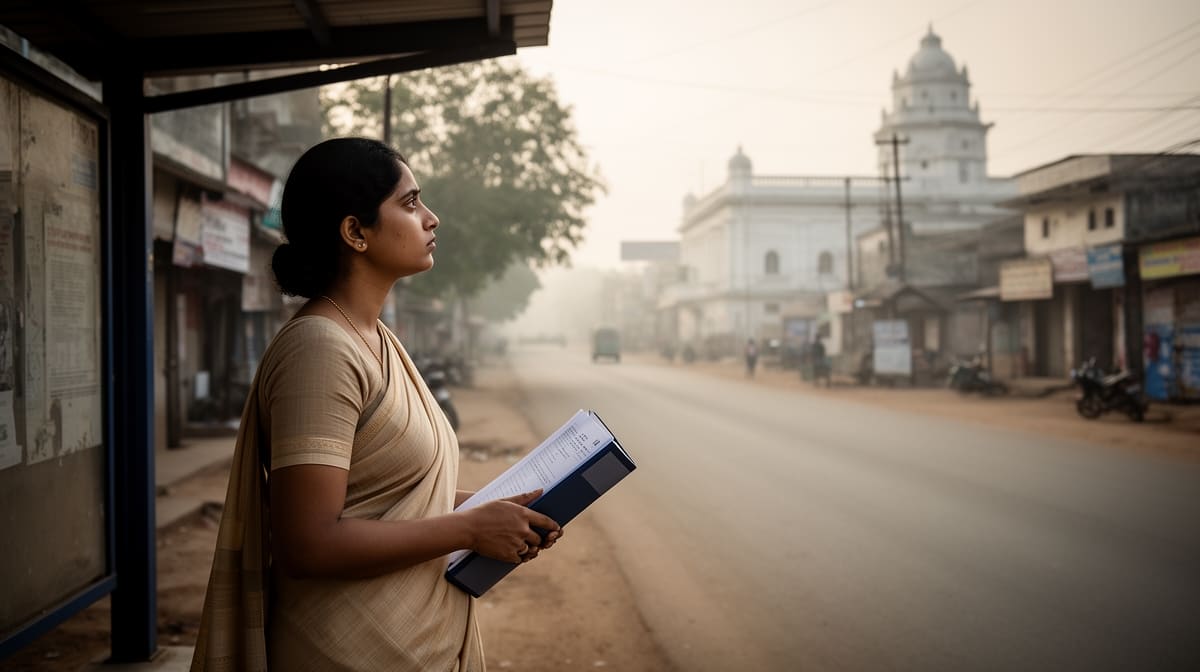
The Andhra Pradesh High Court has reaffirmed that in matrimonial disputes, the convenience and safety of the wife must take precedence over the husband’s choice of forum. This ruling reinforces the principle that procedural fairness in family law cannot be divorced from socio-economic realities, particularly when women are economically dependent and subject to harassment.
Background & Facts
The Dispute
The petitioner, a 28-year-old woman, married the respondent on 13.05.2021 under Christian rites in Bapatla District. Following marital discord, she left the matrimonial home and has been residing with her parents in Guntur. She filed two legal proceedings against her husband: a criminal complaint under Sections 354, 323, and 506 read with Section 34 IPC (Crime No. 128 of 2023) and a Domestic Violence case (D.V.C. No. 13 of 2024) before the Additional Civil Judge (Junior Division), Chilakaluripet. Both cases remain pending.
Procedural History
- 2023: Criminal complaint registered at Chilakaluripet Rural Police Station
- 2024: Domestic Violence Case filed in Chilakaluripet
- 2024: Respondent filed divorce petition under Section 10(1)(IX) & (X) of the Indian Divorce Act, 1869 in Ongole, Prakasam District (D.O.P. No. 36 of 2024)
- 2025: Petitioner filed Transfer Petition under Section 24 of the CPC seeking transfer of the divorce case to Guntur
- 2025: Respondent declined to file a counter-affidavit
Relief Sought
The petitioner sought withdrawal of the divorce petition from the Principal District Judge’s Court in Ongole and its transfer to the Principal District Judge’s Court in Guntur, citing her inability to travel without male accompaniment due to safety concerns and financial dependence on her parents.
The Legal Issue
The central question was whether Section 24 of the Code of Civil Procedure permits transfer of a matrimonial suit solely on grounds of the wife’s economic vulnerability, physical safety, and logistical hardship, even when the husband has initiated proceedings in his home jurisdiction.
Arguments Presented
For the Petitioner
Learned counsel argued that the petitioner, as a woman residing separately and financially dependent on her parents, faces severe hardship in attending proceedings in Ongole, located over 150 km away. She lacks independent means of transport and faces potential harassment if forced to travel alone. Reliance was placed on Geeta Heera v. Harish Chander Heera and N.C.V. Aishwarya v. S.S. Saravana Karthik Sha to establish that the wife’s convenience is paramount in transfer petitions under Section 24 CPC.
For the Respondent
The respondent did not file a counter-affidavit or appear through counsel to contest the petition. The respondent’s advocate merely submitted that no valid grounds existed for transfer, offering no factual or legal rebuttal to the petitioner’s claims of hardship.
The Court's Analysis
The Court examined the cardinal principles governing transfer under Section 24 CPC, emphasizing that the ends of justice must dictate the decision. It noted that in matrimonial matters, courts must consider not only procedural convenience but also the socio-economic realities of the parties, particularly the wife’s position in a patriarchal society.
"In matrimonial matters, wherever Courts are called upon to consider the plea of transfer, the Courts have to take into consideration the economic soundness of both the parties, the social strata of the spouses and their behavioural pattern, their standard of life prior to the marriage and subsequent thereto and the circumstances of both the parties in eking out their livelihood and under whose protective umbrella they are seeking their sustenance to life."
The Court observed that the petitioner was not merely inconvenienced - she was economically dependent, living under her parents’ protection, and already subjected to criminal and domestic violence proceedings. Forcing her to litigate in Ongole would effectively deny her access to justice. The Court distinguished this from mere preference, holding that the wife’s safety and accessibility to legal redress constitute a compelling interest under Section 24.
The Court also rejected the notion that the husband’s choice of forum should prevail absent countervailing evidence. The absence of a counter-affidavit from the respondent further weakened any claim of legitimate forum necessity.
The Verdict
The petitioner succeeded. The Court held that the wife’s convenience, safety, and economic vulnerability must override the husband’s choice of forum in matrimonial transfer petitions under Section 24 CPC. The divorce case was transferred from Ongole to Guntur, with the record to be transmitted within one week and both parties directed to appear before the Guntur court on 09.03.2026.
What This Means For Similar Cases
Wife's Convenience Is a Ground of Right, Not Discretion
- Practitioners must now treat economic dependence and safety concerns as presumptive grounds for transfer in matrimonial cases
- Courts cannot dismiss transfer petitions merely because the husband filed first
- Affidavits detailing financial constraints, lack of transport, and risk of harassment must be systematically documented and submitted
Transfer Under Section 24 CPC Is Not Limited to Financial Hardship Alone
- The judgment expands the scope of "ends of justice" to include psychological safety and gender-based vulnerability
- Pending criminal or DV cases against the spouse strengthen the case for transfer
- Courts must now evaluate the totality of circumstances, not just distance or cost
Absence of Counter-Affidavit May Be Deemed Concession
- When the respondent fails to file a counter-affidavit, courts may infer acquiescence to the petitioner’s factual assertions
- This shifts the burden to the respondent to actively contest claims of hardship
- Practitioners should advise clients to file counter-affidavits even in uncontested matters to avoid adverse inferences