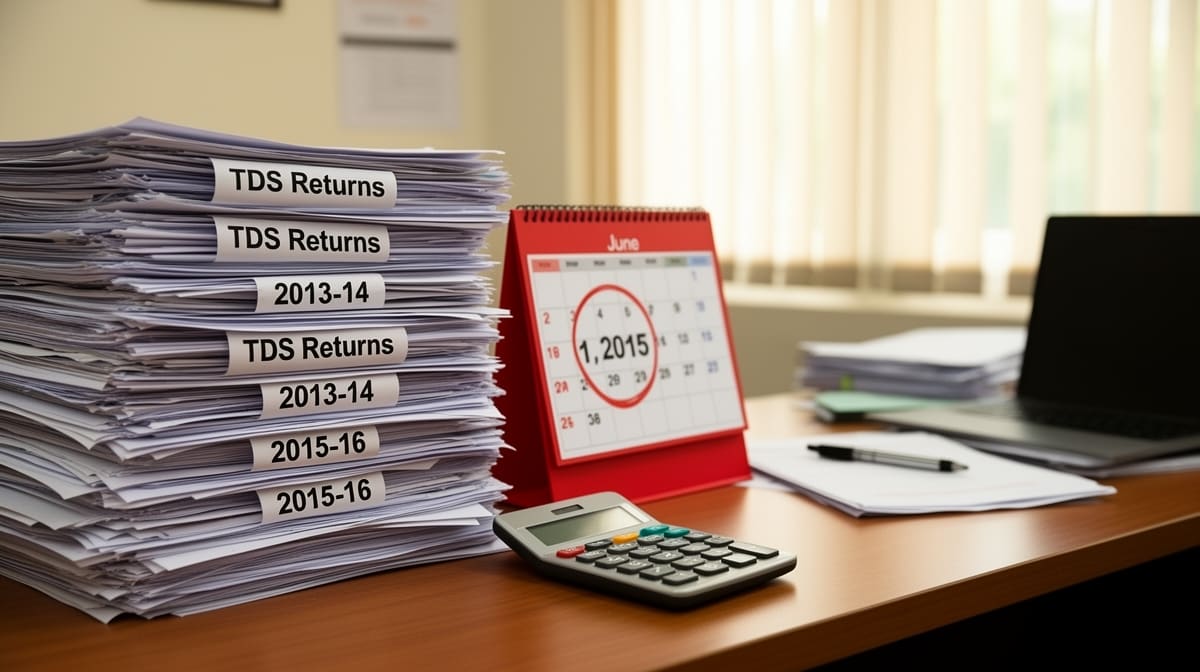
The Income Tax Appellate Tribunal, Pune, has clarified that late fees under Section 234E of the Income Tax Act cannot be imposed for periods before 01.06.2015, and that procedural delays in filing appeals must be condoned when the authority imposing the demand lacks jurisdiction ab initio. This ruling reinforces a critical principle in tax litigation: jurisdictional defects override technical defaults.
Background & Facts
The Dispute
The assessee, Durga Machtech Pvt. Ltd., is a private limited company engaged in manufacturing activities. The dispute arises from the levy of late fees under Section 234E of the Income Tax Act, 1961, for delayed filing of TDS statements (Form 24Q and Form 26Q) for multiple quarters across assessment years 2013-14 to 2015-16. The Centralized Processing Centre (CPC), TDS, computed and imposed late fees totaling Rs. 47,760 for Q2 of A.Y. 2013-14, and similar amounts for other quarters, on the ground that the TDS returns were filed beyond the statutory due dates.
Key Facts
- The assessee filed Form 24Q for Q2 of A.Y. 2013-14 on 31.10.2013, whereas the due date was 15.10.2012, resulting in a delay of 381 days.
- The CPC, TDS, levied late fees of Rs. 47,760 under Section 234E for this delay.
- The assessee filed a rectification application under Section 154 seeking correction of the intimation dated 25.10.2016.
- A rectified order was issued on 20.04.2024, confirming the late fee.
- The assessee filed an appeal before the Commissioner of Income Tax (Appeals), National Faceless Appeal Centre (CIT(A)/NFAC), on 09.02.2025 - 314 days after the rectified order.
- The CIT(A)/NFAC dismissed the appeal on 29.08.2025 solely on the ground of delay, without examining the substantive challenge to the legality of the late fee.
- The assessee’s counsel submitted a paper book containing legal submissions and relied on the judgment in Jiji Varghese v. ITO (2022) 443 ITR 267 (Ker).
- No power of attorney was filed on record at the time of hearing before the Tribunal.
Procedural History
- 15.10.2012: Due date for filing Form 24Q for Q2 of A.Y. 2012-13
- 31.10.2013: Assessee filed Form 24Q for Q2 of A.Y. 2012-13
- 25.10.2016: CPC, TDS issued intimation under Section 200A levying late fee of Rs. 47,760
- 20.04.2024: Rectification order issued under Section 154 confirming the late fee
- 09.02.2025: Appeal filed before CIT(A)/NFAC
- 29.08.2025: CIT(A)/NFAC dismissed appeal on ground of delay
- 12.03.2026: Hearing before ITAT Pune
- 26.03.2026: Judgment pronounced by ITAT Pune
The Parties' Positions
For the Assessee
- Challenged the legality of the late fee under Section 234E for periods prior to 01.06.2015, citing the Kerala High Court’s judgment in Jiji Varghese.
- Argued that the CIT(A)/NFAC erred in dismissing the appeal on technical grounds of delay, when the underlying demand was void for lack of jurisdiction.
- Submitted that delay in filing an appeal cannot be a bar when the authority lacks jurisdiction to impose the demand.
For the Revenue
- Did not appear before the Tribunal.
- Relied on the CIT(A)/NFAC’s order dismissing the appeal on procedural grounds.
- Did not file any written submissions or contest the jurisdictional challenge.
Relief Sought
The assessee sought:
- Setting aside of the CIT(A)/NFAC order dated 29.08.2025
- Quashing of the late fee demand under Section 234E for all quarters prior to 01.06.2015
- Condonation of delay in filing the appeal
- Restoration of the appeal for fresh adjudication on merits
The Legal Issue
The central question was whether Section 234E of the Income Tax Act permits the levy of late fees for TDS returns filed before 01.06.2015, and whether a delay in filing an appeal can be invoked to deny relief when the authority imposing the demand lacks jurisdiction ab initio.
Arguments Presented
For the Appellant
The assessee relied on the Kerala High Court’s judgment in Jiji Varghese v. ITO (2022) 443 ITR 267 (Ker), which held that the amendment introducing Section 234E was prospective in nature and effective only from 01.06.2015. The court observed that imposing late fees for periods prior to that date was ultra vires and void for lack of jurisdiction. The assessee argued that where an authority acts without jurisdiction, the principle of nemo judex in causa sua applies, and delay cannot be used to defeat a substantive right. The paper book submitted by counsel contained detailed legal arguments and supporting case law.
For the Respondent
The Revenue did not appear before the Tribunal or file any written submissions. The CIT(A)/NFAC’s order, which was ex parte and based solely on delay, was the only response on record. No legal argument was advanced to contest the jurisdictional challenge or the applicability of Jiji Varghese.
The Court's Analysis
The Tribunal observed that the CIT(A)/NFAC dismissed the appeal without addressing the substantive legal challenge to the levy of late fees under Section 234E. The dismissal was based entirely on the delay in filing the appeal, despite the assessee raising a jurisdictional objection grounded in a binding precedent.
"In matters where total lack of jurisdiction is alleged, delay cannot be relied upon as a ground to deny the relief."
The Tribunal explicitly adopted the reasoning from Jiji Varghese, noting that the amendment to Section 234E was introduced by the Finance Act, 2015, and came into force only on 01.06.2015. Therefore, any late fee imposed for TDS returns filed before that date was legally unsustainable and void ab initio.
The Tribunal emphasized that the doctrine of jurisdictional defect overrides procedural irregularities. Citing established principles of natural justice, it held that an authority cannot rely on delay to deny relief when the very power to impose the demand is non-existent. The CIT(A)/NFAC’s failure to consider this jurisdictional challenge rendered its order legally flawed.
The Tribunal further noted that the assessee had submitted a comprehensive paper book and that the absence of a power of attorney did not invalidate the submissions, particularly in light of the clear legal principle at stake. The Tribunal rejected the request for adjournment but proceeded to adjudicate the appeal on the merits of the paper book.
The Verdict
The assessee succeeded. The Tribunal set aside the CIT(A)/NFAC order dated 29.08.2025 and restored the appeal to the file of the CIT(A)/NFAC with directions to condone the delay and decide the appeal afresh on merits. The Tribunal directed the assessee to respond to notices without seeking further adjournments, failing which the CIT(A)/NFAC may pass appropriate orders. The late fee demand under Section 234E for all quarters prior to 01.06.2015 stands quashed as legally unsustainable.
What This Means For Similar Cases
Jurisdictional Defects Override Procedural Delays
- Practitioners must raise jurisdictional challenges at the earliest opportunity, even if the appeal is technically time-barred.
- If the authority lacks statutory power to impose a demand, delay in filing an appeal is not a valid ground for dismissal.
- Tribunals and appellate authorities are bound to examine jurisdictional objections before invoking procedural bars.
Section 234E Is Prospective Only
- Late fees under Section 234E cannot be levied for any TDS return filed before 01.06.2015, regardless of the delay.
- Assessing officers and CPC, TDS must cease levying such fees for pre-2015 periods and rectify past demands.
- Taxpayers with pending appeals or rectification applications involving pre-2015 TDS delays should file objections citing Jiji Varghese and this ITAT ruling.
Strategic Use of Binding Precedents
- A binding judgment from a High Court on identical facts and law must be accepted by lower authorities and appellate forums.
- Submitting a paper book with relevant case law is sufficient to trigger substantive adjudication, even in the absence of oral arguments or formal power of attorney.
- Practitioners should routinely cite Jiji Varghese in all TDS-related appeals involving pre-2015 late fee demands.