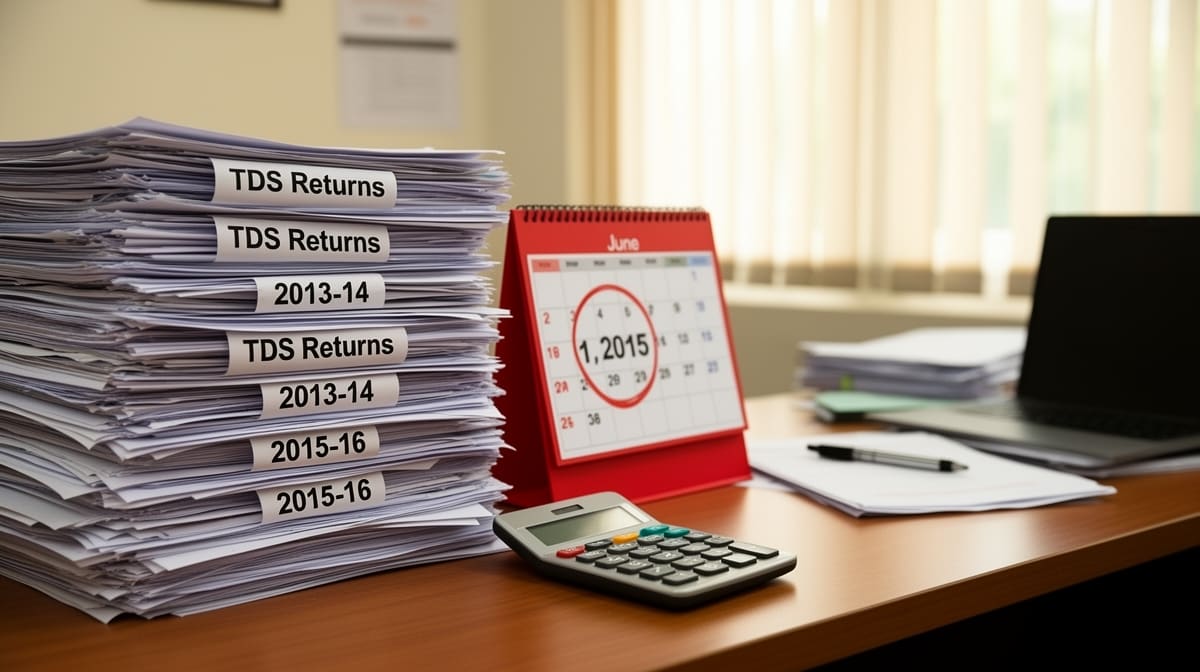
The Income Tax Appellate Tribunal (ITAT), Kolkata, has delivered a significant ruling clarifying that Section 234E of the Income Tax Act, 1961, which imposes a late fee for delayed filing of TDS statements, cannot be levied for periods prior to 01.06.2015. The judgment, relying on precedents from multiple High Courts, underscores the importance of statutory enabling provisions for imposing penalties or fees.
Background & Facts
The Dispute
The appellant, Kaushalya Infrastructure Development Corporation Ltd., challenged the levy of late fees under Section 234E for the assessment years 2013-14 to 2015-16. The fees were imposed during the processing of TDS returns under Section 200A of the Act. The appellant contended that Section 200A(1)(c), which enables the levy of fees under Section 234E, came into effect only on 01.06.2015, and thus, no fee could be imposed for periods before this date.
Key Facts
- The appellant filed TDS statements for the assessment years 2013-14, 2014-15, and 2015-16.
- The Assessing Officer (AO) levied late fees under Section 234E while processing the returns under Section 200A.
- The appellant appealed to the Commissioner of Income Tax (Appeals) [CIT(A)], who upheld the levy in orders dated 19.11.2025.
- The appellant subsequently filed appeals before the ITAT, Kolkata, challenging the CIT(A)'s orders.
Procedural History
- 19.11.2025: CIT(A) dismissed the appeals (Appeal Nos. NFAC/2011-12/10384523, NFAC/2013-14/10384527).
- ITA Nos. 178 to 180/Kol/2026: Appeals filed before ITAT, Kolkata, for assessment years 2013-14 to 2015-16.
- 13.04.2026: ITAT pronounced the order allowing the appeals.
Relief Sought
The appellant sought the deletion of the late fees levied under Section 234E for the assessment years in question, arguing that the enabling provision (Section 200A(1)(c)) was not in force during the relevant period.
The Legal Issue
The central question before the ITAT was whether Section 234E could be invoked to levy late fees for TDS statements filed before 01.06.2015, in the absence of an enabling provision under Section 200A(1)(c) of the Act.
Arguments Presented
For the Appellant
The appellant's counsel, Shri Miraj D. Sha, argued that Section 200A(1)(c), which empowers the levy of fees under Section 234E, came into effect only on 01.06.2015. Consequently, no late fee could be imposed for TDS statements filed before this date. The counsel relied on the following judgments:
- Lingeswara Creations vs. PCIT ([2024] 168 taxmann.com 383 (Madras)): The Madras High Court held that Section 200A was not in force during the assessment years 2012-13 and 2013-14, and thus, no late fee under Section 234E could be levied.
- Fatheraj Singhvi v. UOI ([2016] 73 taxmann.com 252 (Karnataka)): The Karnataka High Court observed that Section 234E and Section 271H (penalty for failure to furnish TDS statements) were inserted simultaneously, and the former could not be invoked without the enabling mechanism under Section 200A.
- United Metals vs. ITO ([2022] 137 taxmann.com 115 (Kerala)): The Kerala High Court upheld the same principle, emphasizing the absence of an enabling provision for levying fees before 01.06.2015.
- ITO vs. Maa Tarini Transport Pvt. Ltd. (ITA Nos. 454 & 455/CTK/2024, order dated 07.01.2025): The ITAT, Cuttack Bench, deleted the late fee levied under Section 234E for periods prior to 01.06.2015, relying on coordinate bench decisions.
For the Respondent
Shri Pradip Kumar Biswas, Senior Departmental Representative (Sr. DR), supported the orders of the AO and CIT(A), arguing that the late fee under Section 234E was validly levied. However, the Sr. DR did not cite any contrary judicial precedent to counter the appellant's submissions.
The Court's Analysis
The ITAT examined the legal framework governing the levy of late fees under Section 234E and the enabling provision under Section 200A(1)(c). The Tribunal noted that Section 200A(1)(c), which authorizes the levy of fees under Section 234E, was inserted by the Finance Act, 2015, with effect from 01.06.2015. Prior to this date, there was no statutory mechanism to impose such fees during the processing of TDS statements.
The Tribunal relied heavily on the judgments cited by the appellant, particularly the observations of the Madras High Court in Lingeswara Creations vs. PCIT:
"In the present case, the respondent had imposed the late fee only under section 234E for the assessment years 2012-2013, 2013-2014. However, section 200A was not introduced during the said assessment years and it was introduced only with effect from 01.06.2015. Therefore, in the absence of any provisions under Section 200A, the respondents ought not to have imposed late fee under Section 234E while processing the applications for TDS under Section 200A. Hence, in such view of the matter, this Court is of the opinion that the impugned Demand Intimation Letters are liable to be set aside. [Para 4]"
The ITAT also referred to the Karnataka High Court's decision in Fatheraj Singhvi v. UOI, which emphasized that Section 234E cannot be read in isolation and requires the enabling provision under Section 200A for its enforcement. The Court observed that the simultaneous insertion of Section 234E and Section 271H (penalty provision) indicated that the former was intended to provide relief from the rigors of the latter, subject to compliance within one year.
The Tribunal further noted that the coordinate bench decision in ITO vs. Maa Tarini Transport Pvt. Ltd. had already deleted the late fee levied under Section 234E for periods prior to 01.06.2015, and no contrary decisions were brought to its attention. Thus, the ITAT concluded that the late fee levied under Section 234E for the assessment years in question was unsustainable in law.
The Verdict
The ITAT allowed the appeals filed by the assessee and deleted the late fees levied under Section 234E for the assessment years 2013-14 to 2015-16. The Tribunal held that the enabling provision under Section 200A(1)(c) was not in force during the relevant period, and thus, no late fee could be imposed.
What This Means For Similar Cases
No Retrospective Levy Without Enabling Provision
This judgment reinforces the principle that penalties or fees cannot be levied retrospectively in the absence of a statutory enabling provision. Practitioners should note:
- Section 234E cannot be invoked for TDS statements filed before 01.06.2015, as Section 200A(1)(c) was not in force.
- Assessees facing similar levies for pre-01.06.2015 periods can challenge the fees on the grounds of lack of statutory authority.
Judicial Precedent as a Shield
The ITAT's reliance on High Court judgments (Lingeswara Creations, Fatheraj Singhvi, and United Metals) demonstrates the importance of coordinate bench decisions in tax litigation. Key takeaways:
- High Court judgments carry significant persuasive value, especially when no contrary jurisdictional precedent exists.
- Assessees can cite these judgments to challenge Section 234E levies for periods prior to 01.06.2015.
Implications for TDS Compliance
- Deductors should ensure timely filing of TDS statements to avoid penalties under Section 271H, which remains applicable even for pre-01.06.2015 periods.
- The judgment does not absolve deductors of their obligation to file TDS statements but merely deletes the late fee for the period in question.
- Post-01.06.2015, Section 234E remains enforceable, and deductors must comply with the prescribed timelines to avoid levies.