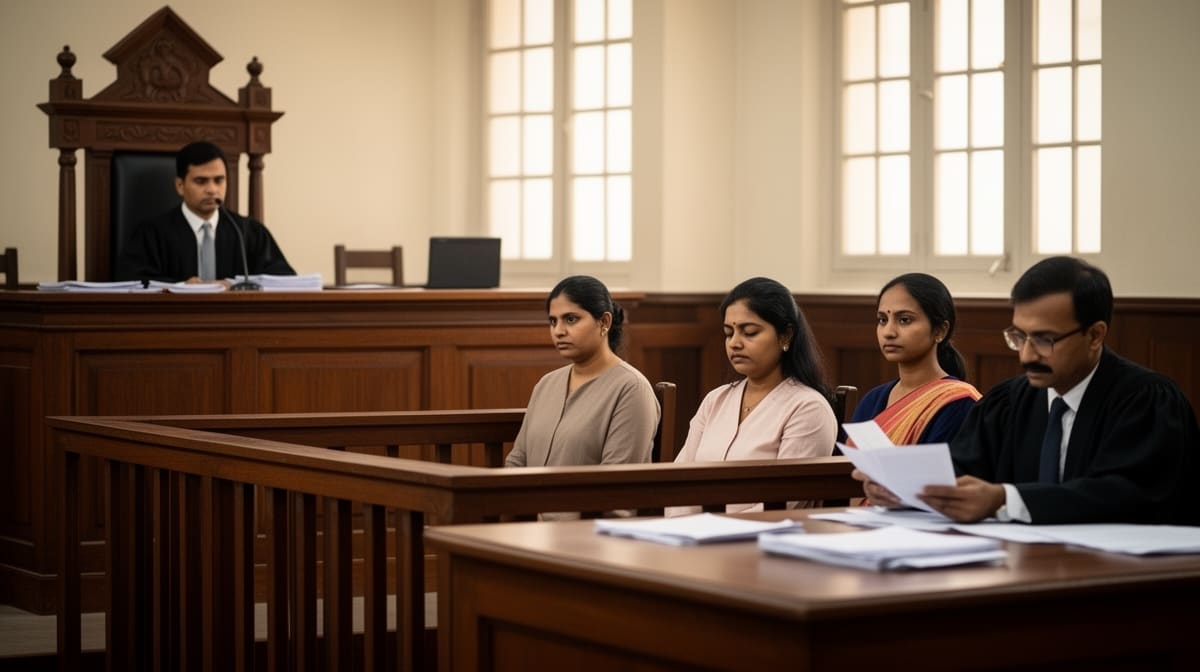
The Madhya Pradesh High Court has reaffirmed that the discretion to defer cross-examination under Section 231(2) of the Criminal Procedure Code is not a routine procedural tool but a limited safeguard that must be invoked with specific justification and at the earliest opportunity. The judgment underscores the imperative of expeditious trials and the dangers of strategic delays that undermine witness integrity and fair trial principles.
Background & Facts
The Dispute
The petitioner, Prateek @ Rahul Kushwaha, was accused in a case registered under Sections 64(1), 103, 331(8), 115(2), and 351(3) of the Bharatiya Nyaya Sanhita, 2023, and Sections 3(1)(r), 3(1)(w)(i), 3(2)(v), and 3(2)(va) of the Scheduled Castes and Scheduled Tribes (Prevention of Atrocities) Act, 1989. The allegations relate to an incident involving the prosecutrix and the subsequent death of her grandmother, Smt. Hirabai Choudhary, at Damoh Naka, Jabalpur.
Key Facts
- The FIR was registered on 29.07.2025 at Police Station Kotwali, Jabalpur, as Crime No. 301/2025.
- The prosecution’s case rests primarily on the testimonies of four witnesses: the prosecutrix (PW-1), her younger sister, her mother, and her maternal aunt (Bua), all residing in the same household.
- The trial calendar was prepared on 26.12.2025.
- The case was first listed for prosecution evidence on 16.02.2026, but was adjourned because the accused’s counsel did not appear.
- On 02.03.2026, the chief examination of the prosecutrix (PW-1) was recorded.
- The petitioner filed an application under Section 231(2) CrPC on 02.03.2026 seeking deferment of cross-examination of the four witnesses until after the completion of the chief examination of all four.
- The Trial Court noted in the record that the application was filed after the completion of the prosecutrix’s examination-in-chief.
- The petitioner claimed that premature cross-examination would disclose his defence strategy, enabling the prosecution to tailor subsequent testimony.
Procedural History
- 29.07.2025: FIR registered at PS Kotwali, Jabalpur.
- 26.12.2025: Trial calendar prepared by the Special Judge (SC/ST), Jabalpur.
- 16.02.2026: Case listed for prosecution evidence; accused’s counsel absent; adjourned.
- 02.03.2026: Chief examination of PW-1 (prosecutrix) completed; application for deferment filed same day.
- 02.03.2026: Special Judge dismissed the application for deferment.
- 25.03.2026: Criminal Revision No. 1096 of 2026 reserved for orders.
- 31.03.2026: Judgment pronounced by Justice Dwarka Dhish Bansal.
The Parties' Positions
For the Petitioner
The petitioner’s counsel argued that:
- The four key witnesses are closely related and testify on the same set of facts.
- Cross-examination before completion of all chief examinations would prematurely reveal the defence strategy.
- This would allow the prosecution to fill lacunae in its case by tailoring subsequent testimony.
- Reliance was placed on State of Kerala v. Rasheed, Vishal Jat, Pankaj Uday, and Bharat Baghel to support the request.
For the Respondent/State
The State and complainant’s counsel contended that:
- The application was filed belatedly, after the chief examination of the principal witness.
- No specific reasons were articulated in the application to justify prejudice.
- The Trial Court correctly applied the principles laid down in State of Kerala v. Rasheed and Vinod Kumar v. State of Punjab.
- Routine deferment undermines trial efficiency and witness safety.
Relief Sought
The petitioner sought quashing of the order dated 02.03.2026 dismissing his application and a direction to the Trial Court to defer cross-examination of the four witnesses until after completion of their chief examinations.
The Legal Issue
The central question was whether the Trial Court erred in dismissing the petitioner’s application under Section 231(2) of the Criminal Procedure Code, 1973 for deferment of cross-examination, and whether such deferment can be granted in the absence of specific reasons, timely application, and demonstrable risk of prejudice.
Arguments Presented
For the Petitioner
The petitioner’s counsel relied on State of Kerala v. Rasheed (2019) 13 SCC 297 to argue that deferment is permissible when witnesses are related and testify on the same facts. He cited three Madhya Pradesh High Court orders (Vishal Jat, Pankaj Uday, Bharat Baghel) where similar prayers were granted. He contended that the defence strategy would be exposed if cross-examination commenced before all chief examinations were complete, thereby enabling the prosecution to adjust its narrative. He emphasized that the application was filed on the same day as the chief examination, implying timeliness.
For the Respondent
The State countered that the application was filed after the chief examination of PW-1 had concluded, as recorded by the Trial Court. It argued that mere familial relationship among witnesses is insufficient to justify deferment. Reliance was placed on Vinod Kumar v. State of Punjab (2015) 3 SCC 220 and Surender Singh v. State (NCT) of Delhi (AIR 2024 SC 3220), which prohibit routine deferment and stress the need for immediate cross-examination to preserve trial integrity. The State also cited Vijay Kumar v. State (NCT of Delhi) and Bela Bhattacharya v. State of West Bengal to underscore that vague assertions of prejudice are legally inadequate.
The Court's Analysis
The Court undertook a comprehensive review of the Supreme Court’s jurisprudence on deferment under Section 231(2) CrPC. It emphasized that the provision permits discretion, but not as a matter of right. The Court quoted from State of Kerala v. Rasheed:
"The circumstances in which deferral has been refused are: (i) where the ground for deferral was the mere existence of a relationship between the witnesses; (ii) where specific reasons were not given in support of the claim that prejudice would be caused since the defence strategy would be disclosed; (iii) where no prejudice would have been caused."
The Court further relied on Surender Singh v. State (NCT) of Delhi, which held that deferment should be granted only in "very exceptional cases, and for reasons to be recorded," and that "cross-examination should be completed on the same day or the following day."
The Court noted that the petitioner’s application contained no specific factual basis for the claim of prejudice. The assertion that defence strategy would be disclosed was conclusory and unsupported by any detail regarding the nature of the defence or how prior cross-examination would compromise it. The Trial Court’s observation that the application was filed after the chief examination of PW-1 was accepted as accurate.
The Court also highlighted the procedural failure: the application was not filed before the trial calendar was prepared, as recommended in paragraph 24.5 of Rasheed. The Court stated:
"The settled position of law emerges that jurisdiction of the criminal court to exercise the discretion under Section 231(2) CrPC can be invoked... only in very exceptional cases, and for reasons to be recorded, but not in routine manner."
The Court distinguished the cited precedents (Vishal Jat, Pankaj Uday, Bharat Baghel) on the ground that they involved timely applications with specific reasons, which were absent here. The Court concluded that the Trial Court acted within its discretion and committed no illegality, perversity, or error of law.
The Verdict
The criminal revision was dismissed. The order dated 02.03.2026 of the Special Judge (SC/ST), Jabalpur, dismissing the application for deferment of cross-examination, was upheld. The petitioner’s prayer for deferral of cross-examination was denied. Pending applications were disposed of.
What This Means For Similar Cases
Timeliness Is Non-Negotiable
- Practitioners must file applications for deferment under Section 231(2) CrPC before the trial calendar is finalized, and ideally before any examination-in-chief begins.
- Applications filed after the commencement of evidence, especially after the chief examination of a key witness, will be viewed with extreme skepticism.
Specificity of Reasoning Is Mandatory
- Vague claims that "defence strategy will be disclosed" are legally insufficient.
- The application must articulate: (a) the nature of the defence strategy, (b) how early cross-examination would expose it, and (c) how this exposure would materially prejudice the accused.
- Mere assertion of witness relationship is not enough - the facts must show a real risk of tailored testimony.
Trial Efficiency Overrides Tactical Advantage
- Courts will not permit delays that disrupt the flow of trial or risk witness tampering.
- Defence counsel must be prepared to cross-examine immediately after examination-in-chief, unless exceptional circumstances are proven and recorded.
- Routine adjournments for cross-examination will be viewed as an abuse of process and contrary to the spirit of Vinod Kumar and Surender Singh.
Strategic Planning Is Essential
- Defence teams must coordinate with the court during the trial calendar stage to request appropriate sequencing of witnesses.
- If deferment is anticipated, it must be raised at the pre-trial stage, not as a last-minute tactical move.
- Failure to plan ahead will result in the denial of relief, regardless of the merits of the underlying defence.