The Bombay High Court has reaffirmed that compensation under Section 163-A of the Motor Vehicles Act, 1988 must be calculated strictly according to the structured formula in the Second Schedule, irrespective of fault, negligence, or the existence of an FIR. This ruling resolves a critical confusion in claim adjudication and reinforces the no-fault liability regime established by Parliament.
Background & Facts
The Dispute
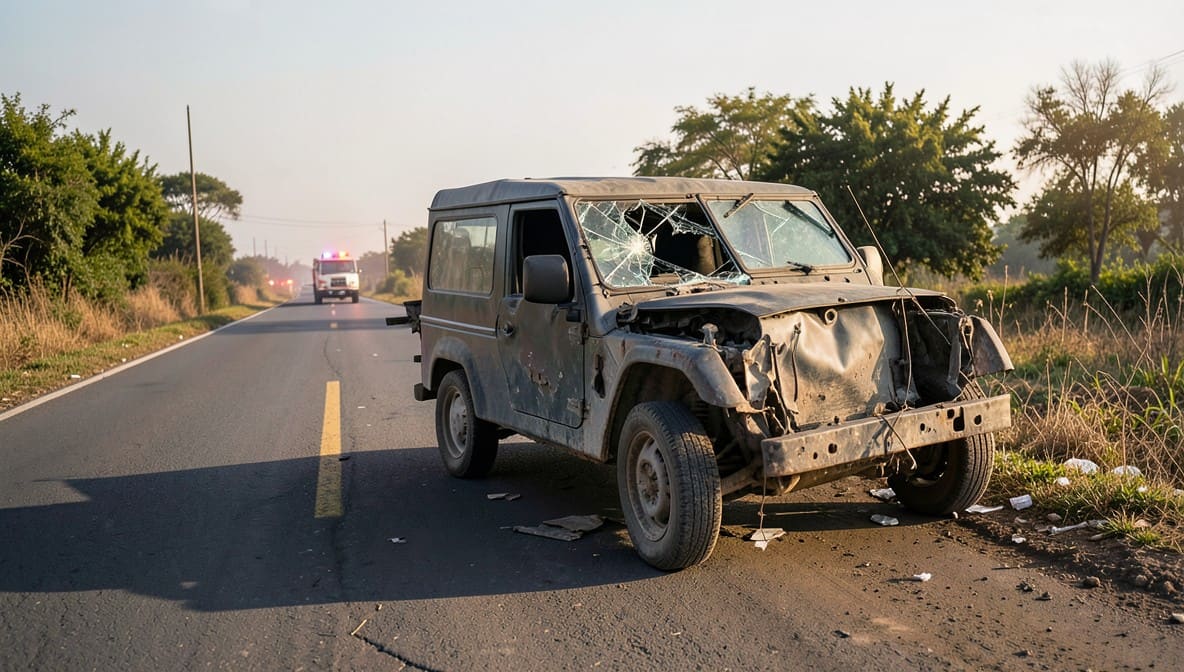
The dispute arose from a fatal motor accident involving a vehicle insured with the United India Insurance Company. The deceased, Mohan Vinayak Gaikwad, was riding a two-wheeler when he collided with a truck driven by Respondent No. 4 and a tractor driven by Respondent No. 5. The accident occurred on an unspecified date prior to the filing of the claim petition. The deceased was survived by his wife (Respondent No. 2), daughter (Respondent No. 3), and his father (Respondent No. 1). The claimants filed Claim Petition No. 307/2011 before the Motor Accident Claims Tribunal, Buldhana, seeking compensation under Section 163-A of the Motor Vehicles Act, 1988.
Key Facts
- The deceased was aged 45 years at the time of death and was employed as a daily wage laborer with no fixed income
- The claimants did not produce formal wage slips or income proof
- No FIR was registered against the insured vehicle or its driver
- The claim petition was filed under Section 163-A, invoking the no-fault liability regime
- The Tribunal awarded Rs. 8,90,000/- with 8% interest without applying the Second Schedule
- The insurer appealed, contending the award was arbitrary and contrary to statutory mandate
Procedural History
- Date of Accident: Not specified in judgment, but occurred prior to filing of claim petition
- 15.06.2011: Claim Petition No. 307/2011 filed before Motor Accident Claims Tribunal, Buldhana
- 22.09.2014: Tribunal awarded Rs. 8,90,000/- with 8% interest, without reference to Second Schedule
- 22.01.2026: Judgment reserved by the High Court
- 09.04.2026: Judgment pronounced by the Bombay High Court, Nagpur Bench
The Parties' Positions
Appellant (United India Insurance Company): Argued that the Tribunal erred in awarding compensation without applying the Second Schedule. Contended that Section 163-A mandates a fixed formula, and no proof of negligence is required - but neither can the Tribunal depart from the statutory formula. Relied on Sarla Verma and New India Assurance Co. Ltd. to assert that the award was ultra vires.
Respondents (Claimants): Argued that the Tribunal had correctly assessed the loss and awarded reasonable compensation. Contended that the insurer’s objections were technical and that the award was fair given the deceased’s earning capacity and family dependency.
Relief Sought
The Appellant sought modification of the award to conform with the Second Schedule. The Claimants sought confirmation of the Tribunal’s award. The Appellant also sought refund of any excess amount paid if the award was reduced.
The Legal Issue
The central question was whether the Motor Accident Claims Tribunal is bound to determine compensation under Section 163-A strictly in accordance with the structured formula prescribed in the Second Schedule of the Motor Vehicles Act, 1988, and whether it may deviate from that formula based on equitable considerations or the absence of an FIR.
Arguments Presented
For the Appellant
The appellant’s counsel relied on Sarla Verma v. Delhi Transport Corporation (2009) 6 SCC 121 to emphasize that Section 163-A and Section 166 operate under entirely different legal frameworks. While Section 166 requires proof of negligence and allows discretionary awards, Section 163-A is a statutory scheme designed for quick, formula-based compensation without inquiry into fault. She further cited New India Assurance Co. Ltd. v. Usha Devi (2025 SCC OnLine SC 1417), where the Supreme Court upheld the application of the Second Schedule even when the claimant’s income was unproven, and the Tribunal was directed to use the minimum wage as baseline. She argued that the Tribunal’s failure to apply the Schedule rendered the award illegal and arbitrary.
For the Respondent
The respondents’ counsel contended that the Tribunal had considered the deceased’s age, family dependency, and earning potential, and that the award was just. He relied on United India Insurance Co. Ltd. v. Sunil Kumar (2017) 13 SCALE 652, arguing that insurers cannot raise defenses of negligence under Section 163-A, and by implication, the Tribunal should have flexibility to ensure adequate compensation. He maintained that the absence of an FIR should not prejudice the claimants.
The Court's Analysis
The Court undertook a detailed review of the statutory scheme under Sections 163-A and 166. It noted that Section 163-A was introduced to provide a no-fault, expeditious remedy to victims of motor accidents, and that the Second Schedule was designed to standardize compensation across the country. The Court emphasized that the structured formula is not merely a guideline but a mandatory statutory requirement.
"The grant of compensation under Section 163-A of the M.V. Act on the basis of the structured formula is in the nature of final award and the adjudication thereunder is required to be made without any requirement of any proof of negligence of driver/owner of the vehicle(s) involved in the accident."
The Court rejected the respondents’ reliance on Sunil Kumar as inapposite, clarifying that while insurers cannot raise defenses of negligence, the Tribunal is equally barred from departing from the Second Schedule. The absence of an FIR was held to be legally irrelevant under Section 163-A, as liability is statutory, not tortious.
The Court then examined the calculations submitted by both parties. It accepted the appellant’s computation based on the minimum wage of Rs. 40,000/- per annum as the baseline income, in line with Sarla Verma and New India Assurance. Applying a multiplier of 17 (for a 45-year-old deceased), deducting one-third for personal expenses, and adding funeral expenses, loss of consortium, and loss of estate, the Court arrived at a total compensation of Rs. 4,62,834/-. The Court held that this was the only legally permissible amount under Section 163-A.
The Verdict
The appeal was allowed. The Tribunal’s award of Rs. 8,90,000/- was set aside. The claimants are entitled to compensation of Rs. 4,62,834/- from the appellant and respondents 4 and 5 jointly and severally, with interest at 8% per annum from the date of the Tribunal’s award (22.09.2014) until realization. Upon receipt of the compensation, any excess amount deposited by the insurer shall be refunded to it with interest. The matter is remanded to the Tribunal for compliance within four weeks.
What This Means For Similar Cases
Structured Formula Is Non-Negotiable
- Practitioners must now calculate Section 163-A claims strictly using the Second Schedule - no discretion permitted
- Income must be estimated using minimum wage if no proof exists, as per Sarla Verma
- Multipliers must be applied based on age and statutory tables, not judicial discretion
No-Fault Does Not Mean No-Formula
- Insurers cannot raise defenses of negligence, but claimants cannot demand higher amounts by invoking equity
- Absence of FIR, delay in filing, or lack of documentation does not justify deviation from the Schedule
- Tribunals must record explicit application of the Second Schedule in their awards
Procedural Compliance Is Mandatory
- All Section 163-A awards must now include a line-by-line computation referencing the Schedule
- Failure to do so invites appellate interference and remand
- Advocates must submit structured calculations at the earliest stage to avoid delays