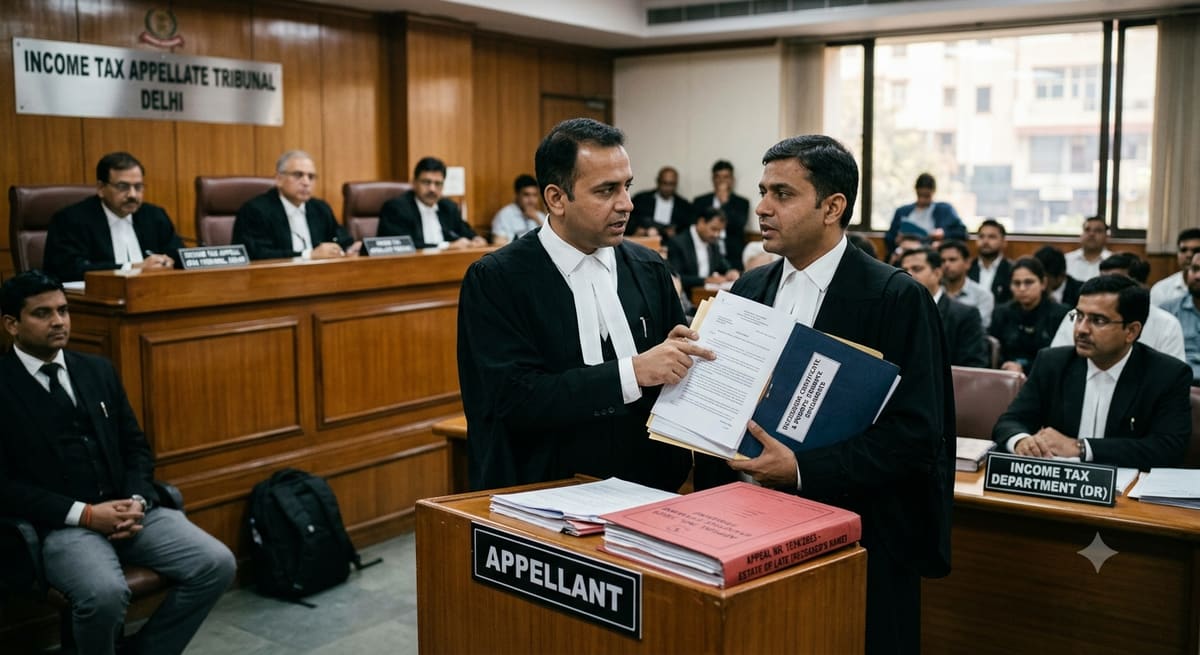
The Madras High Court has unequivocally held that any notice, assessment, or demand issued under the Income Tax Act, 1961, to a deceased person is legally void ab initio. This landmark ruling clarifies that the tax department cannot proceed against a dead assessee, regardless of whether legal representatives were aware of the proceedings. The judgment reinforces foundational jurisdictional principles in tax law and places the burden of accurate identification squarely on the Revenue.
Background & Facts
The Dispute
The appellant, Gowthaman S, is the legal heir of the deceased assessee, Late K. Selvarasu, who passed away on 04.01.2024. The Income Tax Department initiated reassessment proceedings under Section 148A(d) of the Income Tax Act, 1961, on 31.03.2024 - nearly two months after the assessee’s death. Subsequently, an assessment order was passed on 17.02.2025, followed by a notice of demand under Section 156 on the same date. All documents were addressed to the deceased, with no mention of the legal heir or any attempt to substitute the party under Section 159(2).
Key Facts
- The deceased assessee, K. Selvarasu, died on 04.01.2024
- The notice under Section 148A(d) was issued on 31.03.2024
- The assessment order was passed on 17.02.2025
- The notice of demand under Section 156 was issued on 17.02.2025
- The appellant was not notified of any proceedings prior to the issuance of the assessment order
- The Department had dropped penalty proceedings under Section 270A on 02.08.2025, acknowledging the death of the assessee
- No record exists that the appellant or any legal representative was ever informed of the reopening or assessment proceedings
Procedural History
- 04.01.2024: Death of the assessee, K. Selvarasu
- 31.03.2024: Notice under Section 148A(d) issued to the deceased
- 17.02.2025: Assessment order and notice of demand issued under Sections 143(3) and 156
- 27.10.2025: Writ Petition (WP(C) No. 39793 of 2025) dismissed by the Single Judge, who held that Section 159(1) made the legal heir liable, despite lack of notice
- 28.10.2025: Writ Appeal (W.A. No. 529 of 2026) filed before the Division Bench
- 23.03.2026: Judgment delivered by the Division Bench
The Parties' Positions
The appellant, as legal heir, contended that the proceedings were initiated against a non-existent legal entity and were therefore null and void. He argued that Section 159(2) requires proceedings to be initiated against the legal representative within the limitation period, and that no such initiation occurred. The Department, on the other hand, relied on Section 159(1) to argue that liability automatically devolves on the legal heir, and that the failure to notify the heir was a procedural lapse, not a jurisdictional defect.
Relief Sought
The appellant sought quashing of the notice under Section 148A(d) dated 31.03.2024, the assessment order dated 17.02.2025, and the notice of demand dated 17.02.2025. He further sought a declaration that proceedings against a deceased person are legally unsustainable and that the Department must initiate fresh proceedings against the legal representative, if at all, within the statutory period.
The Legal Issue
The central question was whether Section 148A(d) and consequential proceedings under the Income Tax Act, 1961, can be validly initiated against a deceased person, and whether the legal representative’s failure to inform the Department of the death renders such proceedings lawful under Section 159(1).
Arguments Presented
For the Appellant
Counsel for the appellant relied on Meet Lalwani v. Income-tax Officer and cited judgments from the Delhi, Bombay, and Madras High Courts to argue that a notice issued to a dead person is a nullity. He emphasized that Section 159(2) requires proceedings to be initiated against the legal representative, not merely continued against the deceased. He further contended that Section 292B cannot cure a jurisdictional defect, as the notice was never issued to a proper person. The Department’s own withdrawal of penalty proceedings under Section 270A demonstrated internal recognition of the legal impossibility of proceeding against a deceased.
For the Respondent
The Revenue argued that Section 159(1) imposes automatic liability on the legal representative for the deceased’s tax dues, and that the failure to notify the Department of the death was a lapse on the heir’s part. It contended that the proceedings were valid because the liability transferred upon death, and that the absence of notice to the heir was a procedural irregularity, not a jurisdictional flaw.
The Court's Analysis
The Court undertook a rigorous analysis of the statutory framework under the Income Tax Act, particularly Section 148A, Section 159, and Section 292B. It held that the issuance of a notice under Section 148A(d) is a condition precedent to the exercise of jurisdiction for reassessment. The Court observed:
"The sine qua non for acquiring jurisdiction to reopen an assessment is that such notice should be issued in the name of the correct person. This requirement of issuing notice to a correct person and not to a dead person is not merely a procedural requirement but is a condition precedent to the impugned notice being valid in law."
The Court rejected the Revenue’s reliance on Section 159(1), noting that this provision governs the liability of the legal representative, not the initiation of proceedings. It clarified that Section 159(2) requires the Department to initiate proceedings against the legal representative, and that continuation of proceedings against a deceased person is impermissible.
The Court further held that Section 292B, which allows for rectification of procedural defects, cannot validate a notice issued to a non-existent person. It cited Sumit Balkrishna Gupta v. Asst. CIT to affirm that such an error is not a mere irregularity but a fundamental jurisdictional defect.
The Court also dismissed the notion that legal heirs have a statutory duty to inform the Department of the death, citing Savita Kapila v. Asst. CIT and Alamelu Veerappan v. ITO, which held that no such obligation exists under the Act.
The Verdict
The writ appeal was allowed. The Court set aside the order dated 27.10.2025 of the Single Judge, and quashed the notice under Section 148A(d) dated 31.03.2024, the assessment order dated 17.02.2025, and the notice of demand dated 17.02.2025. The Court held that all proceedings initiated against the deceased person are null and void. There shall be no order as to costs. The Department may initiate fresh proceedings against the legal representative, if warranted, within the applicable limitation period.
What This Means For Similar Cases
Notice to Deceased Person Is Jurisdictionally Invalid
- Practitioners must challenge any notice, assessment, or demand issued in the name of a deceased person as void ab initio
- The mere existence of liability under Section 159(1) does not validate proceedings initiated against a dead person
- Section 292B cannot cure a jurisdictional defect arising from issuance to a non-existent entity
Department Must Initiate Proceedings Against Legal Representative Under Section 159(2)
- The Income Tax Department must identify and serve the legal representative within the limitation period
- Failure to do so renders any subsequent proceedings invalid, even if the liability is undisputed
- Penalty proceedings under Section 270A were dropped in this case - this should be the standard for all proceedings
No Statutory Duty on Legal Heirs to Intimate Death
- Legal heirs are under no obligation to notify the Department of the assessee’s death
- Any adverse inference drawn from non-intimation is legally unsustainable
- Practitioners should assert this principle in all cases where the Department alleges delay or laches by heirs