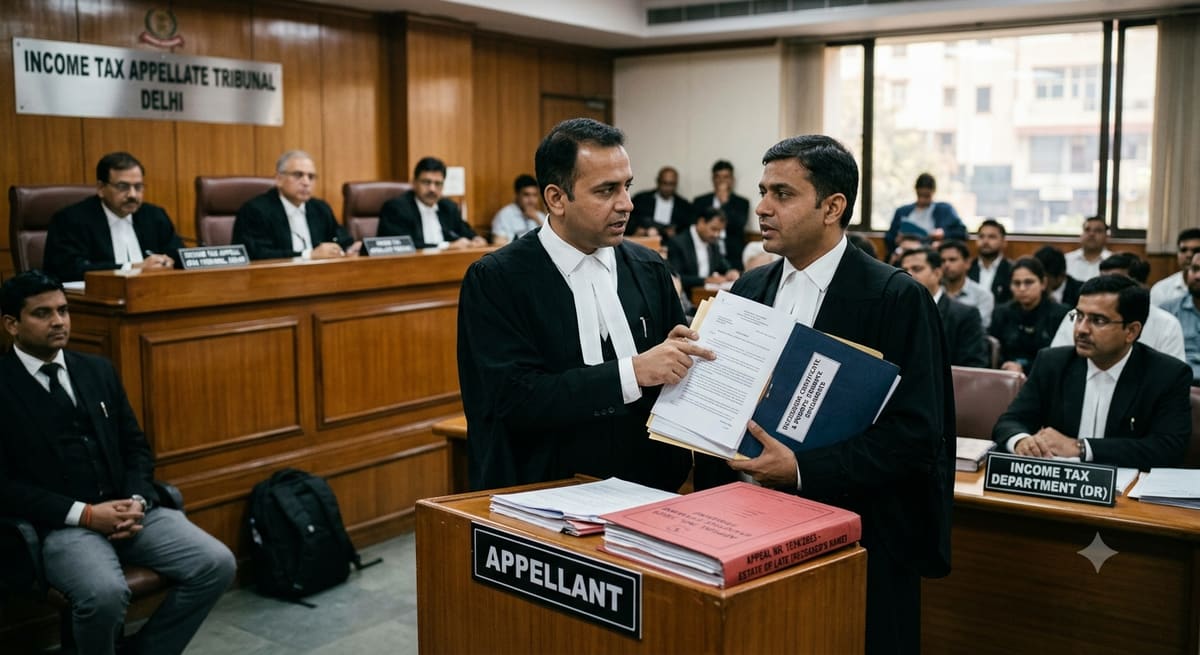
The Income Tax Appellate Tribunal, Delhi, recently dismissed an appeal on procedural grounds, holding that the appellant failed to establish his status as a legal representative of the deceased assessee under Section 159 of the Income Tax Act, 1961. The judgment underscores the statutory prerequisites for representing a deceased assessee’s estate, offering critical guidance for practitioners handling tax disputes involving succession.
Background & Facts
The Dispute
The appeal arose from an assessment order dated 12.02.2026 passed by the Commissioner of Income Tax (Appeals), Coimbatore, under Section 143(3) of the Income Tax Act, 1961 for the assessment year 2017-18. The appellant, Sh. Gaurav Garg, claimed to be the legal representative of the deceased assessee, Late Sh. Mukesh Garg, who passed away on 17.05.2021. The appellant sought to challenge the assessment order on behalf of the deceased’s estate.
Key Facts
The deceased assessee, Sh. Mukesh Garg (PAN: AAGPK0427P), was the original assessee for the assessment year 2017-18
The appellant, Sh. Gaurav Garg, is the son of the deceased and claimed to be the legal representative
The deceased passed away on 17.05.2021, prior to the filing of the appeal
The appellant filed the appeal before the ITAT, Delhi, without demonstrating succession to the estate or intermeddling with the deceased’s assets
The department had not initiated proceedings against the appellant under Section 159 of the Income Tax Act
Procedural History
Assessment Year: 2017-18
12.02.2026: Order passed by the Commissioner of Income Tax (Appeals), Coimbatore (DIN: ITBA/APL/S/250/2025-26/1085921424(1))
ITA No. 3659/Del/2026: Appeal filed by the appellant before the ITAT, Delhi
01.06.2026: Date of hearing and pronouncement of the ITAT order
Relief Sought
The appellant sought to challenge the assessment order dated 12.02.2026, arguing that he was entitled to represent the deceased assessee’s estate as the legal representative.
The Legal Issue
The central question before the ITAT was whether the appellant, Sh. Gaurav Garg, could be recognized as the legal representative of the deceased assessee under Section 159 of the Income Tax Act, 1961, in the absence of evidence demonstrating succession to the estate or proceedings initiated by the department under the said section.
Arguments Presented
For the Appellant
The appellant contended that he was the legal heir of the deceased assessee and, therefore, entitled to represent the estate in the appeal. However, no substantive evidence or documentation was submitted to establish his status as a legal representative under Section 2(11) of the Code of Civil Procedure, 1908 or Section 159 of the Income Tax Act.
For the Respondent
The Revenue, represented by Sh. Manoj Kumar, Senior Departmental Representative, argued that the appellant had failed to satisfy the statutory conditions for being recognized as a legal representative. Specifically, the appellant had not demonstrated succession to the estate or intermeddling with the deceased’s assets, nor had the department initiated proceedings under Section 159 of the Act. The Revenue relied on the definition of legal representative under Section 2(29) of the Income Tax Act read with Section 2(11) of the Code of Civil Procedure, 1908, which requires proof of succession or management of the estate.
The Court's Analysis
The ITAT examined the statutory framework governing legal representation in tax proceedings. The Tribunal noted that Section 159 of the Income Tax Act provides for the department to proceed against the legal representative of a deceased assessee, but such proceedings must be initiated by the department. The appellant, however, had not been proceeded against under this section.
The Tribunal further observed that the term legal representative is defined under Section 2(11) of the Code of Civil Procedure, 1908 as a person who, in law, represents the estate of a deceased person. This includes:
A person who has succeeded to the estate of the deceased
A person who is managing the estate
An intermeddler with the estate
The appellant had not provided any evidence to establish any of these conditions. The Tribunal emphasized that mere assertion of being a legal heir was insufficient without proof of succession or management of the estate.
"There is not even an iota of indication in the appellant's submissions that either he has succeeded to the estate of the deceased or he is managing the same or as an intermeddler thereof; as the case may be, as per section 2(29) of the Act r.w.s. 2(11) of the Code of Civil Procedure, 1908 defining such a 'legal representative' in very terms."
The Tribunal concluded that the appellant’s claim as legal representative was devoid of merit at this stage, given the absence of statutory compliance.
The Verdict
The ITAT dismissed the appeal (ITA No. 3659/Del/2026) at this stage, holding that the appellant had failed to establish his status as a legal representative under Section 159 of the Income Tax Act. The Tribunal, however, granted the appellant liberty to file a fresh appeal upon satisfying the statutory conditions under Section 2(11) of the Code of Civil Procedure, 1908 or upon being proceeded against by the department under Section 159 of the Act. The order was pronounced in open court on 01.06.2026.
What This Means For Similar Cases
Proof of Legal Representative Status Is Mandatory
Practitioners must ensure that the legal representative of a deceased assessee provides concrete evidence of succession, management, or intermeddling with the estate. Mere assertion of being a legal heir is insufficient to establish representation under Section 159 of the Income Tax Act.
Documentary Evidence: Submit proof of succession, such as a will, succession certificate, or legal heir certificate
Departmental Proceedings: Ensure the department initiates proceedings under Section 159 if the legal representative is to be proceeded against
Intermeddling: If the legal representative is managing the estate, provide evidence of such management (e.g., bank statements, property records)
Procedural Compliance Is Non-Negotiable
The judgment reinforces that procedural compliance under the Income Tax Act and the Code of Civil Procedure is critical. Failure to satisfy the statutory conditions for legal representation will result in dismissal of the appeal, as seen in this case.
Section 159 Proceedings: The department must initiate proceedings against the legal representative for the provisions of Section 159 to apply
Section 2(11) CPC: Legal representatives must demonstrate their status under this section to represent the deceased’s estate
Fresh Appeal: The Tribunal’s order allows the appellant to refile the appeal upon satisfying the statutory conditions, emphasizing the importance of procedural rectification
The Burden Lies on the Appellant
The onus is on the appellant to establish their status as a legal representative. The Tribunal’s order makes it clear that the department is not obligated to proceed under Section 159 unless the appellant provides evidence of their legal standing.
Active Role: Legal representatives must actively demonstrate their role in managing or succeeding to the estate
No Presumption: The Tribunal will not presume legal representation based on familial relationships alone
Strategic Filing: Practitioners should ensure all statutory prerequisites are met before filing appeals on behalf of deceased assessees