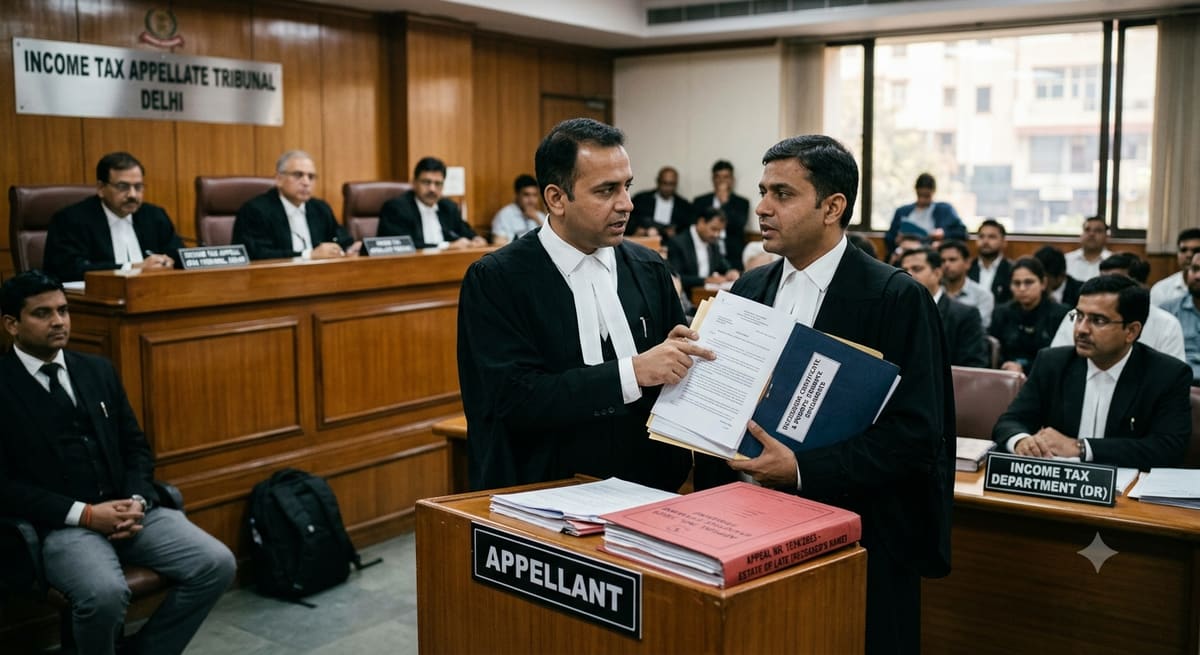
The Income Tax Appellate Tribunal, Agra, has delivered a pivotal ruling clarifying the legal distinction between a 'legal heir' and a 'legal representative' in the context of income tax assessments following the death of an assessee. The judgment invalidates assessments initiated against mere legal heirs without proof of succession to the deceased’s estate, reinforcing statutory compliance under the Income Tax Act.
Background & Facts
The Dispute
The dispute arose from the Income Tax Department’s assessment of income tax liabilities for Assessment Years 2010-11 and 2012-13 in the name of Ms. Chandrawati Devi, the widow of the deceased assessee, Shri Mangal Sen. Shri Mangal Sen passed away on 31.07.2017. Despite his death, the Assessing Officer proceeded to complete the assessment proceedings by bringing Ms. Chandrawati Devi on record as the 'legal heir' and passed ex-parte assessment orders. The assessee’s appeal before the Commissioner of Income Tax (Appeals) was dismissed on grounds of non-prosecution, prompting the present appeals before the ITAT.
Key Facts
- Shri Mangal Sen, the original assessee, died on 31.07.2017
- Assessment proceedings for AY 2010-11 and AY 2012-13 were initiated posthumously
- The Assessing Officer treated Ms. Chandrawati Devi as the 'legal heir' and completed assessments in her name
- No evidence was recorded or considered regarding succession to the deceased’s estate
- No finding was made as to whether the appellant had inherited, managed, or intermeddled with the estate of the deceased
- The appeal before the ld. CIT(A) was dismissed on 11.12.2025 for non-prosecution, not on merits
Procedural History
- 31.07.2017: Death of original assessee, Shri Mangal Sen
- 2020-2021: Assessment orders issued for AY 2010-11 and AY 2012-13 in the name of Ms. Chandrawati Devi
- 11.12.2025: Order of ld. CIT(A) dismissing appeal for non-prosecution
- 23.04.2026: Hearing before ITAT Agra
- 16.06.2026: Judgment delivered by Accountant Member S. Rifaur Rahman
The Parties' Positions
For the Appellant (Ms. Chandrawati Devi):
- Argued that she was incorrectly treated as a 'legal heir' rather than a 'legal representative'
- Relied on the precedent in Pradeep Jain, Legal Heir of late Shri Jay Narayan (ITA Nos.334-338/Agr/2024, dated 06.02.2025)
- Contended that Section 159 of the Income Tax Act requires proof of succession to the estate, not mere heirship
- Emphasized that the department failed to establish any legal representative status under Section 2(29) read with Section 2(11) of the CPC
For the Respondent (Revenue):
- Relied on the findings of the Assessing Officer and ld. CIT(A)
- Did not contest the legal distinction but failed to provide any evidence or reasoning to establish estate succession
- Offered no response to the tribunal’s query regarding whether the appellant had succeeded to the estate
Relief Sought
The appellant sought:
- Setting aside of the assessment orders for AY 2010-11 and AY 2012-13
- Restoration of the position prior to the impugned assessments
- Direction to the department to initiate proceedings only against a legally recognized representative, if any
The Legal Issue
The central question was whether an income tax assessment can be lawfully completed against a person merely identified as a 'legal heir' of a deceased assessee, without establishing that such person qualifies as a 'legal representative' under Section 2(29) of the Income Tax Act, read with Section 2(11) of the Code of Civil Procedure, 1908.
Arguments Presented
For the Appellant
The appellant’s counsel relied on the binding precedent of Pradeep Jain, Legal Heir of late Shri Jay Narayan (ITA Nos.334-338/Agr/2024), wherein the ITAT Agra held that treating a legal heir as a legal representative without proof of estate succession is legally unsustainable. The counsel emphasized that Section 159 limits liability to the extent of the estate’s value and requires the representative to have succeeded to the estate. Mere heirship, without evidence of inheritance, management, or intermeddling, does not satisfy the statutory definition under Section 2(29). The counsel also cited Commissioner vs. Dilip Kumar And Co. & Ors. [2018] 9 SCC 1 (SC) to support a strict construction of statutory terms.
For the Respondent
The Revenue did not dispute the legal distinction between 'legal heir' and 'legal representative'. However, it failed to produce any evidence or reasoning to establish that Ms. Chandrawati Devi had succeeded to the estate of Shri Mangal Sen. No findings were made by the Assessing Officer or the ld. CIT(A) regarding estate succession, management, or intermeddling. The Revenue’s position was essentially passive, relying on procedural default rather than substantive legal grounds.
The Court's Analysis
The Tribunal conducted a rigorous statutory interpretation of Section 2(29), which defines 'legal representative' as a person who, in law, represents the estate of a deceased person. This definition is explicitly linked to Section 2(11) of the Code of Civil Procedure, 1908, which requires more than mere heirship - it demands legal succession to the estate. The Tribunal noted that the department had treated the appellant as a 'legal heir' throughout the proceedings, without ever establishing her as a 'legal representative'.
"We deem it appropriate to quote Section 159(4) of the Act as well that liability in such an instance of a legal representative is to the extent of deceased assessee's estate's value only. There is again no finding either in the assessment order or in the lower appellate discussion that such an estate has ever devolved upon the appellant or he is managing the same or an intermeddler thereof, as the case may be."
The Tribunal observed that the department’s failure to prove estate succession rendered the entire assessment proceeding legally void ab initio. It applied the principle of strict construction from Commissioner vs. Dilip Kumar And Co. & Ors. [2018] 9 SCC 1, holding that tax authorities cannot bypass statutory definitions to impose liability. The Tribunal further held that the dismissal of the appeal before the ld. CIT(A) on grounds of non-prosecution did not validate the underlying assessment, which was fundamentally flawed on jurisdictional grounds.
The Tribunal concluded that the assessment orders were passed without jurisdiction, as the person against whom they were passed did not meet the statutory definition of a 'legal representative'. Consequently, all proceedings against her were unsustainable in law.
The Verdict
The appeals are allowed. The assessment orders for Assessment Year 2010-11 and Assessment Year 2012-13 are set aside. The department is directed to initiate proceedings only against a person who qualifies as a 'legal representative' under Section 2(29) of the Income Tax Act, upon proof of succession to the estate of the deceased assessee. No costs are awarded.
What This Means For Similar Cases
Legal Heir Status Is Insufficient for Tax Assessment
- Practitioners must now challenge any assessment initiated against a 'legal heir' without proof of estate succession
- The burden lies on the Revenue to establish that the person named is a 'legal representative' under Section 2(29)
- Mere familial relationship or inheritance under personal law is not enough - legal succession must be documented
Procedural Dismissals Do Not Cure Jurisdictional Defects
- Appeals dismissed for non-prosecution cannot validate assessments that are void due to lack of legal standing
- Tribunals and courts must examine jurisdictional foundations even if the appeal is technically defective
- This judgment reinforces that substantive law overrides procedural defaults
Estate Succession Must Be Proven, Not Assumed
- Tax officers must record specific findings on: (a) whether the estate devolved, (b) whether the person is managing it, and (c) whether they are an intermeddler
- No assessment can proceed under Section 159 without these findings
- Practitioners should demand production of succession certificates, probate, or court orders establishing legal representation
Documentation Required for Succession-Based Assessments
- File a succession certificate under the Succession Act, 1925
- Obtain a probate or letter of administration if the deceased left a will
- Submit evidence of estate management or intermeddling
- Avoid accepting notices or assessments addressed to 'legal heir' without verifying legal representative status
The Doctrine of Strict Construction Applies to Tax Statutes
- Tax statutes must be interpreted narrowly where liability is imposed on third parties
- Ambiguities in definitions like 'legal representative' must be resolved in favor of the taxpayer
- This judgment aligns with the principle that tax liability cannot be extended beyond statutory boundaries