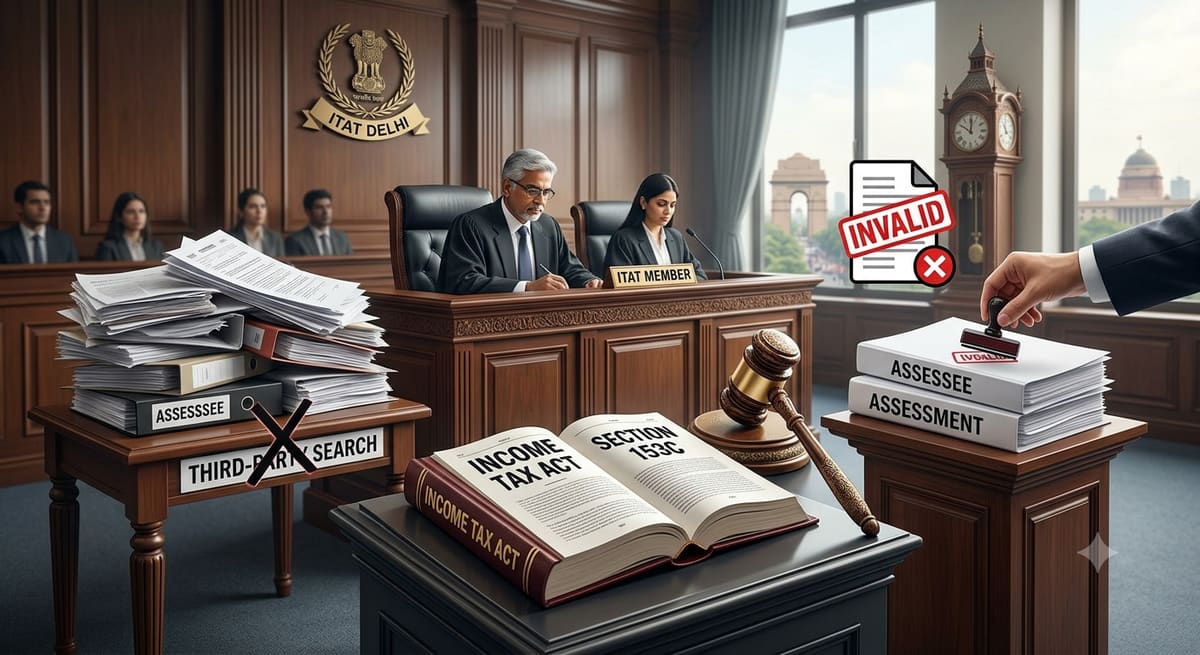
The Income Tax Appellate Tribunal, Mumbai, has delivered a significant ruling affirming that uncorroborated electronic data seized from a third party cannot form the basis for an addition under Section 69 of the Income-tax Act, 1961, absent confrontation with the assessee and compliance with the principles of natural justice. This judgment reinforces procedural safeguards in search-based reassessments and sets a clear boundary on the admissibility of third-party digital evidence.
Background & Facts
The Dispute
The assessee, Bharat Kumar Mali, was assessed under Section 153C of the Income-tax Act, 1961, following a search and seizure operation conducted on 17.03.2021 on the Rubberwala Group and its associates. The Assessing Officer (AO) made an addition of Rs. 25,43,750 under Section 69 as unexplained investment, alleging that the assessee had paid cash "on-money" over and above the registered agreement value for property purchases. The addition was based solely on an Excel file found on a pen drive seized from the residence of Shri Imran Ansari, a key employee of Rubberwala Group, who handled sales registrations for the Platinum Mall project.
Key Facts
- The assessee purchased two commercial shops in the Platinum Mall project developed by Rubberwala Housing & Infrastructure Ltd (RHIL)
- The registered sale agreements for the shops were executed at values higher than the stamp duty valuation
- The entire purchase consideration was funded through a sanctioned housing loan from ICICI Bank, with payments made via account payee cheques
- During the search on 17.03.2021, a 16GB pen drive was seized from the residence of Shri Imran Ansari, containing an Excel file titled "consolidated 1 2 3 balance"
- The Excel file listed 27 shops, including two allegedly purchased by the assessee, with cash payment entries
- The phone number associated with the cash payment entries (9892196071) matched the assessee’s registered mobile number
- The assessee categorically denied making any cash payments beyond the bank-funded consideration
- No incriminating material, document, or statement directly linking the assessee to cash payments was found during the search of his premises
- The AO did not confront the assessee with the pen drive, the Excel file, or the statement of Shri Imran Ansari
- The assessee requested cross-examination of Shri Imran Ansari and other third parties whose statements were relied upon; this request was denied
Procedural History
- 17.03.2021: Search and seizure conducted under Section 132 on Rubberwala Group and associates, including Shri Imran Ansari
- 01.10.2025: Orders passed by National Faceless Appeal Centre / CIT(A) confirming addition of Rs. 25,43,750 under Section 69 for A.Y. 2018-19 and 2019-20
- 05.03.2026: Hearing before ITAT Mumbai
- 23.03.2026: Judgment pronounced by ITAT Mumbai
The Parties' Positions
For the Assessee:
- The Excel data was not seized from his possession
- No document bearing his name or signature was recovered
- The AO failed to confront him with the adverse material
- The bank-funded nature of the transaction negates any claim of unexplained cash investment
- The presumption under Section 292C applies only to the person from whose possession documents are seized
- The electronic evidence was not authenticated under Section 65B of the Indian Evidence Act
- Denial of cross-examination violated principles of natural justice
For the Revenue:
- The Excel file contained entries linking the assessee to cash payments
- The phone number matched the assessee’s
- The statements of Shri Imran Ansari and Shri Tabrez Shaikh corroborated the data
- The addition was justified under Section 153C as the search was on a related group
- No independent evidence was required beyond the third-party data
Relief Sought
The assessee sought deletion of the addition of Rs. 25,43,750 under Section 69 for both A.Y. 2018-19 and 2019-20, and requested that the total income be computed as per the return filed.
The Legal Issue
The central question was whether Section 153C permits an addition under Section 69 based solely on uncorroborated electronic data seized from a third party, without confronting the assessee with the material or providing an opportunity for cross-examination.
Arguments Presented
For the Appellant
The assessee relied on multiple coordinate bench decisions of the ITAT Mumbai, including Rajesh Jain, Heena Dashrath Jhanglani, Monika Anand Gupta, and Mamta Sharad Gupta, all holding that third-party electronic data without corroboration or confrontation cannot sustain an addition. It was argued that:
- Section 292C’s presumption applies only to the person from whose possession documents are seized
- Section 65B of the Evidence Act requires authentication of electronic records, which was not done
- The denial of cross-examination violated the principles of natural justice as affirmed in Andaman Timber Industries v. CCE
- The bank-funded nature of the transaction conclusively rebutted any suspicion of unexplained cash
- The AO’s failure to provide copies of statements or the pen drive rendered the proceedings fundamentally flawed
For the Respondent
The Revenue contended that:
- The Excel file was part of the incriminating material seized during a valid search
- The matching phone number and corroborative statements of RHIL employees established a link
- Section 153C allows assessment based on material found in the course of a search on a related person
- The burden shifted to the assessee to explain the source of funds
- No additional corroboration was necessary as the data was consistent and detailed
The Court's Analysis
The Tribunal conducted a meticulous review of the facts and legal precedents. It emphasized that Section 153C permits assessment based on material found during a search, but only if that material is directly or inferentially linked to the assessee. The Court observed:
"The information if any found in the pendrive etc., cannot be considered as 'credible evidence', unless they have been corroborated with any other evidence. Since the assessee was not provided with the adverse material, if any, based on which notice u/s 153 of the Act, was issued, in our view, it hampers the primary and fundamental requirement of natural justice."
The Tribunal noted that the AO had not confronted the assessee with the Excel file, the pen drive, or the statement of Shri Imran Ansari. Crucially, the statement of Shri Imran Ansari did not explicitly name the assessee as a cash payer; the linkage was inferred solely from a phone number. The Court held that such an inference, without independent verification or opportunity to rebut, is legally unsustainable.
The Tribunal further relied on Andaman Timber Industries v. CCE, where the Supreme Court held that failure to provide opportunity for cross-examination renders an order a nullity. It also cited CIT v. Odeon Builders Pvt. Ltd., which held that additions based solely on third-party information without scrutiny are bad in law.
The Court rejected the Revenue’s argument that Section 292C applies to third parties, clarifying that the presumption under this section is strictly limited to the person from whose possession documents are seized. The Excel file, recovered from the residence of a third party, could not trigger this presumption against the assessee.
Additionally, the Tribunal noted that the electronic evidence had not been authenticated under Section 65B of the Indian Evidence Act, which mandates certification of electronic records by a responsible official. The absence of such certification rendered the data inadmissible as substantive evidence.
The Court also acknowledged the assessee’s evidence of bank-funded transactions, which further undermined the Revenue’s claim of unexplained cash investment.
The Verdict
The appeals filed by the assessee are allowed. The addition of Rs. 25,43,750 under Section 69 for A.Y. 2018-19 and 2019-20 is deleted. The Assessing Officer is directed to compute the total income as per the return filed by the assessee. The order is passed without any costs.
What This Means For Similar Cases
Third-Party Digital Evidence Requires Corroboration
- Practitioners must challenge any addition based solely on third-party Excel sheets, pen drives, or digital records recovered during a search on unrelated persons
- The burden remains on the Revenue to establish a direct, verifiable link between the assessee and the incriminating data
- Mere matching of phone numbers or inferred associations are insufficient without corroborative documents or admissions
Natural Justice Is Non-Negotiable in Reassessment
- Failure to provide copies of adverse statements or allow cross-examination renders the assessment void
- Any request for cross-examination must be formally addressed; silence or non-compliance is fatal to the Revenue’s case
- The principles of natural justice under Article 14 of the Constitution apply with full force in income tax proceedings
Electronic Evidence Must Be Authenticated
-
All digital evidence must comply with Section 65B of the Indian Evidence Act to be admissible
-
Unauthenticated Excel files, PDFs, or digital logs cannot be the sole basis for additions under Section 69 or 69A
-
Practitioners should routinely raise objections to electronic evidence lacking certification under Section 65B
-
Always demand production of the original electronic medium and certification
-
File applications for cross-examination of third-party witnesses at the earliest opportunity
-
Highlight bank transaction trails to rebut allegations of unexplained cash